
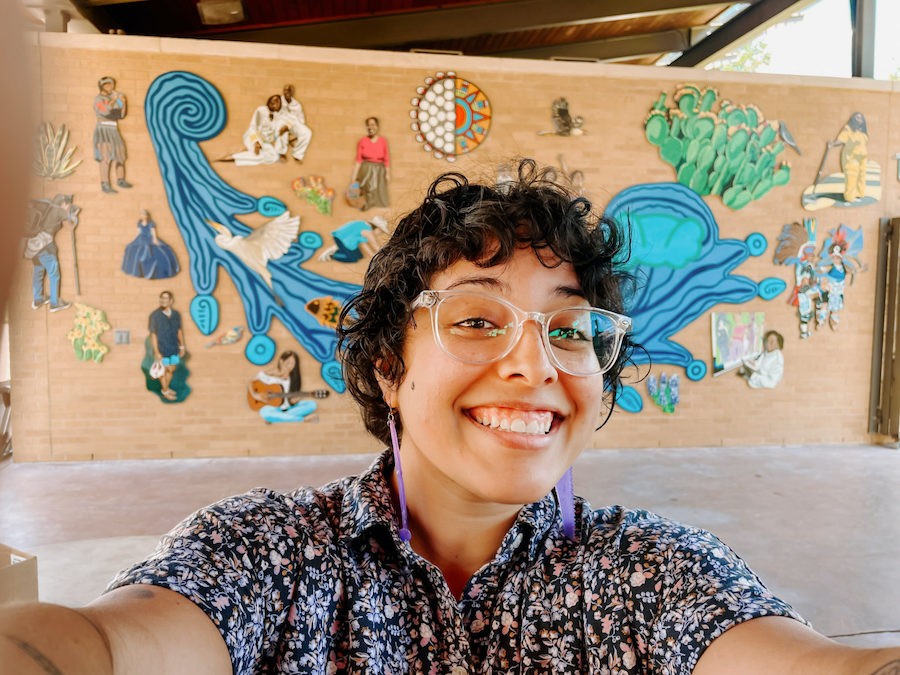
Photo Credit: https://suzygonzalez.com/
Suzy González is a Xicana vegan artist, an educator, and creator of the Xicana Vegan Zine who specializes in themes of decolonization and intersectional liberation efforts.
What led you to focus on intersections of gender and species?
While earning my BFA at Texas State University (2007-2012), I was gaining an understanding of feminism and my place within it. I co-published a feminist zine called Yes, Ma’am with my friend Elle Minter, and one day, Elle recommended a book to me called The Pornography of Meat by Carol J. Adams. This book opened my eyes to the overlap of human and non-human animal rights as it relates to feminism and the objectification of both women and animals. I then read The Sexual Politics of Meat: A Feminist-Vegetarian Critical Theory, and learned further about how bodily autonomy is not afforded to animals, especially female animals, who are bred for the purpose of reproductive exploitation in the dairy industry, then killed for consumption. I also learned that it appeared my interest was in ecofeminism, an intersection of feminist theory, animal advocacy, and environmentalism. I knew I had to go vegan to align my lifestyle with my newfound values. I set a date to begin my vegan journey for my New Year’s Resolution in 2013, and I’ve kept my resolution since then!
Historically, what do you think were the biggest barriers to vegan feminist activism?
I think that awareness and education are really important around any issue. Our eyes are kept closed by certain powers that be when it comes to exploitation and violence against animals and humans unless we choose to actively open them. Accessibility is also a huge issue, especially when it comes to communities of color and lower income communities that, through food apartheid, are not provided as much access to healthy produce and plant-based foods.
Knowledge of the intersections of oppression is also vital. It’s about the animals, and it’s about women, but it’s also about all of us, the entire planet. It’s about food justice and how we are not all afforded healthy or cruelty free consumption. I learned that the finger should be pointed at corporations and those who exploit rather than at individuals who are just eating to survive. Also, when it comes to language, not everyone identifies with veganism or with feminism as the terms have white origins. BIPOC have been actively working towards these ideals before these terms were ever coined—eating plant based and fighting for human rights.
What do you think are the major obstacles facing animal liberation today?
As I’ve grown to understand not only how veganism and feminism intersect through ecofeminism, I also acknowledge the underlying reason why non-human animals, BIPOC, those with identities that have been marginalized, and our mother earth have been historically and continuously exploited, oppressed, or subordinated—and that is due to colonization. The settler colonial project has taken every opportunity to try to erase our ways of surviving and thriving when it comes to our health, foodways, spirituality, communities, language, art, and other aspects of our Indigenous cultures. The root of human oppression over time has been permitted and even validated through an intentional and systemic method of animalizing various groups of people. Whether these people are enslaved, massacred, prevented from crossing borders, or displaced by occupation, a political tactic is put in place to ensure that people think of them as less-than-human. We see this on the Texas-Mexico border and with the genocide occurring in Palestine. If humans are thought of in this way, the violent and inhumane actions against them are portrayed to the masses as justified. This is connected to how non-human animals have always been seen as lesser-than, and to treat an animal with violence has always been socially acceptable. In order to make connections to animal liberation, we must first understand our own liberation—and how these oppressions and struggles are all results of white supremacy.
As an activist, what campaigns or movement achievements have you contributed to?
I used to organize with the San Antonio International Women’s Day March, and I remember also protesting elephant cruelty at the Ringling Brothers Circus before they ended their usage of elephants in 2016, so that felt like an accomplishment. I attend marches and rallies for a variety of movements, because they are all linked. And today, as an artist and educator, I know that art is activism. My work now is done through a decolonial lens, and I focus less on what’s wrong with the world, and more on what’s beautiful about it. While these go hand in hand, it’s about a shift in perspective. Instead of pointing fingers at the horrors, I’m focusing on my love for plants and encouraging folks who may have stepped off course to reconnect with the earth.
In addition to creating visual art, I publish a zine called Xicana Vegan. In the vegan community, I often felt as though my story was not being told, so I decided to self-publish and create a space of my own. I premise the zine by saying that Xicana Vegan “contains recipes and thoughts for and by animal-loving and plant-eating folks, and works to embrace culture while practicing an ethics of care and compassion.” It’s a place where myself and contributors can share recipes, essays, artwork, poetry, or any other expression based on these concepts.
What do you see as important for achieving animal liberation?
The conversation of culture and ancestry is important and often overlooked; we must look to our past in order to progress forward. As a Xicanx-identifying individual I know that my family and I have been detribalized, as have so many of our Latinx relatives and community members. I acknowledge that I live in an imbalanced Eurocentric reality, and that it takes effort to remember the Indigenous parts of myself and our culture that have been intentionally erased. I know that foods from before colonization were much healthier, and that the less healthy cultural food came from colonization. Eating animals was done in small quantities if necessary, and my Indigenous ancestors survived largely on plants like beans, squash, corn, wild greens, nopales, and chiles. Learning about the work of Luz Calvo and Catriona Rueda Esquibel in their book, Decolonize Your Diet: Plant-Based Mexican-American Recipes for Health and Healing, opened my eyes and I could finally see myself represented in the plant-based conversation! My appreciation for veganism grew even further to an understanding that not only was eating plant foods good for the animals, but for the health of my community. My ancestors were majority-plant based before Spanish colonization, and now these foods that come from Europe are what make us sick—factory farmed animal products, dairy, an overconsumption of wheat in some cases. For my community, it’s about returning to these plants foods and medicines that nourish us rather than harm us.
What does vegan feminism mean to you?
It means a love for this life, for this earth, and for those who inhabit this earth, and putting those ideals into action every day.
Learn more about Suzy González’s work on their website. They can be found on Instagram and their work can be found on Etsy.