A Commentary on Non-Humans First

There is an animal rights activist group trying to shake things up by taking three steps backwards and dragging veganism/ animal rights to an all-time low. They recently put forward a declaration titled “Non-Human Animals First.”  Their mission? Vegans need to put animals first because apparently we are back in the activist dark ages, during which we assumed activism was a zero-sum game. Also, something about temporality because certain groups have to be “first” or “not first” or something like that for a movement to achieve anything.
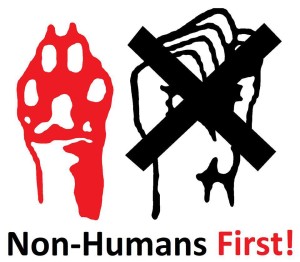
Reads "Non-Humans First!" Image of upraised dog paw and human fist, with human fist crossed out

A representative of the group (which I will refer to as NHFirst) wants us to use the single-issue mindset espoused by early women’s liberation efforts, civil rights, etc as evidence that an intersectional approach is not needed. For instance, NHFirst points out that MLK Jr. was a “sexist” and “homophobe” and that while “it is great to be against all injustice, in reality people are complex and have differing views.” Who knew that being a sexist or a homophobe was simply a sign of character complexity?!

It speaks volumes that NHFirst is willing to deal with and accept “complex” characters like racists, sexists and homophobes, but not willing to deal with and accept speciesists.  This position echoes the ridiculous synchronic position I keep seeing in the animal rights movement which goes like this:  If we just accept everyone, no matter how horrendous they are, we’ll have more people “for the animals.”  They don’t seem to realize that over time, we will lose people from the movement since women, people of color, homosexuals, disabled people, etc will run the hell away. If we are all in a movement, we have to work together and that’s not going to happen if the movement is filled with people who have attitudes that motivate particular behaviors toward particular people against whom they hold those attitudes.

Moreover, they seem to overlook the fact that the lack of intersectionality that plagued (and continues to plague) many early (and current) movements is the precise reason we are still dealing with the very same problems those movements sought (and seek) to dissolve. Corey Lee Wrenn has already pointed out that NHFirst’s approach fails to appreciate what I call the ‘pernicious holism’ existing among speciesism, sexism, racism, ecocide, etc., and, as such, cannot possibly begin to dismantle our dependence and subsequent exploitation of animals. In other words, if we correctly identify the depth of the problem- that is, that the exploitation of animals is systemic and a crucial element of the ‘pernicious holism’- but we refuse to engage with the problem -the system of pernicious holism itself- then, we are doing absolutely nothing to address the problem of animal exploitation. All of NHFirst’s words are basically a lot of hot air.

As a charitable reader, I initially assumed NHFirst had good intentions that simply went horribly awry. After all, at one point many of my vegan companions were very animal-focused in their activism and never thought to incorporate human rights activism into their “animal work.” NHFirst, on the other hand, explicitly go out of their way to mention their awareness of (daily) human rights violations and human suffering only to point out that those violations should remain outside the range of our concern as vegans. Animal exploitation is an emergency situation whereas human exploitation is. .. well, just something brown people and women need to suck up because ANIMALS FIRST.

I don’t think the “brown” and “woman” stuff is wholly coincidental to NHFirst’s insistence to downplay the extent of human suffering. In fact, I think it is precisely because exploited humans are generally non-white and/or women that NHFirst thinks it’s totally fine to pretend human suffering has nothing to do with or cannot be addressed in conjunction with animal suffering. We all know that if there were to be a holocaust disproportionately impacting white or white-looking people, everyone would think it highly inappropriate to start yelling, “ANIMALS FIRST!”

Having said all of that, I don’t mean to claim that vegan/animal rights activism is reducible to civil rights activism or feminist activism or other human rights activism and I don’t mean to suggest that any species of human rights activism is reducible to vegan/animal rights activism. Certainly feminism has a specific beneficiary in mind; namely, feminism seeks to grow the rights and improve the lives of women, while gay rights activism seeks to grow the rights and improve the lives in the LGBTQ community, and so on and on with other oppressed groups. In the same vein, veganism/animal rights activism seeks to grow the rights and improve the lives of non-human animals. I don’t mean to deny the constraints that determine the specific flavor of distinct activisms. However, what I do claim is that achieving those specific ends of distinct activisms requires taking into account other social forces that shape and affect the specific -ism we seek to dismantle in any activist site.

For (an easy) example, a feminist activist who fails to acknowledge the unique role race and class plays in shaping the very gendered oppression that women face, especially women of color or poor women, cannot begin to adequately engage with, address, or dismantle gender oppression. She would be missing crucial components that shape sexism. So, one activism cannot be carried out in isolation from other activisms. It has to be done in concert with other movements (which is why the great Frederick Douglass said, “All great reforms go together.”)

I would like to take this one step further in the case of animal exploitation. Unlike any other oppressed group (possibly with the exception of prison inmates), animals are the only group that has never been granted rights. That is, although (some) animals have been granted some measure of legal protections, none have been granted proper rights in the United States. Rights language is needed to formally acknowledge the vulnerability and violability of beings. Unlike animals, humans have all been granted rights simply by virtue of being human. The distinction that rests between oppressed humans and animals, then, is this: while oppressed humans’ rights remains in the space of theory- that is, those rights are rarely enforced in practice despite having been granted- animals simply don’t have rights. There is nothing to enforce since nothing has been granted. This leads to a terrifying revelation: beings can be rights-having subjects and still face horrifying violence and exploitation, as we see with oppressed humans.

Hence, taking oppressed humans into consideration, the problem we face as vegan activists is actually two-fold: first, animals are not granted rights. In other words, even in the space of theory, animals are not seen as subjects that can be rights-having, which means they are not seen as beings that can be properly violated or vulnerable. Killing them, eating them, torturing them, raping them, etc are not considered ‘violations’ in the robust sense of the word. Second, even if animals were to be granted rights, there would be no assurance that these rights would be enforced in practice. Like most humans, animals’ rights would remain in the space of theory, which leaves them practically in the exact same position they were in before: subject to violence and exploitation.

Monkey in cage looks up to viewer, hands on bars

Even if one cannot see the pernicious holism among the -isms that Corey Lee Wrenn and other writers point out, the fact remains that vegans have a duty to involve themselves in human rights activisms to make sense of and work to close the gap between rights in the space of theory and rights in the practical sense. If granting rights is the only means to formally establish violability and vulnerability, but rights-having subjects continue to be violated and exploited in practice, then rights-having is essentially useless. It would be a shame if we worked this hard and this long to gain rights for animals only to have those rights ring hollow in the face of violence and exploitation.

NHFirst, then, is very, very wrong. It does matter if your movement is riddled with sexists, homophobes, racists, and the like because these are the very kinds of attitudes that play a role in nullifying the practicality of rights-having. Sure, plenty of historical figures that played a large part in movements were sexists, homophobes, racists, etc., but that only explains why sexism, homophobia, racism, etc are even more deeply (and invisibly) embedded in the structure of present-day society. It doesn’t explain why that’s a good template to follow in our movements today. We know better.

By Syl 
The New Frontier of Rape Porn in Animal Rights

Trigger Warning: Graphic descriptions of rape and violence against women.

On a public walkway, women are gathered around.  One woman cradles her baby. Suddenly a gang of men dressed in black with ski masks grab her. They pull her child away, place the baby in a crate, and she screams and cries for her child. The assailants rip open her blouse, exposing her breasts. She is beaten, pulled by the hair, and a man forcibly clamps a breast pump to her nipple. She screams in agony, blood pours from her breast. When they are finished milking her, they beat her about the head, tie a lead to her neck, and drag her to a waiting van, where she is dumped inside.

Screaming woman holding a baby surrounded by men in black ski masks

This assault (what Nonhuman Animal rights organization 269 Life describes as a “performance”) is currently hosted on Youtube (not linked to here because it basically amounts to rape porn). As of this writing, it has over 36,000 views. The top comments are:

Stop it boner!

And

Nice tits!

One commenter requested they go further and actually rape, maim, kill, dismember, and cannibalize her:

LOL! Great! Keep doing this so people can see how radical vegans really are. Why stop at branding and milking? Seems kinda wimpy to not go all the way. C’mon, 269, you can do better than this. Let’s see impregnation! Spaying! Neutering! Euthanasia! How about butchering! Fire up the grill along side the branding iron. A video of you radical vegans chomping on some human steaks would really prove how sincere you are about animals being equal to humans.

But 269 Life reassures us that the message we should be gleaning is that dairy consumption is immoral and exploitative.  Really? Because all I got from watching this video was sick to my stomach, fearful for my life, and flash backs to my own experience with rape and male violence. As for the male viewers, they were apparently turned on and hungry for more.

Dairy farmers do not dress in black with ski masks and dump their victims in vans, the stereotypical rapist does that.  269 Life uses the language of human female rape and murder to tell a story about cow rape and murder.  While there are certainly similarities, 269 Life has botched this job big time.  By the way, the infant used in the rape demonstration was real.  Exposing a baby to this violence, staged or not, qualifies as child abuse.

Incidentally, this group also hosted another street demonstration where three white men were chained and branded with a hot iron.  As with the white woman who was forcibly separated from her child and beaten by her owners, these branded men in chains draw on a history of human slavery.  There’s something disturbing about white skinned activists from a mostly white organization reenacting a history of racial oppression while simultaneously failing to acknowledge it in their narrative.

Man with chain around his neck and a brand on his arm lays on the ground.

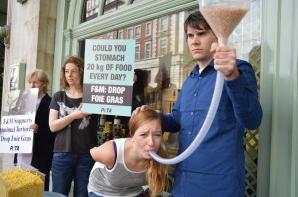
In another street demonstration, this time against foie gras (the diseased livers of ducks who are force fed sometimes to the point that their esophagus or stomach ruptures before they are even slaughtered), a male activist forcibly holds down the head of a young woman. Her face shows terror, his shows violent determination. Her hands are bound and a feeding tube is forced into her mouth.  The imagery is, not by coincidence, drawing on the popularity of “gagging” gonzo porn.  Watching a woman gag on a penis, or feeding tube, whichever, is supposed to be sexy . . . especially if she is hurting and humiliated.

Woman in a PETA protest on her knees with her hands tied behind her back, looks scared and in pain, a man is pushing her head down and forcing a feeding tube down her throat

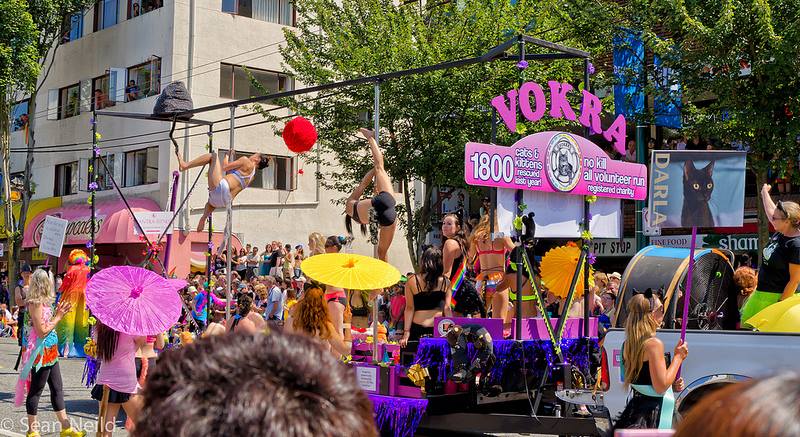
In another demonstration by the Vancouver Orphan Kitten Rescue Association, a parade float that is intended to “raise awareness” for homeless kittens is one big mobile strip joint. Nearly naked women writhe and flip on stripper poles down the street. Somewhere in the crowd of nearly naked women, you can make out a sign that pictures a kitten in need. One commenter writes: “Nice pussies.”

Parade float with many women in underwear and lingerie dancing on poles. A kitten adoption group.

Some third wave feminists hail stripping as “empowering,” but for less privileged women who live the reality of sex work, there is nothing glamorous or liberating about stripping at all.  The profession has extraordinarily high rates of sexual assault, rape, and pimping.

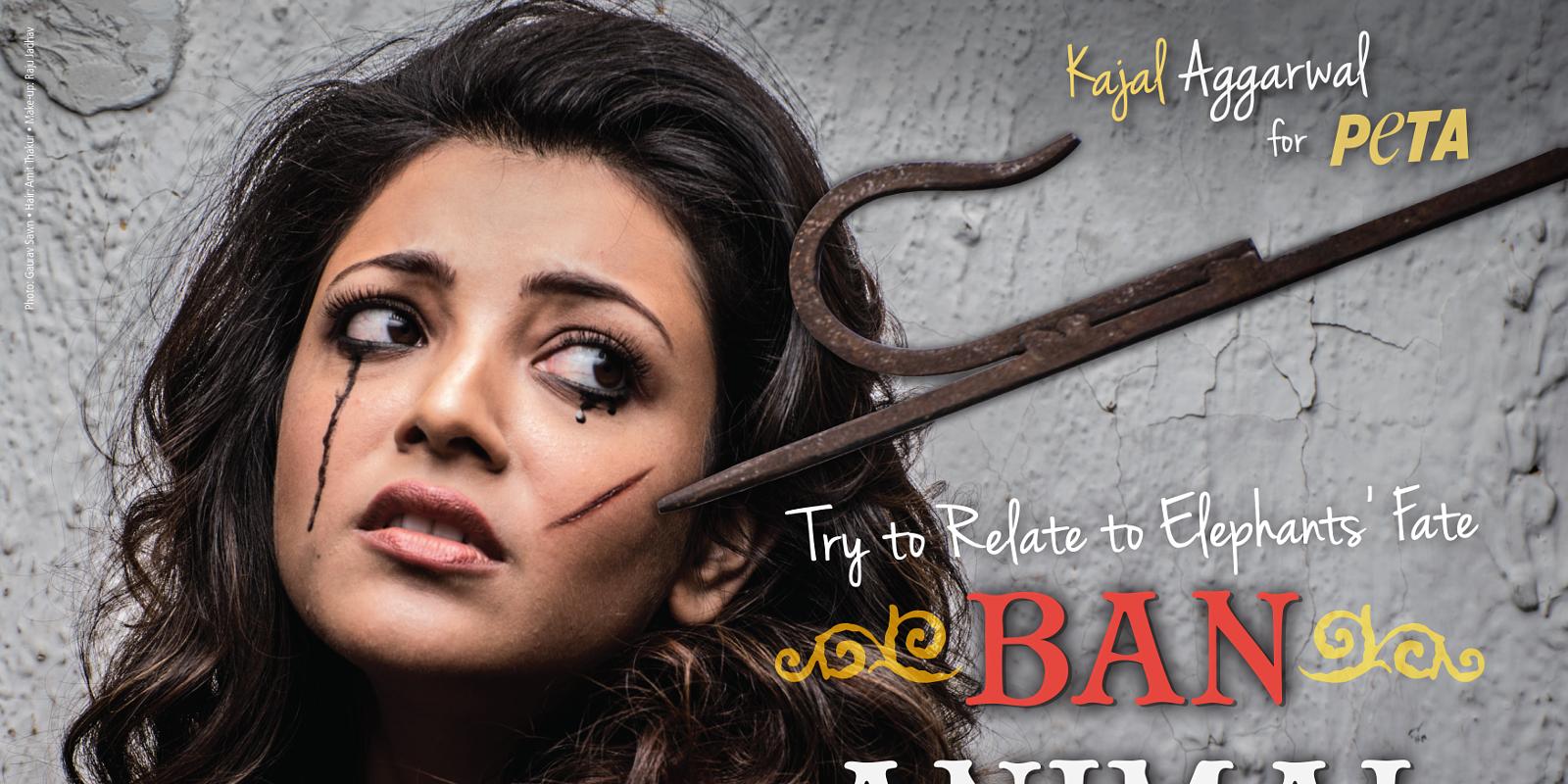
Animal rights activism draws on very real violence against women, children, and people of color, aggravating it, normalizing it, and sexualizing it.  It’s clear from the public reaction, their intention to help Nonhuman Animals is getting completely obscured.  Instead of alleviating violence and suffering, they aggravate it.


Corey Lee WrennDr. Wrenn is Lecturer of Sociology. She received her Ph.D. in Sociology with Colorado State University in 2016. She received her M.S. in Sociology in 2008 and her B.A. in Political Science in 2005, both from Virginia Tech. She was awarded Exemplary Diversity Scholar, 2016 by the University of Michigan’s National Center for Institutional Diversity. She served as council member with the American Sociological Association’s Animals & Society section (2013-2016) and was elected Chair in 2018. She serves as Book Review Editor to Society & Animals and has contributed to the Human-Animal Studies Images and Cinema blogs for the Animals and Society Institute. She has been published in several peer-reviewed academic journals including the Journal of Gender Studies, Feminist Media Studies, Disability & Society, Food, Culture & Society, and Society & Animals. In July 2013, she founded the Vegan Feminist Network, an academic-activist project engaging intersectional social justice praxis. She is the author of A Rational Approach to Animal Rights: Extensions in Abolitionist Theory (Palgrave MacMillan 2016).

Receive research updates straight to your inbox by subscribing to my newsletter.

Social Movement Prostitution

Trigger Warning: Discusses prostitution and pornography.

Not Safe for Work: Contains nude images.

Nude PETA protester (white and female) stands in city street and is surrounded by menNude protest has a long history in social activism, but it is certainly gaining a lot of momentum in today’s hyper-sexualized world where pornography is mainstream and third-wave feminism prioritizes sexualization as empowerment.  Media attention is a social movement’s best asset.  It gets the organization more recognition, attracts more volunteers, and more importantly, it brings in more donations.  These days, to get media attention in a digitized, high-speed media landscape that is bombarded with trillions of competing images, some social movement organizations attempt to stand out with free soft-core porn. Free sampling is a technique heavily utilized by pornographers in a highly competitive online pornography space.  They give the consumer a little taste of the product with the expectation that the consumer will become excited and will want to purchase more.

When I set out to write this essay, I had hoped to explore social movements as a whole, but sadly, once again, the Nonhuman Animal rights movement steals the show in its problematic treatment of women.  The only other large social movement (that isn’t the nudity movement itself, where people advocate for the freedom to be naked without penalization) is the peace and anti-war movement.  Breasts Not Bombs, for instance, has female volunteers march in public spaces holding political signs.

Protesters (mostly white and middle-aged or older) holding a number of signs, predominantly a banner that reads "Breasts Not Bombs"

Then there’s Femen, a male-led feminist group of mostly white, thin young women who claim to speak on behalf of all women (and sometimes brown women in particular) by going topless in public spaces.

Four young white thin women wearing only underwear holding signs in front of the Eiffel tower, "Muslim women, let's get naked," and "I am a woman, not an object"

Aside from these exceptions, getting naked for a cause is the Nonhuman Animal rights movement’s modus operandi. And, though many supporters of Nonhuman Animal rights organizations that utilize sexualization as a tactic may claim that men’s naked bodies are used, too, the overwhelming majority of sexualized bodies presented to the public are that of young, thin, white women. With 80% of the movement identifying as female, the movement’s largest volunteer pool offers to organizations a wealth of physical assets. Body parts are politicized to the exclusion of women’s intelligence, skills, creativity, dedication, or leadership ability.

Organizations like PETA take female volunteers, put them on street corners, posters, and film, and, for all intents and purposes, prostitute these unpaid women to extract funding, media attention, or other resources (incidentally PETA may be the most infamous, but it is certainly not the only organization engaging this tactic). This systemic social movement prostitution is defended in ways similar to that of typical street prostitution: women choose to do it, or she’s getting something out of it. But free choice is often an illusion. Women do not have the same choices available to them that men do. Women in Nonhuman Animal rights are being funneled into the “choice” of stripping down for the male gaze in public spaces. Do women get something out of it? Some do, particularly middle-class white women. Is nudity a bad thing? No, of course not. But we need to be cognizant of patterns and power. There is a pattern of women’s bodies being used in a world where men have the power.

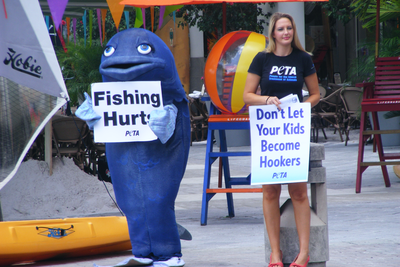
PETA protest with person in fish suit holding sign that says "Fishing hurts," next to a thin white woman holding a sign that says, "Don't let your kids become hookers."

PETA sign reads, “Don’t Let Your Kids Become Hookers.”

Female activists are “selling” their bodies for resources, but none of the profit goes to these sex workers.  Instead, the money raised goes to the organizations that they represent.  If a John buys a prostituted woman for sex acts, he pays her, and more often than not, the money goes to her pimp.  If a John buys a PETA membership because of his interest in PETA’s women (see PETA’s “Veggie Love” campaign for example), the money goes to her organization.

Incidentally, there is a vegan strip club in Portland, Oregon where women are also being prostituted for “the cause.”  The male club owner insists that “throwing boobs out there” is the only way to get people to visit his restaurant and try his vegan menu.  He claims he wants to “end the suffering of all creatures,” but it seems that he and the movement ignore the fact that women are “creatures,” too. We can be certain that “throwing penises out there” would draw some attention as well, but, patriarchy ensures that it is female nudity that will expected.

Stripping, like prostitution, is sex work that often preys on vulnerable populations of women (many feminists and survivors regard “sex work” to be a euphemism; for women who are trafficked, we must recognize it as sex slavery).  It is “work” with extremely high rates of sexual assault, rape, and other forms of violence.  It is “work” that is extremely difficult for most women to make a living with and it is “work” with little job security.  Strip clubs have a strict set of rules that ensure most money stays in the hands of the male owners, not in the hands of the hard-working women.  Like prostitution, stripping is glamorized or romanticized in the liberal imagination as something freely chosen by independent women who have full control over their work and lives. Some women enjoy that kind of agency, but most women do not.

Social activism today has been swept into the Non-Profit Industrial Complex, where organizations must compete for vital fundraising in order to survive. This extreme dependence on funding means that tactics are compromised, and advocacy becomes a means of making money to sustain the organization, not changing the world. In other words, even if viewers were to begin supporting Nonhuman Animal rights organizations as a result of being exposed to these sexualized tactics (and there is no evidence to support such a notion), most of the money raised will not be used in support of anti-speciesism. Instead, most of it will be put toward keeping the lights on, paying staff members, and funding more ways to raise money.

I argue that the Nonhuman Animal rights movement squanders an important resource by degrading women’s participation to stripping and legal forms of prostitution. So much more could be accomplished by nurturing women’s brains instead of objectifying their bodies. Beyond the negative impact that these tactics are having on so many of the girls and women groomed by the movement, we also need to take into account the impact that this type of activism has on women as a demographic. The socially-accepted degradation of women and their sexual objectification is directly linked with discrimination and violence against women. This is a consequence that social justice movements should take very seriously.


Corey Lee WrennDr. Wrenn is Lecturer of Sociology. She received her Ph.D. in Sociology with Colorado State University in 2016. She received her M.S. in Sociology in 2008 and her B.A. in Political Science in 2005, both from Virginia Tech. She was awarded Exemplary Diversity Scholar, 2016 by the University of Michigan’s National Center for Institutional Diversity. She served as council member with the American Sociological Association’s Animals & Society section (2013-2016) and was elected Chair in 2018. She serves as Book Review Editor to Society & Animals and has contributed to the Human-Animal Studies Images and Cinema blogs for the Animals and Society Institute. She has been published in several peer-reviewed academic journals including the Journal of Gender Studies, Feminist Media Studies, Disability & Society, Food, Culture & Society, and Society & Animals. In July 2013, she founded the Vegan Feminist Network, an academic-activist project engaging intersectional social justice praxis. She is the author of A Rational Approach to Animal Rights: Extensions in Abolitionist Theory (Palgrave MacMillan 2016).

Receive research updates straight to your inbox by subscribing to my newsletter.

What’s that Dirty “V” Word?

Women dressed in vagina costumes wave banners that read: "VAGINA" and "I heart Vaginas"

Vegans and vaginas, yes, there is an important connection. Hang with me here…

A colleague of mine mentioned to me that she would be using “the V word” in an essay she was working on and was worried about the push back she expected to receive. A little confused, I responded asking if she meant “vagina” or “vegan.”  Honestly, given the stigmatization of both words, I had no idea which she meant.  And I must not be the only one. When I conducted an image search for “the V word” to illustrate this essay, most of the results are pictures of feminists and vegan food.

I see news items from time to time in the feminist media chastising this or that organization for censoring the word “vagina.”  I also hear a lot of talk in the Nonhuman Animal rights movement about moving away from the word “vegan” in favor of “vegetarian,” “veg,” “veg*n,” “plant-based,” “meat-free,” etc.

I’m wondering what exactly is so off-putting about vaginas and veganism.  Why have these words become so stigmatized that they are often censored?  What are we trying to hide?  Who are we trying to silence?

VAGINAS: Many women have them; patriarchy wants to control them.*

VEGANS: Many activists are them; anthroparchy wants to control them.

I think the common factor between vaginas and vegans is that being loud and proud about them means posing a direct challenge to oppressive social structures.

But, if feminists wouldn’t dream of telling women to shut up about their vaginas, then why do professionalized welfare organizations tell people to shut up about their veganism?

Vegan campaigners hold signs at a demo

Being a woman shouldn’t be something to be ashamed of, neither should being a vegan.  Hiding these terms and identities away as if they’re dirty no-nos only serves to protect structural oppression. The strategy of silence does little to liberate.  It will not be possible to make any headway as long as women, men, and the media are uncomfortable using the word “vagina.” The same holds true for vegans and Nonhuman Animal rights/welfare organizations that are uncomfortable using the word “vegan.”

*This essay is meant to be trans-inclusive. Not all women have vaginas, and some men have vaginas.


Corey Lee WrennDr. Wrenn is Lecturer of Sociology. She received her Ph.D. in Sociology with Colorado State University in 2016. She received her M.S. in Sociology in 2008 and her B.A. in Political Science in 2005, both from Virginia Tech. She was awarded Exemplary Diversity Scholar, 2016 by the University of Michigan’s National Center for Institutional Diversity. She served as council member with the American Sociological Association’s Animals & Society section (2013-2016) and was elected Chair in 2018. She serves as Book Review Editor to Society & Animals and has contributed to the Human-Animal Studies Images and Cinema blogs for the Animals and Society Institute. She has been published in several peer-reviewed academic journals including the Journal of Gender Studies, Feminist Media Studies, Disability & Society, Food, Culture & Society, and Society & Animals. In July 2013, she founded the Vegan Feminist Network, an academic-activist project engaging intersectional social justice praxis. She is the author of A Rational Approach to Animal Rights: Extensions in Abolitionist Theory (Palgrave MacMillan 2016).

Receive research updates straight to your inbox by subscribing to my newsletter.