On Policing Male Allies

Fake Male Feminist

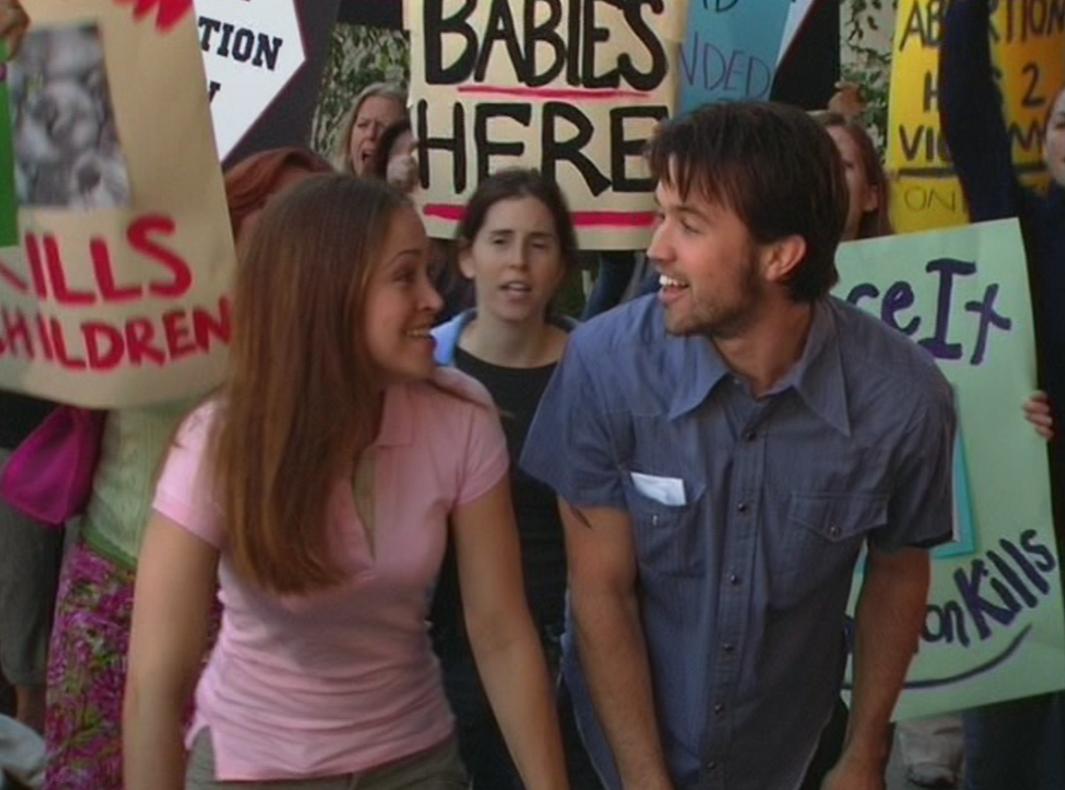
In 2013, I was the victim of an online harassment campaign. It was a cyber mob attack organized to punish me for publicly criticizing a number of sexist comments made by a leading male theorist in the Nonhuman Animal rights movement (he was avidly supporting women’s sexual objection as a valid tactic). I received hundreds of aggressive and often gendered messages in response with the intent of validating the man’s patriarchal position and silencing my feminism (this is a phenomenon that happens with excruciating regularity in online spaces).

It was a frightening, upsetting, and deeply alienating experience. In the height of the chaos, one man appeared among the crowd of sexist barraging to defend my feminist critique. His support came as a great relief to me. It was much needed and much appreciated. While he would later become a good friend of mine, at that time, he was largely unknown to me. Someone amidst the fray immediately responded, labeling him my “partner.” Others responded understandingly: “Oh, that makes sense now.” Men, it seems, can’t be allies without an incentive.

David FutrelleThis experience, as it turns out, is a common one. For instance, David Futrelle of the anti-misogyny blog We Hunted the Mammoth, an online watchdog project tracking “men’s rights” advocacy, is regularly accused of writing about misogyny to “get laid.” It is as though feminist ideas are so wacky and so unimportant that the only reason men would be interested in fighting against sexism and misogyny would be to get something from women. Some men are so completely indoctrinated with the idea that women exist only as a resource that it becomes unfathomable that any man would want to challenge patriarchy. What rational man could actually take feminism seriously?

When men attack other men for promoting or defending feminism, it constitutes gender policing. Masculinity is protected in defining it by what it is not, and it is not feminine. Boys who play with Barbies, enjoy theater, or otherwise fail to “man up” may find themselves chastised. Similarly, boys who advocate gender equality are also chastised. Masculinity necessitates the rejection or devaluation of the feminine. Under patriarchy, there is no room for women’s rights, and there is even less room for traitorous men colluding with marginalized women.

Policing male allies is hurtful for a number of reasons. First, it dismisses the legitimacy of feminism. Feminism is presented as not worth supporting unless it provides men with sexual favors. Second, it reduces masculinity to the tired trope that men are only interested in sex. Third, it often entails emasculating and heterosexist gender policing. Finally, it discourages men’s involvement. Men are acutely aware that supporting feminism threatens their tenuous position in the patriarchal hierarchy and will solicit policing from other men (and some women). None of these consequences are compatible with the goals espoused by a social justice movement.

Although a number of men will feign interest in search of fame, fortune, or sex, to be sure, the truth is that some men really are interested in social justice, and not because of any personal reward. For that matter, faking feminism would prove to be a poor tactic. Many feminist women are not the easiest for patriarchal, chauvinistic men to get along with. They hold their male friends and romantic partners up to a higher standard of integrity (or, some might say, a standard of basic human decency). It is not as easy as posting a pro-feminist statement in a forum and then sitting back and waiting for the ladies to swarm in. Heterosexual feminists are more likely to be attracted to men who understand the issues, genuinely care about the issues, and can be counted on to fight for the issues. It is not something easily faked.

Writing off a man’s support with the ridiculous suggestion that he’s only interested in sex is about as shallow and lazy as calling feminists “man-haters.” It is not true, but for those committed to oppressive systems, truth is not the point. Rather, the point is to silence women and their allies in order to protect patriarchy. I believe that men claiming to be feminists (especially when they have been informed that doing so is appropriative and hurtful) is a problem, but when men are performing their duties as allies, they can be important sources of strength and support. Perhaps it is predictable then, that supporters of sexism will seek to undermine that relationship by digging deeper into sexism, degrading women as sex objects and the men that help them as hormone-driven lackeys.
 

ARationalApproachtoAnimalRights

This essay is a revision of “Are Male Allies Just Trying to Get Laid?” first published on August 1st, 2013 with a now defunct feminist blog. You can read more about gender and anti-speciesist activism in my 2016 publication, A Rational Approach to Animal Rights.



Corey Lee WrennDr. Wrenn is Lecturer of Sociology. She received her Ph.D. in Sociology with Colorado State University in 2016. She received her M.S. in Sociology in 2008 and her B.A. in Political Science in 2005, both from Virginia Tech. She was awarded Exemplary Diversity Scholar, 2016 by the University of Michigan’s National Center for Institutional Diversity. She served as council member with the American Sociological Association’s Animals & Society section (2013-2016) and was elected Chair in 2018. She serves as Book Review Editor to Society & Animals and has contributed to the Human-Animal Studies Images and Cinema blogs for the Animals and Society Institute. She has been published in several peer-reviewed academic journals including the Journal of Gender Studies, Feminist Media Studies, Disability & Society, Food, Culture & Society, and Society & Animals. In July 2013, she founded the Vegan Feminist Network, an academic-activist project engaging intersectional social justice praxis. She is the author of A Rational Approach to Animal Rights: Extensions in Abolitionist Theory (Palgrave MacMillan 2016).

Receive research updates straight to your inbox by subscribing to my newsletter.
Girl Power: How Dairy Pornifies Motherhood

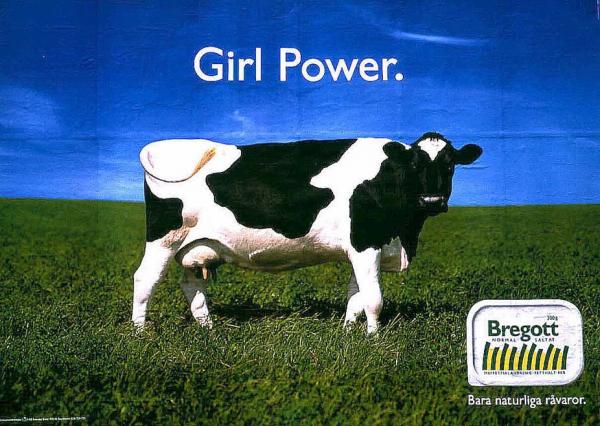
Dairy cow in field, reads "Girl Power." Ad for dairy products.

The capitalist system is a degendered one. Although capitalism heavily relies on female bodies, this reality is relatively obscured from popular consciousness. Advertisements selling hens’ eggs or cows’ milk exemplify this phenomenon. Although hens and cows are often anthropomorphized as “girls” or “ladies,” their mother status is frequently concealed.

In a typical advertisement for Bregott dairy products, for instance, a cow stands in a sunny field under a bright blue sky. The image reads “Girl Power.” On Bregott’s Instagram page, dozens of portraits capture these “girls” as they graze, relax, and play. Very rarely are the children of these “girls” pictured. Indeed, the invisibility of childbirth, nursing, and parenting is a consistent theme.

Images from Bergott including cows walking through fields, resting together, and wearing a wreath of flowers on their head

Consider also the “Happy Cows Come from California” television campaign for Real California Cheese or Laughing Cow’s advertising imagery. These cows are shown as giggling, trivial, and carefree. These are not depictions of ideal mothers, or even competent mothers. Depicting these cows as mothers would disrupt the fantasy presented to the human consumer; the presence of calves forces the viewer to acknowledge the intended purpose of cows’ breast milk.


Instead, farmers are more frequently pictured nurturing calves, when calves are visible at all. Farmers are thus presented as caring stewards, while the bovine mothers are dematernalized as silly and immature good-time girls. Characterized as such, they are not to be taken seriously as willing participants in this seemingly harmless, live-and-let-live industry.

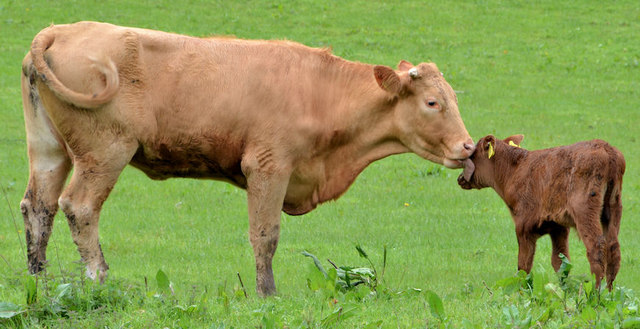
It is worth considering that “girl” language encourages consumers to only superficially conceptualize dairy cows as female. Subsequently, the audience will not be invited to acknowledge that they are actually mothers. Motherhood reminds the audience that these animals do not exist solely for the pleasure of the consumer. It is a reminder of their connectedness in complex social relationships, their responsibilities for others, their love for others, and others’ love for them.

Cow grooming calf

Motherhood is essential to the reproduction of the capitalist system, but it must be hidden from the public sphere, lest its sentimentality interfere with cold and rational business. That said, it is also true that characterizing mothers as “girls” is certainly accurate in the sense that these are immature cows who are still juveniles themselves. While bovines live an average of two decades, their average age at slaughter is just four or five years. In this way, their own childhoods are erased as well.

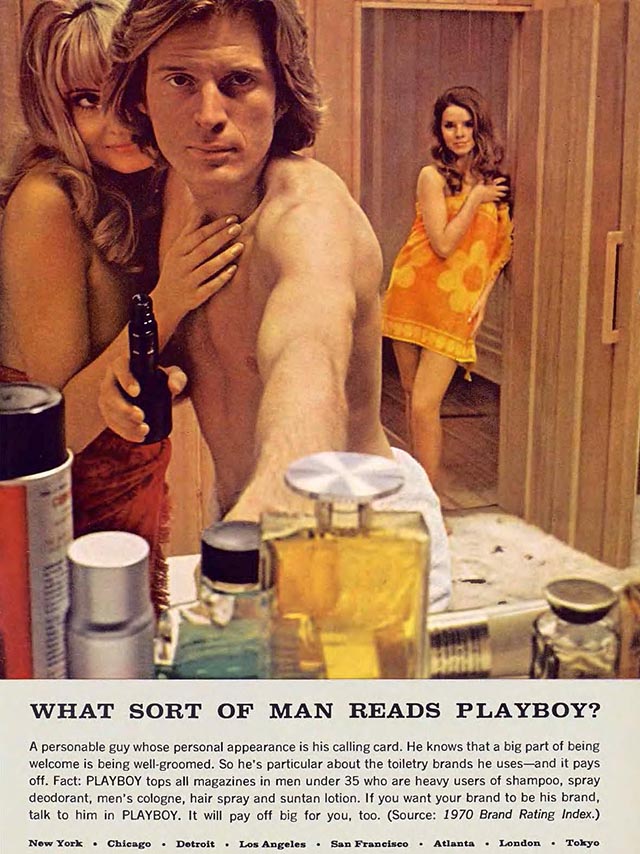
As Carol Adams has indicated, pornography extends beyond the consumption of women’s bodies to include that of other animals as well. Pornography encourages the viewer to consume without emotional attachment, infantalizing adults, sexually exploiting children, and erasing the inherent violence in production. Flesh-eating consumers are thus encouraged to become “playboys,” enjoying the pleasures of nonhuman bodies, guilt-free with no strings attached.

Playboy Ad from 1960s showing a shirtless man in a bathroom with two women wearing only towels Playboy cover from the 1960s showing a model who looks underage wearing a nightie and holding a pen and a pink envelope Playboy cover from the 1960s showing a nude model with pigtails and tube socks squeezing a teddy bear


ARationalApproachtoAnimalRights

You can read more about intersections of gender, capitalism, and Nonhuman Animal rights in my 2016 publication, A Rational Approach to Animal Rights.


Corey Lee WrennDr. Wrenn is Lecturer of Sociology. She received her Ph.D. in Sociology with Colorado State University in 2016. She received her M.S. in Sociology in 2008 and her B.A. in Political Science in 2005, both from Virginia Tech. She was awarded Exemplary Diversity Scholar, 2016 by the University of Michigan’s National Center for Institutional Diversity. She served as council member with the American Sociological Association’s Animals & Society section (2013-2016) and was elected Chair in 2018. She serves as Book Review Editor to Society & Animals and has contributed to the Human-Animal Studies Images and Cinema blogs for the Animals and Society Institute. She has been published in several peer-reviewed academic journals including the Journal of Gender Studies, Feminist Media Studies, Disability & Society, Food, Culture & Society, and Society & Animals. In July 2013, she founded the Vegan Feminist Network, an academic-activist project engaging intersectional social justice praxis. She is the author of A Rational Approach to Animal Rights: Extensions in Abolitionist Theory (Palgrave MacMillan 2016).

Receive research updates straight to your inbox by subscribing to my newsletter.

The Woman as Sexy Dying Animal Trope

Women crouch in filthy cages, dressed in rags, looking around in fear; promo image for "The Herd"

Too frequently in anti-speciesism advocacy, women become stand-ins for Nonhuman Animals suffering from extreme human violence and degradation. It is not by chance that women predominate in these roles. Women are selected (or self-select) because it culturally “makes sense” to audiences that sexualized violence will be aimed at women. If men, a relatively privileged group, were to substitute the vulnerable and suffering Nonhuman Animals, it just wouldn’t compute.

Women are regularly subject to violence and degradation, so they become the “natural” choice when staffing campaigns. Women in the audience, too, are familiar with the normalcy of misogyny, and perhaps social movements hope to trigger them into supporting the cause by tapping into their fears and traumas. Such a tactic begs the question as to how aggravating inequality for women could reduce inequality for other animals.

Consider the vegan advocacy film, The Herd. Status quo misogyny predominates, and there is arguably nothing that sets this film apart from standard sexist and violent horror movies except the good intentions of the filmmakers. The script is exactly the same: young, thin, white women, naked or nearly naked, are sexually brutalized for the titillation of the audience.

https://vimeo.com/119688523

I ask activists to consider how replicating violent, misogynistic media could, logistically, disrupt oppressive thinking about other vulnerable demographics. Further, I believe it is ethically problematic to contribute to a culture of woman-hating in a world where actual violence against actual women continues to happen so frequently that it can only be described as normal. Images have power, and these images should be used responsibly in service of social justice. It is both unwise and immoral to capitalize on sexism to advance anti-speciesism.

In the video linked below, I have compiled a number of images to illustrate the woman as sexy dying animal trope. This is a pattern that extends across a number of organizations, notably PETA, but also LUSH Cosmetics, 269life, and others. Consider what it means when activists instinctively position women as representatives of speciesist violence. Consider also the privilege afforded to men who are less frequently used, but also the dangers in positioning them as abusers in protest scenarios. In a society where violence against women is still not taken seriously, it is unclear how movement audiences could be expected to take violence against animals seriously through misogynist imagery of this kind.


Corey Lee WrennDr. Wrenn is Lecturer of Sociology. She received her Ph.D. in Sociology with Colorado State University in 2016. She received her M.S. in Sociology in 2008 and her B.A. in Political Science in 2005, both from Virginia Tech. She was awarded Exemplary Diversity Scholar, 2016 by the University of Michigan’s National Center for Institutional Diversity. She served as council member with the American Sociological Association’s Animals & Society section (2013-2016) and was elected Chair in 2018. She serves as Book Review Editor to Society & Animals and has contributed to the Human-Animal Studies Images and Cinema blogs for the Animals and Society Institute. She has been published in several peer-reviewed academic journals including the Journal of Gender Studies, Feminist Media Studies, Disability & Society, Food, Culture & Society, and Society & Animals. In July 2013, she founded the Vegan Feminist Network, an academic-activist project engaging intersectional social justice praxis. She is the author of A Rational Approach to Animal Rights: Extensions in Abolitionist Theory (Palgrave MacMillan 2016).

Receive research updates straight to your inbox by subscribing to my newsletter.
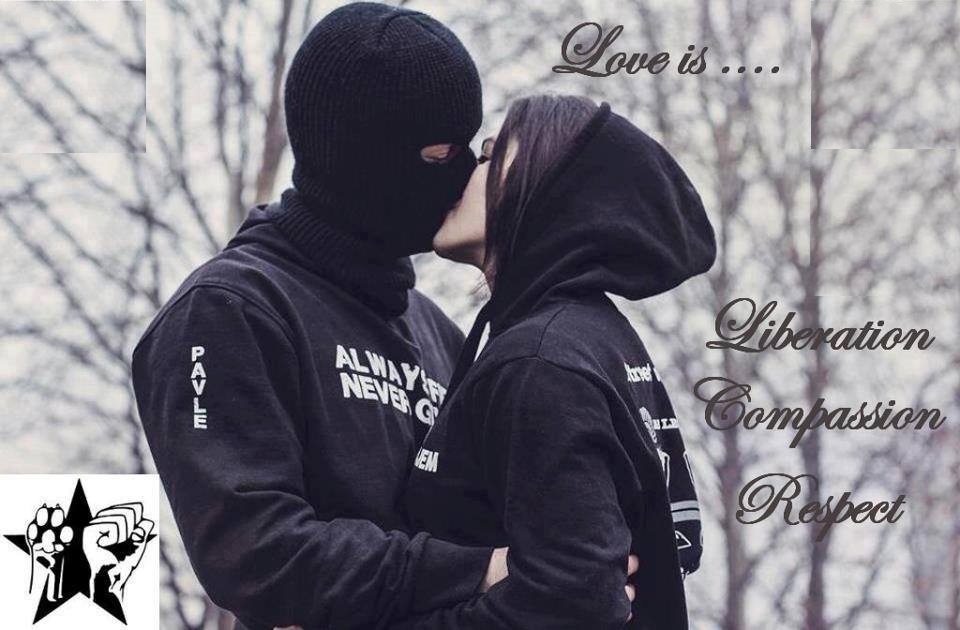
Love, Sex, and the Animal Liberation Front

Man in ski mask kisses woman in black hoodie
Image from Animal Freedom Fighters Unite Facebook group

More so than other factions of the Nonhuman Animal rights movement, the “liberation” or “direct action” faction (frequently associated with the Animal Liberation Front) often engages symbolism of human-to-human love, intimacy, and sex in its activist narrative.

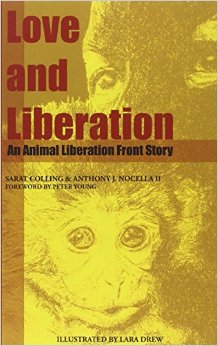
Consider Love and Liberation: An Animal Liberation Front Story, a romance novel following a young female activist who falls in love with another direct action activist, the two of them bonding over illegal actions in the name of anti-speciesism.

Cover of Love and Liberation

Consider also the direct action comic, The Liberator, male-created with a male and female protagonist. The female-bodied hero, however, tends to be drawn for the male-gaze, large breasted and sometimes bra-less.

Liberator

More than other factions of the movement, the direct action faction relies on narratives of heroism, machismo, and domination. As with any hero’s tale, the “girl as reward” must be present. In a previous essay, I note the “Liam Neeson effect,” whereby Nonhuman Animals are feminized and their plight exploited as a plot device to excuse hypermasculine vigilantism and violence. “Direct action” activism hopes to attract members and new recruits by creating an opportunity for boys and men to prove their manhood and become real-life superheroes. Steve Best, a leader of the ALF faction, has stated that it will be the media coverage of this type of activism which will motivate and inspire viewers to take up arms, so to speak. Love and sex must be part of this opportunity, as becoming a “man” necessitates power over the feminine.

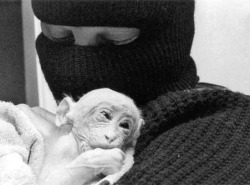
Relatedly, ALF activists also frequently pose with Nonhuman Animals as loving and thankful. Most of these survivors are undoubtedly relieved, but we must keep in mind that media is not created by accident, and images are carefully chosen to convey a particular message. I see in this thankful animal trope the same patriarchal or paternalist concept: man as liberator and benevolent leader, woman and animal as grateful and dependent. Savior narratives, well-meaning though they may be, are inherently disempowering to the marginalized (this is a major concern in ally politics).

ALF member in ski mask cradling small monkey

Social movements consciously strategize in their media representations, using particular codes that the audience will be expected to accurately and favorably interpret. The ALF and other direct action collectives bank on our cultural literacy with misogyny and patriarchy in order for these scripts and codes to make sense. I question as to whether or not this hypermasculine script will translate for an anti-oppression future if we’re still speaking the same language of domination.


Corey Lee WrennDr. Wrenn is Lecturer of Sociology. She received her Ph.D. in Sociology with Colorado State University in 2016. She received her M.S. in Sociology in 2008 and her B.A. in Political Science in 2005, both from Virginia Tech. She was awarded Exemplary Diversity Scholar, 2016 by the University of Michigan’s National Center for Institutional Diversity. She served as council member with the American Sociological Association’s Animals & Society section (2013-2016) and was elected Chair in 2018. She serves as Book Review Editor to Society & Animals and is a member of the Research Advisory Council of The Vegan Society. She has contributed to the Human-Animal Studies Images and Cinema blogs for the Animals and Society Institute and has been published in several peer-reviewed academic journals including the Journal of Gender Studies, Environmental Values, Feminist Media Studies, Disability & Society, Food, Culture & Society, and Society & Animals. In July 2013, she founded the Vegan Feminist Network, an academic-activist project engaging intersectional social justice praxis. She is the author of A Rational Approach to Animal Rights: Extensions in Abolitionist Theory (Palgrave MacMillan 2016).

Receive research updates straight to your inbox by subscribing to my newsletter.
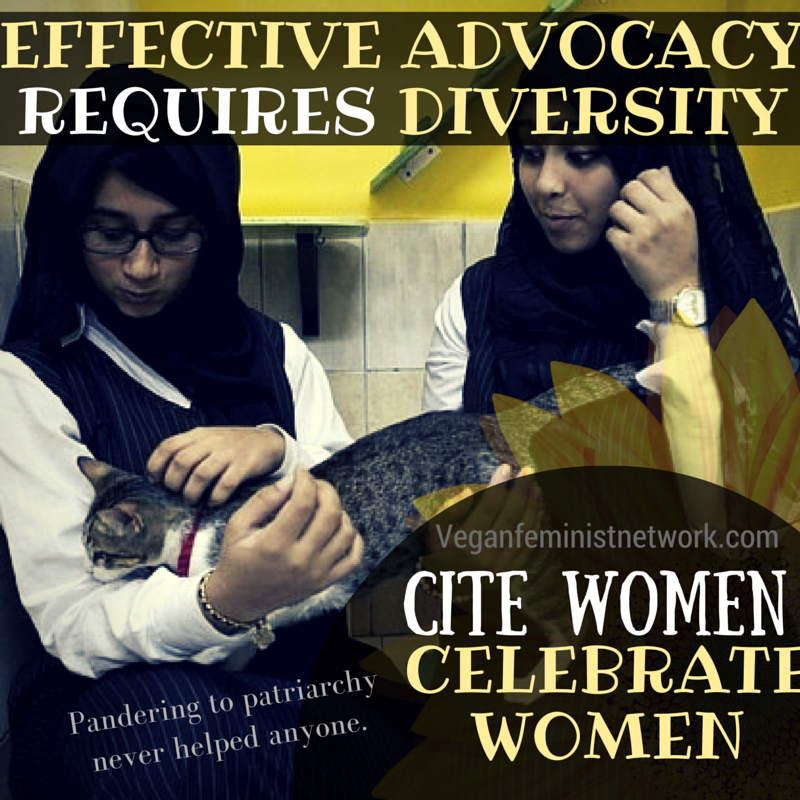
Three Reasons Why Veganism Needs Diversity

Two girls in hijabs caring for a cat. Reads, "Effective Advocacy Requires Diversity; Cite Women; Celebrate Women; Patriarchy never helped anyone"

Diversity matters in the vegan movement for three reasons.

First, social movement research indicates that a diversity of representatives will be more likely to resonate with a diverse audience, and a diverse audience is needed for social change.

Second, a diversity in leadership provides role models, which attracts and nurtures a diverse activist pool. Social psychological research supports that marginalized people find a sense of agency and belonging when they see people like them doing important work.

Third, a white-centric/male-centric movement relies on the very same hierarchies of power that facilitate speciesism.  As Audre Lorde famously stated, “The master’s tools will never dismantle the master’s house.”

Here is my challenge to you. Try going an entire week without citing, referencing, or promoting a male leader or a male-led project. Replace them with women/of color doing similar work. Highlight diversity instead of spotlighting privilege.

Then, expand your practice. Make it a habit to promote diversity in Nonhuman Animal rights spaces instead of defaulting to the status quo of men, all day, every day. Double-down on your anti-speciesism politics by maintaining an intersectional lens.


Corey Lee WrennDr. Wrenn is Lecturer of Sociology and past Director of Gender Studies (2016-2018) with Monmouth University. She received her Ph.D. in Sociology with Colorado State University in 2016. She received her M.S. in Sociology in 2008 and her B.A. in Political Science in 2005, both from Virginia Tech. She was awarded Exemplary Diversity Scholar, 2016 by the University of Michigan’s National Center for Institutional Diversity. She served as council member with the American Sociological Association’s Animals & Society section (2013-2016) and was elected Chair in 2018. She serves as Book Review Editor to Society & Animals and has contributed to the Human-Animal Studies Images and Cinema blogs for the Animals and Society Institute. She has been published in several peer-reviewed academic journals including the Journal of Gender Studies, Feminist Media Studies, Disability & Society, Food, Culture & Society, and Society & Animals. In July 2013, she founded the Vegan Feminist Network, an academic-activist project engaging intersectional social justice praxis. She is the author of A Rational Approach to Animal Rights: Extensions in Abolitionist Theory (Palgrave MacMillan 2016).

Feminism, Veganism, and Vaginal Beer

Vantage Points

Editor’s Note: Despite the publication date of this essay, this is not an April Fool’s Day joke, and we encourage you to actually view the campaign linked below. In a porn culture, the consumption of women’s body parts is normalized and fetishized. Shocking as it may seem, products and projects like this one are the predictable result.

Here we go, as if the daily reminders of women’s bodies as objects through the media are not enough, consumer culture has concocted yet another way of degrading women. As of last week an IndieGogo campaign has been created to fund the first vaginal beer. The pitch is that they will use a Czech model’s lactic acid bacteria from her vagina and implement it into a beer. Their long-term plan is to expand the line to involve other women in the production of this beer.

Before getting too deeply into this topic, it is important to point out that not all women have vaginas and that men can also have vaginas, so the pairing of the words “woman” and “vagina is problematic. Although as a cisgender person myself, I cannot accurately critique this from a transgender perspective. Therefore, the light referencing of this issue is not meant to undermine, but rather it is the recognition on my part that it would be disingenuous of me to deeply dissect this project through such a lens.

To start off, the campaign video for project is riddled with sexist language and makes no effort to hide the high levels of objectification being used to appeal to a straight male audience. In the first ten seconds of the video the viewer is presented with the words, “Imagine a woman of you dreams, your object of desire.” The first words of this video flat out refer to women as an object of desire. The hook of this campaign’s video starts off strong with these words, which are accompanied by a sketch of the behind of a naked woman. The first couple seconds presents us with the reality that referring to women as an object in a patriarchal society can be done in such a casual manner without any pressure on the speaker to defend such a statement.  Even more so, this statement is intended to drive profit.

This campaign is not unusual in that sexualized women’s bodies are used to sell everything, especially consumptive products. The term consumptive product here is used in the literal meaning of “things that can be ingested into the body”. It is not new information that these sexualized tactics are used to sell an array of animal products such as hamburgers and steaks in commercials and other forms of media. Although, this campaign takes it even farther by creating a product that literally allows men to drink particular female bodies. This is the actual bottling of vaginal secretions to be sold, so that men can ingest “the essence of femininity and women’s instincts”. Not to mention that there is an intentional use of beer to be the subject of this product, being that beer is a notoriously male-marketed alcoholic beverage.

Pinup woman holding glass of beer

The creators of this project also make sure that they sexualize women, while also shaming them. They explain that the drink does not taste or smell like a vagina. Through doing this it can be understood that women’s bodies are only profitable as long as they are represented in this particular fantasy framework of desire. The natural functions of a vagina are not desirable; in fact, they are something to be disgusted by. Therefore, any arguments that women are being honored in this product should pay attention to this distinction of the smell and taste by the creators while unpacking the true intentions of this product. A true honoring of women would recognize the diversity of women and a true honoring of vaginas would entail an honest representation of the functions of a vagina, beyond a representation deeply entrenched in sexualization and commodification.

Even more so, the language used to describe what a consumer will supposedly get from this beer provides an overbearing amount of gender norms. The video describes flavoring the beer with female essence, femininity, and instincts. The use of these terms reduces women to the idea that they inherently encapsulate these terms (so inherently that the origins can be traced, extracted, and sold). This ignores the fact that gender is a social construction; the biological female essence or instinct does not exist. Furthermore, as stated before, not everyone with a vagina is a woman and to have such a strong link in this product between these two words is harmful towards those who are transgender. Of the terms used to describe the ingredients of this beverage, the term femininity is particularly oppressive. This term is rooted in a burden on everyone who appears to be a woman to interact with the world in a particular way, regardless of whether they identify as women or their actual personalities. This way of characterizing women is not inherent or natural; it is a way in which society restricts women. One cannot scientifically bottle up femininity or women’s instincts in a bottle, but you sure can put your sexist social constructions into a bottle and start a crowdfunding campaign!

This project further frames the need for an intersection between animal rights and feminism. In this example it is clear that the female human-animal body has been reduced to an object to be ingested into the bodies of others for pleasure. This has been a constant in plight of non-human farm animals. In both cases there is a sense of entitlement of those in a position of power towards the bodies of these persons and what these bodies produce are subject to commodification. The reduction of a person to a product that is purchased and enjoyed so fleetingly is a reflection of the level of worth that person is assumed to have in society. Here specieism and feminism intertwine in the need to recognize that the bodies of persons are not to be objectified and commercialized, but to be respected as individuals with autonomy. The only way this can be achieved is through recognizing that the oppression of marginalized groups is not mutually exclusive, but that they are intertwined and reproduce each other.


AlexusAlexus is an animal rights activist, who is in a constant state of trying to unlearn indoctrinated forms of injustice. She spends the majority of her days reading to get her degree in Environmental Policy, she is also a writer for the EPIB Trail (an environmental justice newsletter), and on the weekends she waitresses at a vegan café.