PETA and the Sexual Objectification Checklist

Identifying sexual objectification in the media is a good skill to learn! Here we’ve applied the sexual objectification checklist to PETA campaigning.

1. Does the image show only part(s) of a sexualized person’s body?
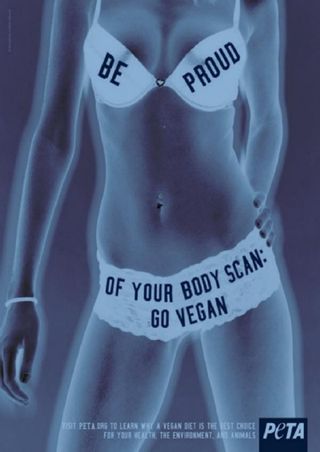
Image of woman's body under a scan. Her bra reads "Be Proud"; her bottom reads: "Of your body scan; go vegan"

Bottom half of a woman in a thong with hair protruding. Reads: Fur trim. Unattractive.

2. Does the image present a sexualized person as a stand-in for an object?
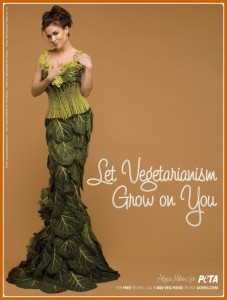
Alyssa Milano dressed in vegetables. Reads: "Let Vegetarianism Grow on You."

Naked woman painted like a globe. Reads: "Fight Climate Change with Diet Change, Go Veg"

3. Does the image show sexualized persons as interchangeable?

Several thin naked women standing close and intertwining. Reads: "Feel beautiful in your own skin."

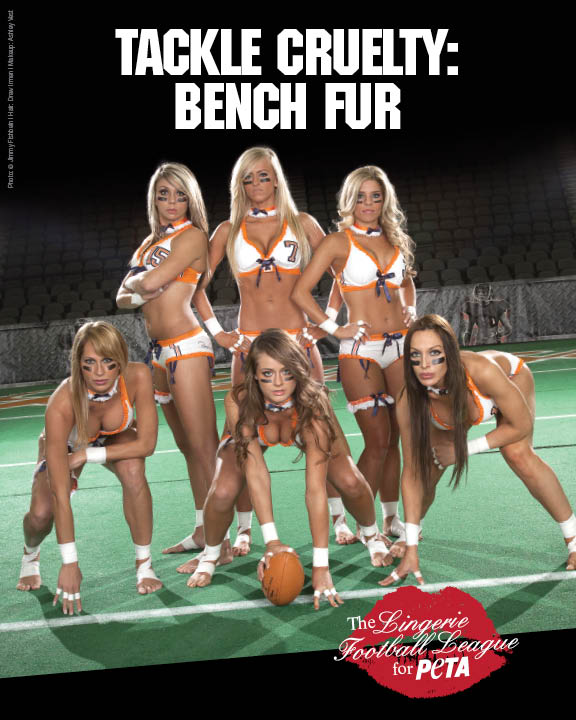
Group of cheerleaders wearing the same bikini outfit with long hair, tan skin, same thin athletic physique. Reads: "Tackle Cruelty: Bench Fur"

4. Does the image affirm the idea of violating the bodily integrity of a sexualized person who can’t consent?

Image depicts the upper body of a woman butchered and hanging on a meat hook. Reads: “Hooked on meat? Go veg.”

Woman on the ground wrapped in chains, legs spread and exposed, cleavage. Reads: "Shackled, Beaten, Abused."

5. Does the image suggest that sexual availability is the defining characteristic of the person?

Sasha Gray sits naked on a bed shown from behind, looking over her shoulder and cupping her breast

Thin white blonde woman sprawled out on some haystacks with legs spread pulling her dress down over her bosom. Reads: "No one likes an 8 second ride."

6. Does the image show a sexualized person as a commodity that can be bought and sold?

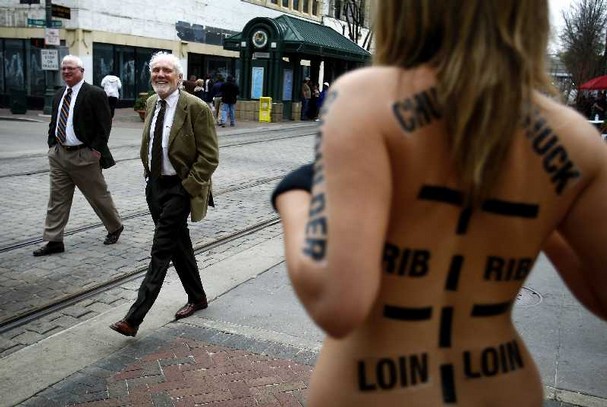
Image shows a white woman reclining on her hand. She is naked and painted with "meat cuts"

Woman laying under plastic wrap like a piece of meat with a bar code.


Corey Lee WrennDr. Wrenn is Lecturer of Sociology. She received her Ph.D. in Sociology with Colorado State University in 2016. She received her M.S. in Sociology in 2008 and her B.A. in Political Science in 2005, both from Virginia Tech. She was awarded Exemplary Diversity Scholar, 2016 by the University of Michigan’s National Center for Institutional Diversity. She served as council member with the American Sociological Association’s Animals & Society section (2013-2016) and was elected Chair in 2018. She serves as Book Review Editor to Society & Animals and has contributed to the Human-Animal Studies Images and Cinema blogs for the Animals and Society Institute. She has been published in several peer-reviewed academic journals including the Journal of Gender Studies, Feminist Media Studies, Disability & Society, Food, Culture & Society, and Society & Animals. In July 2013, she founded the Vegan Feminist Network, an academic-activist project engaging intersectional social justice praxis. She is the author of A Rational Approach to Animal Rights: Extensions in Abolitionist Theory (Palgrave MacMillan 2016).

Receive research updates straight to your inbox by subscribing to my newsletter.
An Open Letter to PETA

Open Letter to PETA

Dear PETA,

We have such a complicated relationship and history. You were one of my first entry points into animal activism, made me feel not so alone, gave me a sense of connection, and so much passion and hope as a middle schooler. I proudly wore my PETA t-shirts to school, lived on your street team website, and even spent the summer interning with you. I learned how to organize my first protest from you. You provided advice when my teacher wouldn’t allow me dissection alternatives. The “Street Team” forums helped me not feel so weird in the world (although, now I know – weirdness is the best) and gave me the strength to keep going, to keep fighting, even after cruel kids and comments.

So much has changed – and it really, really hurts, to be honest. I know you haven’t changed, and I guess that is the problem. You are still doing what you’re doing – in the way you are doing it. I see your campaigns/advertisements – over the past few years, have reflected back on the media “brainstorming” sessions we had when I was an intern, and it creates these twisted knots in my stomach. It’s really hard to describe the feeling. It’s like when a family member says something really homophobic or sexist, does something that you know isn’t right – but they were the ones who stayed up with you  at night as a kid, read you bed time stories, and fought against some of the monsters in your closet. There’s always this soft spot, this hope that they can change, will change.

I’m just. Angry. And sad. Sad for the non-human animals – sad for the animal rights and social justice movements – because it’s a loss, a huge loss, and it’s hurting all of us. We need organizations that are working towards ending ALL forms of oppression – not perpetuating them in the name of justice for one – because it’s not possible. Nothing is a single level issue. And animal rights IS a social justice issue. The non-human animals need everyone.

I struggle when feeling the divide between the social justice/feminist movements and animal rights movements- as though they are separate non-connected issues. And I hate that you are so often the face of the animal rights movement – but you are, so it’s time to hold yourself accountable, take responsibility, and make a change. I beg of you. As that bright and teary fire eyed middle schooler. Please stop with this sexist, racist, non-consent centered bullshit, and please get rid of any remnants related to your latest campaign: “Vegans go all the way.” NO. NO. NO. We need to challenge rape supportive culture, not contribute to it – for non-human animals and human animals.

I don’t really have any more words, but please, I beg of you, on my hands and knees, for all the passionate teens, the cant-quite-fit-in people like me – teach them that we can make a difference, and support them in their multiple identities and experiences, and in ending all forms of violence. Because it’s all connected. Only then can we create a beautifully loving and compassionate world – where violence is not digested. Where sexualized violence is not normalized. Where marginalized non- human animals and human animals are not objectified and seen as inferior.

This goes out to all the feminist movements as well – it’s time to recognize the role violence against non-human animals plays in desensitizing us and normalizing other forms of violence and oppression.

-A once young PETA lover, hoping for change.

By Mary Sue Savage

You can follow her on her blog, Confessions of an Activist with Social Anxiety.

What’s that Dirty “V” Word?

Women dressed in vagina costumes wave banners that read: "VAGINA" and "I heart Vaginas"

Vegans and vaginas, yes, there is an important connection. Hang with me here…

A colleague of mine mentioned to me that she would be using “the V word” in an essay she was working on and was worried about the push back she expected to receive. A little confused, I responded asking if she meant “vagina” or “vegan.”  Honestly, given the stigmatization of both words, I had no idea which she meant.  And I must not be the only one. When I conducted an image search for “the V word” to illustrate this essay, most of the results are pictures of feminists and vegan food.

I see news items from time to time in the feminist media chastising this or that organization for censoring the word “vagina.”  I also hear a lot of talk in the Nonhuman Animal rights movement about moving away from the word “vegan” in favor of “vegetarian,” “veg,” “veg*n,” “plant-based,” “meat-free,” etc.

I’m wondering what exactly is so off-putting about vaginas and veganism.  Why have these words become so stigmatized that they are often censored?  What are we trying to hide?  Who are we trying to silence?

VAGINAS: Many women have them; patriarchy wants to control them.*

VEGANS: Many activists are them; anthroparchy wants to control them.

I think the common factor between vaginas and vegans is that being loud and proud about them means posing a direct challenge to oppressive social structures.

But, if feminists wouldn’t dream of telling women to shut up about their vaginas, then why do professionalized welfare organizations tell people to shut up about their veganism?

Vegan campaigners hold signs at a demo

Being a woman shouldn’t be something to be ashamed of, neither should being a vegan.  Hiding these terms and identities away as if they’re dirty no-nos only serves to protect structural oppression. The strategy of silence does little to liberate.  It will not be possible to make any headway as long as women, men, and the media are uncomfortable using the word “vagina.” The same holds true for vegans and Nonhuman Animal rights/welfare organizations that are uncomfortable using the word “vegan.”

*This essay is meant to be trans-inclusive. Not all women have vaginas, and some men have vaginas.


Corey Lee WrennDr. Wrenn is Lecturer of Sociology. She received her Ph.D. in Sociology with Colorado State University in 2016. She received her M.S. in Sociology in 2008 and her B.A. in Political Science in 2005, both from Virginia Tech. She was awarded Exemplary Diversity Scholar, 2016 by the University of Michigan’s National Center for Institutional Diversity. She served as council member with the American Sociological Association’s Animals & Society section (2013-2016) and was elected Chair in 2018. She serves as Book Review Editor to Society & Animals and has contributed to the Human-Animal Studies Images and Cinema blogs for the Animals and Society Institute. She has been published in several peer-reviewed academic journals including the Journal of Gender Studies, Feminist Media Studies, Disability & Society, Food, Culture & Society, and Society & Animals. In July 2013, she founded the Vegan Feminist Network, an academic-activist project engaging intersectional social justice praxis. She is the author of A Rational Approach to Animal Rights: Extensions in Abolitionist Theory (Palgrave MacMillan 2016).

Receive research updates straight to your inbox by subscribing to my newsletter.

PETA’s “Youngest Pinup”

From PETA:  Women and girls of all ages should “go all the way” . . .  for the animals.

PETA normally waits until people turn 18 before asking them to star in a “provocative” campaign, but not this time. Sixteen-year-old singer-songwriter Samia Najimy Finnerty stars in our new “Vegans Go All the Way” ad. PETA’s youngest pinup is the daughter of actor and longtime PETA supporter Kathy Najimy and Dan Finnerty of The Dan Band.

16 year old girl is posed provocatively with her hand in her hair, lips parted, legs slightly spread. She is wearing a tight fitting gray tanktop and tight black pants. She also has a guitar over her shoulder.

PETA “normally waits” for a girl to reach legal age before they are prostituted for fundraising, but, not anymore.

From this campaign we learn:
1. Statutory rape is condoned.
2. Girls should “go all the way” as though their purpose for existing is to be a sexual resource to others.
3. For women, helping animals means sexually objectifying her body–even if she is still a child.
4. Rape culture reigns. Children cannot consent, and only in a rape culture, would this campaign be acceptable.
5. The sexualization of childhood (girlhood) has encroached on Nonhuman Animal rights advocacy.

Incidentally, PETA had originally planned for the 16 year old to appear on a bed.


Receive research updates straight to your inbox by subscribing to Dr. Corey Wrenn’s newsletter.

Gender Inequity in the Animal Welfare Movement

Jen here. I recently had the pleasure of meeting (through the Internet) a fascinating scholar by the name of Corey Wrenn. She wrote a paper entitled, “The Role of Professionalism Regarding Female Exploitation in the Nonhuman Animal Rights Movement,” published in The Journal of Gender Studies.

Ms. Wrenn makes one point that it not new- that some animal rights groups get their point across by exploiting women, specifically PETA, LUSH, Fish Love, and Animal Liberation Victoria (ALV).

But she makes a larger point that is the elephant in the room: Even though WOMEN make up the majority of those who support animal welfare, it is MEN who are in the leadership positions.

Does this sell our cause, or does it demean women and diminish our voice?

Indeed, the ASPCA, the Humane Society of the US, the Humane Association, the International Fund for Animal Welfare, the World Wildlife Fund, and many other groups are led by men and their top leadership is overwhelmingly male.

But it’s not men that are caring for animals. It’s not men who are lobbying for animals. It’s not men targeted with those emotion-laden commercials begging for money. It’s all about us then, baby.

So why are men running the show in this female-dominated arena? Why are we allowing them to market to us in a way that is demeaning? And does this gender inequity play into our inability to make meaningful changes in the animal welfare arena?

Recently I wrote a blog post where I said I wanted to work in the field of animal welfare. Many posted comments suggesting that I cut back on blogging and show my interest by volunteering for a rescue. Really? I scoop litter boxes every day. Why do I have to prove my worthiness to work in this field by scooping litter boxes for someone else? For free? Do you think Wayne Pacelle, when interviewing to lead the Humane Society, was asked how many litter boxes HE scooped to earn his stripes?

Personally, I’m thinking it’s time for a real change in the path this movement is taking. We need to phase out the Good Old Boy leadership. We need to stop the exploitation of women. Let’s change the face of this movement from the Crazy Cat Lady and clueless co-ed, who each need men to guide them, to that of the Old Crone, the elder who holds the wisdom of the ages.

Painting of an elderly woman wrapped in red.The Wise Crone respects Mother Earth and all of her creations

What do you think? Is Animal Welfare rife with sexism? Do you feel women are respected in the movement, or are we used as funders and cheap labor to promote a male agenda? What do YOU think should be the face of the movement?


By Jenny Threet

You can follow her on Twitter and on her blog, Rumpy Dog.

This post was originally published on  Rumpy Dog on July 8, 2013.

Male PETA Employees Make Women have Sex with Vegetables “For the Animals”

Not Safe for Work: Discusses pornography and contains sexualized imagery.
Trigger Warning: Discusses pornography

Some may recall that PETA launched a pornography site a few years ago, interweaving graphic scenes of violence with sexualized images of women. Fortunately, it removed the images of women, and the porn site is nothing more than short video clips of factory farms. But that wasn’t the end of the story. The porn is back, now under a new campaign called “Veggie Love Casting Session.”

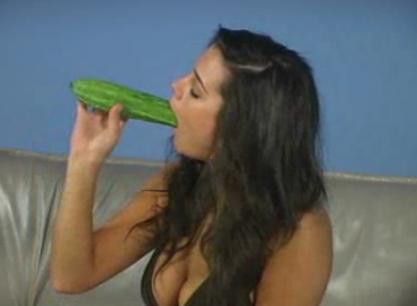
A bright-eyed white woman simulating oral sex on a cucumber. Meant to resemble an internet porn advertisement. Reads: "Can't get enough veggies? Join now!!! All access starting at $16/year."

On the campaign’s website, various clips of women performing sex acts on vegetables are featured. In the television commercial, women are paraded in front of the camera and inspected for the audience like human meat ready for consumption. The project is orchestrated by men who we hear in the background calling the shots, directing the women to show the audience how much they love their assigned vegetable, then laughing at the woman’s humiliation at the end of her session. Photos of the women are listed at the bottom of the page where viewers can rate them with a “thumbs up” or “thumbs down,” adding another level to the women’s objectification.

Image depicts two women in bikinis performing oral sex on a carrot. From PETA's Veggie Love campaign.PETA even manages to mimic the prevalence of racism in pornography.   The only African American woman featured is shown animalized, crawling across the couch to some broccoli where she devours it with no hands.

An African American woman in a bikini and high heels crawling across a couch towards broccoli.

Many would view this campaign and argue that these women are participating “by choice” and they’re “enjoying it.”  But this is missing the point.  We need to consider what shapes those choices, that being an environment that sees women as sex objects and resources for male enjoyment.  Women are under immense pressure to perform the gender roles they have been assigned.  Under patriarchy, women are socialized to be servants to men.  Women are groomed as little girls, taught that providing sex and pleasure for men is both expected and required of them.  Women are given so few opportunities in this world to achieve and succeed based on their skills, knowledge, and other dignifying qualities, sex work is one of the only options available to them. The vast majority of sex work, incidentally, is high risk, low pay work with very little job security and very little agency (most sex workers are pimped or otherwise trafficked). Importantly, this is an option that’s not even on the table for men.

Pornography and other forms of sexual exploitation also target especially vulnerable women, predominantly girls and women from low-income backgrounds or abusive families, girls and women with little occupational or educational opportunities, and girls and women who are suffering from addictions.Pornography hurts all women, but it particularly hurts at-risk women.

A white woman in a bikini and high heels spanking herself with a stalk of celery.

How does this imagery educate the public about speciesism?

After viewing videos of women performing sex acts on vegetables, videos of Nonhuman Animals being beaten and killed automatically pop up on the PETA website. In other words, images of sexualized and humiliated women are juxtaposed with dying animals. PETA is tapping into a new form of sexuality, one that has been popularized by porn culture: subjugating and hurting the vulnerable for the pleasure of the privileged.  Seeing someone humiliated and suffering for our enjoyment has become sexy.

A woman (possibly of color) in a bikini and high heels leaning against a couch on the floor. Her head is back and her back is arched. She is rubbing herself with tomatoes.

PETA is sexualizing the degradation and humiliation of women. PETA is sexualizing the exploitation of vulnerable people. PETA is sexualizing violence against women.  PETA is sexualizing oppression.

A white woman stuffing radishes into her mouth with painfully stretched cheeks.

The director encourages this woman to stuff as many radishes as possible into her mouth to demonstrate to the audience how much girth she can withstand.

The research is overwhelmingly clear: pornography leads to the degradation of women, the objectification of women, the dehumanization of women, and violence against women. It leads women to internalize this devaluation, and women begin to objectify themselves.  It disempowers women, it leaves women susceptible to domestic violence, and it feeds rape culture.  For more information on how pornography hurts women, check out The Price of Pleasure (warning, the material on the website and in the film are extremely triggering and graphic).  I also recommend Gail Dines’ Pornland or Robert Jensen’s Getting Off: Pornography and the End of Masculinity (this book is freely available on his website).

A white woman deep-throating a cucumber.


Corey Lee WrennDr. Wrenn is Lecturer of Sociology. She received her Ph.D. in Sociology with Colorado State University in 2016. She received her M.S. in Sociology in 2008 and her B.A. in Political Science in 2005, both from Virginia Tech. She was awarded Exemplary Diversity Scholar, 2016 by the University of Michigan’s National Center for Institutional Diversity. She served as council member with the American Sociological Association’s Animals & Society section (2013-2016) and was elected Chair in 2018. She serves as Book Review Editor to Society & Animals and has contributed to the Human-Animal Studies Images and Cinema blogs for the Animals and Society Institute. She has been published in several peer-reviewed academic journals including the Journal of Gender Studies, Feminist Media Studies, Disability & Society, Food, Culture & Society, and Society & Animals. In July 2013, she founded the Vegan Feminist Network, an academic-activist project engaging intersectional social justice praxis. She is the author of A Rational Approach to Animal Rights: Extensions in Abolitionist Theory (Palgrave MacMillan 2016).

Receive research updates straight to your inbox by subscribing to my newsletter.