“Booth Babes” Bad for Business & Animal Rights

Two teenagers in mini-dresses pose on a PETA Youth booth offering "Free hugs"

The animal rights movement loves using young women to sell veganism, but whether or not this tactic is effective has come under serious scrutiny.

New research on the effectiveness of “booth babes” at techie conferences suggests that the use of provocatively dressed young women to sell items at trade shows doesn’t work. The comparison group, which consisted professionally dressed older local women, performed significantly better:

The results? They were great. The booth that was staffed with the booth babes generated a third of the foot traffic (as measured by conversations or demos with our reps) and less than half the leads (as measured by a badge swipe or a completed contact form) while the other team had a consistently packed booth that ultimately generated over 550 leads, over triple from the previous year.

Why don’t booth babes make good salespersons?  Marketing executive Spencer Chen suggests that they are intimidating to men.  That is, rather than attracting men, they repel men.  Chen also suggests that women who are hired specifically for these events have little incentive to work for the company. As he explains, “They are used to not doing much except showing up to make their fee for the day.”  Customers are looking to learn more, something models are not often invested in.  This point may or may not apply to vegan booths, as PETA and other organizations that objectify women rely on volunteers as well as paid models.

Chen also reports, “Business and product execs don’t talk to booth babes.”  While vegan “booth babes” are not targeting important business persons, the effect is similar.  Animal justice is a serious matter, as is changing one’s diet, and “booth babes” simply do not convey seriousness:

Many times I observed that while my team was busy in demos with other prospects, the booth babes were unable to hold the interest of these execs for the extra five minutes that I needed to get a person from our team to engage.

Who they do tend to attract, however, are young men who are interested more in photo ops than business.

Young man poses next to the "Ice Queen" while another young man takes their picture. The woman is very thin, white, and painted in blue. She wears a tiara and high heels. Sign reads: "Beat the heat with nondairy treats."
So why use booth babes at all? Chen suggests that it’s simply cheaper than relying on qualified individuals and experts.  It’s not only easier on the budget, but it’s indicative of cheap advertising standards that dominate the marketplace:

[…] there still exists the “stripper and steaks” mentality in sales, where it’s less about the product and more about relationships and the art of the “close.” Booth babes have long been a part of this dog-and-pony show in this old approach to sales.

This study comes on the heels of the Australian study published in December of 2013 that demonstrated PETA’s “sex sells” approach is actually counter-productive.  Male participants recognized that the women were dehumanized and were subsequently less likely to support the animal rights cause.
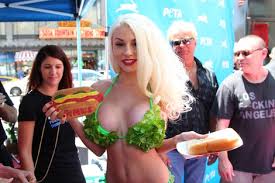

Courtney Stodden poses with a veggie dog in a revealing lettuce bikini. Men in the background stare at her.


Corey Lee WrennDr. Wrenn is Lecturer of Sociology. She received her Ph.D. in Sociology with Colorado State University in 2016. She received her M.S. in Sociology in 2008 and her B.A. in Political Science in 2005, both from Virginia Tech. She was awarded Exemplary Diversity Scholar, 2016 by the University of Michigan’s National Center for Institutional Diversity. She served as council member with the American Sociological Association’s Animals & Society section (2013-2016) and was elected Chair in 2018. She serves as Book Review Editor to Society & Animals and has contributed to the Human-Animal Studies Images and Cinema blogs for the Animals and Society Institute. She has been published in several peer-reviewed academic journals including the Journal of Gender Studies, Feminist Media Studies, Disability & Society, Food, Culture & Society, and Society & Animals. In July 2013, she founded the Vegan Feminist Network, an academic-activist project engaging intersectional social justice praxis. She is the author of A Rational Approach to Animal Rights: Extensions in Abolitionist Theory (Palgrave MacMillan 2016).

Receive research updates straight to your inbox by subscribing to my newsletter.
The Misogyny of Animal Rape Imagery

Trigger Warning:  Discussions of rape.

Dear colleagues,
Many of you may have seen a meme that is floating around called, “Sexual Violation.”  It reads:

Sexual violation of female animal bodies for exploitation, murder and profit.

Animal Agriculture’s shameful standard industry practices.

It is time for the masses to reject these crimes.  LIVE VEGAN.

The image is not reproduced here because it is extremely triggering.  Several species of animals are shown in a variety of compromised positions, as men sexually violate and rape them, the point being that standard animal agricultural practices are similar to the rape of women.  In other words, Nonhuman Animal pornography is being used to promote veganism.

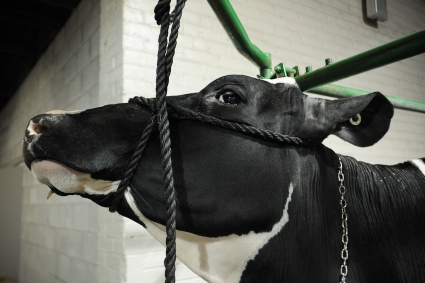
Cow's face is pictured, constrained by ropes and chains

Cow tethered to a “rape rack”

In the caption, the author writes, “I know this is difficult to see.  I take no joy in sharing it.” No joy in sharing it?  Well there’s something behind the rationale of those who have been sharing it…

The entire point of pornography is to titillate via the sexual degradation and humiliation of an oppressed body.  Those who consume pornography are consuming it specifically to “get off,” so to speak, on the demonstrated powerlessness of otherized bodies.  The relationship between the viewer and the viewee is one that reproduces and reinforces a hierarchy of domination.  Pornography users also report experiencing a “tolerance,” meaning increasingly degrading and shocking imagery is needed for them to feel something.  The pornography industry is happy to serve that need by producing increasingly disturbing media.

Male photographers at a pornography convention photographing a woman with her legs spread

So what makes it any different for vegan advocates who share these images with the intention of shocking people with images of violated and degraded animal bodies?  And for that matter, what gives them the right?  What’s stopping them from using images of men raping women to solicit shock value?  Should we also recount graphic tales of other women’s rape to rally for veganism?

I argue that sensationalizing the rape of other animals feeds rape culture and revictimizes women.  While the public may not be aware of the institutionalized rape of Nonhuman Animals, most of us are aware of the epidemic of rape against human women.  Most of us know this from first-hand experience.

Knowing that about 1 in 3 women have or will be raped, I find it extremely inappropriate to utilize rape imagery to promote veganism.  First off, our primary audience is women.  If 80% of the movement is women, and 1 in 3 women are rape victims, that means that more than 27% of our movement (or more than 1 in 4 activists) are likely to have been the victim of rape.  Any rape victim can tell  you, seeing images of rape or reading graphic descriptions is extremely triggering.  It is also revictimizing when it is made obvious that our community doesn’t care enough about our safety to avoid using our experiences for animal rights claims on our behalf.

These types of tactics demonstrate tokenizing.  That is, they appropriate the experiences of an oppressed group for the movement’s purposes, while the movement fails to address the ongoing and continuing oppression that group is still experiencing. What’s worse, the movement itself is responsible for aggravating that oppression.  For example, PETA’s slavery and Holocaust analogies use the horrific experiences of oppressed people of color and Jews for their purposes, but, in doing so, they fail to acknowledge that these memories are not forgotten, but are still hurting. In addition to that blatant insensitivity, PETA is presuming that racism, slavery, and human genocide are things of the past, when they are actually ongoing injustices.  Furthermore, PETA fails to acknowledge the present-day needs of communities of color, often excluding them.  In other words, PETA uses the experiences of the oppressed when it is convenient for them to do so, but they simultaneously haven’t done anything to alleviate those injustices and actually aggravate them.

Outdoor display of several animal rights posters with passerby stopped to read them

PETA’s “Meat Equals Slavery” display

Likewise, the Nonhuman Animal rights movement is a very misogynistic space.  Not only does PETA and other groups like Animal Liberation Victoria, LUSH Cosmetics, and Citizens United For Animals regularly aggravate sexism through their tactics (see our Organization Watch for more examples), but activist spaces themselves are rife with male-on-female violence (See Emily Gaarder’s 2011 release Women and the Animal Rights Movement).  If the movement isn’t going to take violence against women seriously, it has no business using our oppression for its gain.

Recall the author wrote, “I know this is difficult to see.”  The author knew exactly what they were doing.  They wanted to trigger.  Those who utilize memes and arguments that liken Nonhuman Animal rape to women’s rape seem to forget that many people exposed to those arguments are rape victims themselves.  Triggering these memories and trivializing these experiences does nothing to dismantle oppression.  Indeed, they only facilitate it.  It becomes one more means of alienating women from anti-speciesist work. It becomes one more means of solidifying male rule over advocacy spaces.  It works to keep women in a constant state of not-belonging, of victimhood, of hurt.

Recognizing the intersections between human and nonhuman oppression is important, but we have to practice sensitivity in doing so.  Blasting activist spaces with violent pornography is one example of how not to practice sensitivity.


Corey Lee WrennDr. Wrenn is Lecturer of Sociology. She received her Ph.D. in Sociology with Colorado State University in 2016. She received her M.S. in Sociology in 2008 and her B.A. in Political Science in 2005, both from Virginia Tech. She was awarded Exemplary Diversity Scholar, 2016 by the University of Michigan’s National Center for Institutional Diversity. She served as council member with the American Sociological Association’s Animals & Society section (2013-2016) and was elected Chair in 2018. She serves as Book Review Editor to Society & Animals and has contributed to the Human-Animal Studies Images and Cinema blogs for the Animals and Society Institute. She has been published in several peer-reviewed academic journals including the Journal of Gender Studies, Feminist Media Studies, Disability & Society, Food, Culture & Society, and Society & Animals. In July 2013, she founded the Vegan Feminist Network, an academic-activist project engaging intersectional social justice praxis. She is the author of A Rational Approach to Animal Rights: Extensions in Abolitionist Theory (Palgrave MacMillan 2016).

Receive research updates straight to your inbox by subscribing to my newsletter.

PETA Names Part-Time Animal Abuser and Misogynist Ricky Gervais Person of the Year

PETA announced that its “Person of the Year” for 2013 is British comedian and actor Ricky Gervais. He’s not even vegan, and he has an obnoxious track record with women as well.

Having once dated a Brit who was positively obsessed with Gervais (he would even shower listening to his radio shows!), I am relatively familiar with his work.  Gervais has a sort of cult-following (mostly men) stemming from several successful television series, movie appearances, radio shows, cartoons, comedy tours, etc.  Most Americans recognize him from the British version of The Office.  I will admit that I find some of his work pretty funny, but most of the time he leaves me scowling in disgust.  He definitely leaves me very confused as to how he made “Person of the Year.”

Why isn’t Gervais Vegan?

After the announcement, Gervais tweeted from his Christmas shopping excursion, posting a photograph from a gourmet cheese shop.  I can also attest, having seen two seasons of his program, An Idiot Abroad (a travel show starring his radio show’s producer Carl Pilkington), his respect for Nonhuman Animals is considerably limited.

Screencap of Gervais' tweet. Shows inside of a cheese shop. Reads: "I'm cheese shopping for Xmas at the moment."

An Idiot Abroad is the brainchild of Gervais and comedic partner Steve Merchant.  Pilkington is infamously grouchy, so the show involves sending him to the far reaches of the world exploring, socializing, and completing tasks at the request of Gervais and Merchant. Many of the episodes feature the graphic torture and death of Nonhuman Animals, usually for jokes at Pilkington’s expense. In one episode, he was made to ride a camel across the desert, though the camel resisted horribly, eventually collapsing. The entourage had to summon a pickup truck to cart the crew and spent camel for the remainder of the journey.

In another episode, Pilkington visits China, where “bizarre” Chinese food was highlighted. Pilkington was specifically sent to a home where a satchel of frogs were killed in front of him (bashed against a stone) and then cooked and served as dinner. This was arranged specifically because he had complained to Gervais and Merchant at the beginning of the show that he would not be eating any “weird” foods. While shooting in South America, they arranged for Pilkington to enter a cross-country running tournament (for which he was doomed to lose) with the life of a goat at stake.

In another country, Pilkington was sent to a snake charmer, where we finally hear Gervais second guess the ethical implications of the plot. He phones Pilkington to inquire whether or not the snakes were treated poorly. Seeing as how it was a tourist trap intended to wow visitors with irate snakes, one can only guess as to their welfare.

These are only a few of many instances of blatant Nonhuman Animal suffering in Gervais’ program. Really, PETA may as well be awarding Andrew Bourdain of No Reservations or Andrew Zimmern of Bizarre Foods.

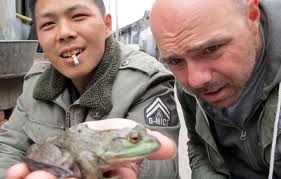
Screenshot from "An Idiot Abroad," Pilkington examines a live frog in the hand of a Chinese man

Having moaned quite a bit about not wanting to have to eat frogs, Gervais’ program ensures a plastic shopping bag full of frogs are smashed to death in front of him, butchered, then served for dinner.

Rape Jokes and Cunts

Perhaps my first real introduction to Gervais was his stand up special Out of England.  I found myself laughing and enjoying it quite a bit…until he randomly inserted a rape joke.  My stomach knotted and the laughs were over. Amid some glib about endangering an elderly woman while drinking and driving, he blurts: “I nearly knocked this old woman over…but I didn’t. I raped her.”

He’s also a huge fan of using the word “cunt” and “twat” as an insult. While I enjoy a lot of his comedy and his outspokenness about atheism and have tried to follow him on his social networking sites, within about two days I’m sick from seeing misogynistic slurs fill up my newsfeeds and find myself unfollowing him again. I understand that the British are more “free” with their misogynistic slurs (which, to me, is no excuse and would be no different than my attempting to defend my fellow Southerners as freely using the “n-word” because they “don’t mean it like that”), but seriously, Gervais is too much.

Gervais submerged in bathtub with blacked out teeth drinking a beer. He is wearing a homemade hat that has "UGLY CUNT" scrawled on it.

One of Gervais’ infamous bathtub photos

Disableism for Fun

Gervais has also come under criticism for regularly calling people “mongs” (racist British slang for mental retardation; short for Mongoloid). His programs regularly use disability as the butt of jokes as well.  An Idiot Abroad has Pilkington visiting little people “villages,” yogis with severe disfigurements, and other exploitative “tourist attractions.” In Season Three, Pilkington is paired up with actor Warwick Davis, as Davis is a little person and Pilkington is famously fascinated with “freaks.” Of course, the title of the program itself reeks of disableism.

Pilkington and Davis on a bicycle. Warwick is grinning, but Pilkington looks miserable.

Pilkington and Davis on the set of “An Idiot Abroad”

Gervais’ current television success, Derek, stars Gervais as a lovable mentally retarded man living in a nursing home. Something I consider the disability version of blackface.

Pilkington and Gervais on the set of "Derek." Gervais is making a face and has arranged his hair in a stereotypical way to suggest mental retardation.

Pilkington and Gervais on the set of “Derek”

A Confused Movement

Surely no one is perfect, and Gervais has done a lot to raise awareness about the suffering of some animals. But, really, PETA is really setting the bar low this time around. It seems PETA was really happy to see Gervais suggesting that Michelle Bachman, who famously killed a lion on a hunting expedition, be shot herself. Of course, men shoot and kill lions all of the time, but because this was a female celebrity, she made for an easy target…especially for known misogynists like Gervais and PETA.

Gervais' tweet, reads: "I'll pay for each pride of lions to have their own designated sniper on their side. Now it's a sport. Where you brave hunters at now? Haha."

Male committed homicide is one of the leading causes of death for women under 35, a context we should seriously consider when joking about shooting women.

The Nonhuman Animal rights movement is not likely to make any serious headway so long as it celebrates those who enact violence against the vulnerable, be it women, disabled persons, or other animals. PETA and other large non-profits are, for better or for worse, the face of the movement and have a responsibility for upholding our goal for a just world. If PETA is awarding known abusers like non-vegans, slaughterhouse designers, fast food chains, and “meat” industries, what does this say about the integrity of animal rights?

Does Sex Sell Animal Rights? RESEARCH SAYS NO!

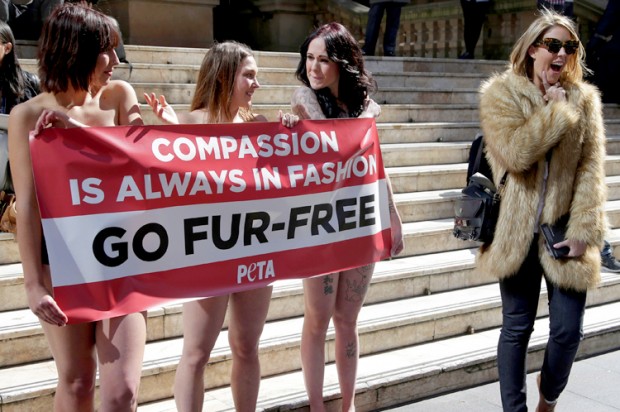
Three naked women stand behind a PETA anti-fur banner outside. A female bystander looks shocked.

Two researchers in Australia sought to test PETA’s hypothesis that sex sells animal rights:

Images of scantily clad women are used by advertisers to make products more attractive to men. This “sex sells” approach is increasingly employed to promote ethical causes, most prominently by the animal-rights organization PETA. Yet sexualized images can dehumanize women, leaving an unresolved paradox – is it effective to advertise an ethical cause using unethical means? In Study 1, a sample of Australian male undergraduates (N = 82) viewed PETA advertisements containing either sexualized or non-sexualized images of women. Intentions to support the ethical organization were reduced for those exposed to the sexualized advertising, and this was explained by their dehumanization of the sexualized women, and not by increased arousal. Study 2 used a mixed-gender community sample from the United States (N = 280), replicating this finding and extending it by showing that behaviors helpful to the ethical cause diminished after viewing the sexualized advertisements, which was again mediated by the dehumanization of the women depicted. Alternative explanations relating to the reduced credibility of the sexualized women and their objectification were not supported. When promoting ethical causes, organizations may benefit from using advertising strategies that do not dehumanize women.

The conclusion?

Overall, these findings are the first to demonstrate that sexualized images that dehumanize women reduce concern for ethical behavior in a domain unrelated to gender relations and sex. 

Salon reports that PETA dug in their heels in response to the research, insisting naked women get the most media attention.  So, perhaps we are misrepresenting PETA’s hypothesis.  They’re using naked women not to raise awareness and stop animal exploitation, but to raise money and awareness about PETA.  The “sex sells” tactic, I have argued, is indicative of the non-profit industrial complex, where compromised messages and fundraising are prioritized over actual social change.  Really, PETA is ignoring this research even though it has been demonstrated that their tactics do not help Nonhuman Animals.  They will continue objectifying women because it “grabs the headlines.” Can it be any clearer that this is not about social change effectiveness?

Of course, while this study demonstrates that there is no effectiveness, there is also a huge body of research that demonstrates that the sexual objectification of women is directly linked to violence against women and the devaluation of women.


This post originally appeared on the Academic Abolitionist Vegan.


Corey Lee WrennDr. Wrenn is Lecturer of Sociology. She received her Ph.D. in Sociology with Colorado State University in 2016. She received her M.S. in Sociology in 2008 and her B.A. in Political Science in 2005, both from Virginia Tech. She was awarded Exemplary Diversity Scholar, 2016 by the University of Michigan’s National Center for Institutional Diversity. She served as council member with the American Sociological Association’s Animals & Society section (2013-2016) and was elected Chair in 2018. She serves as Book Review Editor to Society & Animals and has contributed to the Human-Animal Studies Images and Cinema blogs for the Animals and Society Institute. She has been published in several peer-reviewed academic journals including the Journal of Gender Studies, Feminist Media Studies, Disability & Society, Food, Culture & Society, and Society & Animals. In July 2013, she founded the Vegan Feminist Network, an academic-activist project engaging intersectional social justice praxis. She is the author of A Rational Approach to Animal Rights: Extensions in Abolitionist Theory (Palgrave MacMillan 2016).

Receive research updates straight to your inbox by subscribing to my newsletter.

Are You Bringing Racist Cookies to Your Vegan Thanksgiving?

Content Warning: Racism and white-washing of indigenous genocide.

Three toilet paper tubes, one dressed as a native american, two as pilgrims. NA character speaks in broken english: "Medicine man say I must eat no gluten." Pilgram says "My husband has the same problem." Caption: "Small Talk in Early America"

Alright folks, let’s play “Cowboys & Indians.”  Guess who loses again?

In 2013, Liz Lovely (a Vermont-based vegan cookie business) posted the above Thanksgiving meme in their fan club newsletter, and met with a number of well-earned criticisms.

The cartoon depicts a Native American character in cliché garb (headbands are a white Hollywood invention) who speaks with broken English.  The broken English stereotype is meant to emphasize Native American ignorance and white “settler” superiority, while the “Medicine Man” trope also used here draws on the problematic stereotype of the  “mystical Indian.”

Another issue raised in this cartoon is the white-washing of institutionalized violence inflicted on indigenous populations with the arrival of European colonizers. These intruders arrived uninvited, attempted to colonize regions already inhabited by indigenous communities, and almost all of them died from cold, illness, and hunger in this failed attempt at conquest. Local tribes assisted survivors, only for more European boats to arrive with more white people who would soon pass on their deadly diseases, exploit the land, and declare war on the native population. This history is made invisible in the smiling faces of the toilet roll caricatures.

In a nutshell, Liz Lovely, a white-owned company, is exploiting a stereotype of a heavily oppressed indigenous population to sell expensive white people cookies to other white people.

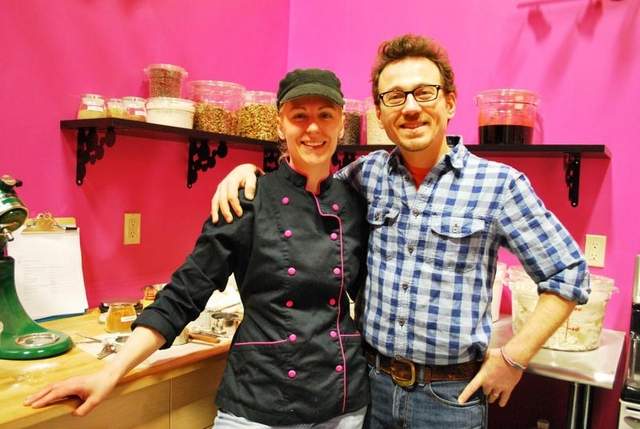
Liz Lovely Owners

So, they boobooed.  It happens. But instead of making it right with a sincere apology and retraction, they made it worse. Way worse.

Following complaints, the cartoon was deleted and Liz Lovely followed up with a mean-spirited not-pology to clear the air (emphasis added):

Message from Cowboy Dan:

First, let me apologize for unintentionally offending Native Americans (and somehow also people who are not Native American, but are extremely sensitive). I am not a racist, I am not ignorant of the plight of Native Americans, and I was not seeking to degrade their heritage.

I knowingly played on a well-established media stereotype to make a silly joke about the first Thanksgiving, assuming the construction paper cutouts would tip people off that it was meant to be ridiculous ~ like an SNL skit for example.

This is not the first content-complaint I’ve received on the fan club. Although, this may be the most well-founded. And while Liz and I like our sense of humor, we understand that it’s not for everyone.

So moving forward, the fan club will be simpler [ . . . ]

Thank you so much for being fans and supporters.

Liz Lovely is sorry that the reader took offense.  So, it is not really sorry at all.  It’s the reader’s fault for being offended, not Liz Lovely’s for offending you. See, “Cowboy Dan” “gets” the issues, and his post was so obviously “ridiculous,” it doesn’t count as racism. After all, these racist stereotypes are “well-established,” so what’s the harm? Cowboy Dan does not identify as a racist, so that means he can’t be racist.

But simply declaring yourself not racist does not actually make you not racist . . . it’s your actions that define you.

By signing off with a thanks to fans and supporters, Cowboy Dan insinuates that his intended or perceived audience is a white one. Liz Lovely makes it clear that the message is really intended for those who are either 1) not Native American, or, 2) persons of color who respect white supremacy; those who are not “extremely sensitive” and can “take a joke.”

The content of the comments on Liz Lovely’s Facebook page that followed the announcement attest to the boundary work of this white space. For instance, one theme was the elevation of cookies over injustice:

Love your humor….but really LOVE THOSE COOKIES!!!

Can’t we all just get along for the sake of DELICIOUS COOKIES!!

Another theme was the dismissal of racism:

People need to stop being so damn sensitive. Bunch of stupid, ugly, butt hurt losers.

I didn’t see it, but am aware that in general society has become far too sensitive. You make a fantastic product, I find you guys to be pretty funny. You can’t please everyone.

Unsubscribe if you’re that easily offended so the rest of us don’t have to walk on egg shells around you!

Seriously, people … if you’re that easily offended, how do you survive in this world? Get over yourselves. It’s a joke. So you didn’t find it funny. Have a cookie and move on.

Those who mind don’t matter and those who matter don’t mind. If we’re looking for a reason to be offended, we’ll always find one. Words to live by from two of my favorite people, Dr. Seuss and Wayne Dyer. BTW, I love your cookies!!

People are WAY TOO SENSITIVE and need to calm down! Being “politically correct” has gone over the top.

And “reverse racism”:

Why is no one offended about the pilgrims?

Because pilgrims are white, and everyone knows any sort of racist tones don’t apply to white people.

Finally, don’t like it? Go elsewhere:

Wow now people are analyzing the sincerity of an apology for a humorous and post that was deleted? Like that was really the most bothersome thing you saw online today – Grow up! If it bothered you that much unlike the page and spend your $ elsewhere.

…which is exactly what countless oppressed persons of color who are regularly made to feel unwelcome in vegan spaces frequently do.

It should be no wonder as to why veganism is viewed as pretentious, elitist, and frivolous when racism is openly supported and people of color are harassed, marginalized, or erased entirely.


Note:  The Food Empowerment Project does not recommend Liz Lovely Cookies because it does not source its chocolate ethically.  Much of the world’s chocolate comes from child slavery.


Corey Lee WrennDr. Wrenn is Lecturer of Sociology. She received her Ph.D. in Sociology with Colorado State University in 2016. She received her M.S. in Sociology in 2008 and her B.A. in Political Science in 2005, both from Virginia Tech. She was awarded Exemplary Diversity Scholar, 2016 by the University of Michigan’s National Center for Institutional Diversity. She served as council member with the American Sociological Association’s Animals & Society section (2013-2016) and was elected Chair in 2018. She serves as Book Review Editor to Society & Animals and has contributed to the Human-Animal Studies Images and Cinema blogs for the Animals and Society Institute. She has been published in several peer-reviewed academic journals including the Journal of Gender Studies, Feminist Media Studies, Disability & Society, Food, Culture & Society, and Society & Animals. In July 2013, she founded the Vegan Feminist Network, an academic-activist project engaging intersectional social justice praxis. She is the author of A Rational Approach to Animal Rights: Extensions in Abolitionist Theory (Palgrave MacMillan 2016).

Receive research updates straight to your inbox by subscribing to my newsletter.

Veganism and the Politics of Gender

A reader Alexander Lawrie sent me this story and I thought it made an excellent example of male supremacy and gender policing as a barrier to advancing the interests of women and other animals.  A Scottish newspaper reported that a woman who had ordered a menu item made vegan at a restaurant was mocked by staff.  Her receipt read:  “Vegan Vegan Vegan Pussy.”  The restaurant added insult to injury when they also mocked the woman on their Facebook page

But it doesn’t end there!  The newspaper covering the story actually found the woman’s Facebook page and printed her profile picture along with her full name and place of work.  The additional harassment that followed was severe enough for the paper to moderate comments and remove her photo.

The incident is saturated with misogyny.  Had the victim been male, I expect the reaction would have been similar, though probably with the addition of homophobia.  Under a patriarchy, the domination of others and the consumption of meat is highly masculinized.  Veganism has been feminized not only because vegans are more likely to be women, but also because veganism represents the interests of those who are subjugated to male oppression.  Veganism fights the patriarchy.

We shouldn’t be surprised that a company that profits from Nonhuman Animal exploitation used a speciesist and sexist insult to belittle the woman, nor should we be surprised that the media (which generally exists to protect and reproduce elite interests) only made things worse.  But why was the waitress in on it, too?

In Female Chauvinist Pigs:  Women in the Rise of Raunch Culture (Pardon the speciesist title), Ariel Levy explains that the popularity of “post-feminism” really represents a patriarchal co-optation of woman-centric anti-oppression ideology.  Women are put in competition with one another as they vie for men’s favor.  In a world where maleness is equated with prestige and power, it is often in women’s interests to abandon feminine ties and appeal to masculinity instead.  Deniz Kandiyoti (1988) calls this patriarchal bargaining.  To cope in a world that is hostile to all things feminine, the waitress was looking out for her interests by supporting male values and trashing on the vegan diner.

Of course, this means that men themselves are under enormous pressure to conform to these masculine values.  This commercial for the “Carnivore Club” seeks to reassert male control, male intelligence, and male superiority in the face of encroaching feminine values.


This commercial plays on many stereotypes of veganism:  It is for women; it is emasculating, flavorless, and fastidiously healthy.  For men, joining the Carnivore Club promises to protect their dominance, their control over nature, and even their virility (though consuming Nonhuman Animal products is linked to a litany of life-threatening diseases including cardiovascular problems and diabetes, which are leading causes of erectile dysfunction).

Carnivore Club Advert

Framing this product as a “club” is intentional.  The advertisers are hoping to draw on masculinity as a members-only, exclusive space for men who are “in the know.”  Like Fortune 500 CEOs, legislative bodies, media executives, and other boys-only spaces of male privilege, the Carnivore Club invites men to join the ranks of the masculine elite in their rule over the vulnerable.  Indeed, one cannot even access their website without a “member login.”  Notice also the familiar “silly clueless wife” trope so often utilized in commercials, programs, and film.  Women are just too incompetent to realize what their mentally superior male partners are up to.

This is toxic masculinity.  Not only are men encouraged to indulge in dietary behaviors that will cause them illness and death, but women are also encouraged to reject veganism as they strategize for survival in an anti-feminist patriarchy.  And, lest we forget, the biggest losers are the Nonhuman Animals whose oppression is naturalized and whose advocates are mocked, harassed, and silenced.


Corey Lee WrennDr. Wrenn is Lecturer of Sociology. She received her Ph.D. in Sociology with Colorado State University in 2016. She received her M.S. in Sociology in 2008 and her B.A. in Political Science in 2005, both from Virginia Tech. She was awarded Exemplary Diversity Scholar, 2016 by the University of Michigan’s National Center for Institutional Diversity. She served as council member with the American Sociological Association’s Animals & Society section (2013-2016) and was elected Chair in 2018. She serves as Book Review Editor to Society & Animals and has contributed to the Human-Animal Studies Images and Cinema blogs for the Animals and Society Institute. She has been published in several peer-reviewed academic journals including the Journal of Gender Studies, Feminist Media Studies, Disability & Society, Food, Culture & Society, and Society & Animals. In July 2013, she founded the Vegan Feminist Network, an academic-activist project engaging intersectional social justice praxis. She is the author of A Rational Approach to Animal Rights: Extensions in Abolitionist Theory (Palgrave MacMillan 2016).

Receive research updates straight to your inbox by subscribing to my newsletter.