Veganism and Natural Disasters in the Global South, How We Can Help

As the news reports the terrible death and destruction in the Philippines resulting from the worst storm ever recorded, I feel sick with worry.  As an environmental sociologist and a vegan researcher, I’m well aware that these storms are only going to worsen and become more common as global warming continues to influence catastrophic climate change. Researchers have already documented that natural disasters are on the rise and we have every reason to predict this trend will continue.

Filipino women cling to wreckage in rising waters.

Along with the heartache I feel from these news stories is an unavoidable annoyance with those who insist that global warming is not real, is a hoax, or is a “natural” event.  Indeed, about half of Americans, most of whom have been influenced by conservative interests, believe that global warming is not a human-made phenomenon.  This frustrates me to no end because it is our ignorance here in the West that is hurting those living in third world regions.  It’s easy for us to kick back and ignore the scientific consensus about global warming when we’re living privileged lives here in the West.  While natural disasters are also on the rise here, it is people (human and nonhuman) living in the Global South who are especially impacted.  These are regions are close to sea level with high coastal populations, weak infrastructures, agriculture-based/weather dependent undiversified economies, high levels of poverty, and pitiful few resources to cope with disaster.  When a major storm hits, it is more likely to hit one of these areas.  Due to centuries of colonization and capitalist exploitation, these are the very areas that are least able to survive them.

So where does veganism come in?  Research shows that Nonhuman Animal agriculture accounts for 51% or more of Greenhouse Gas emissions.  Many cultures living in the Global South have traditionally been plant-based, but increasingly, global capitalist pressures have pushed them into adopting Western diets and producing Nonhuman Animals and their feed.  The Global South is exploited as a producer of non-vegan products, a market for our non-vegan products, and a dumping ground for the pollution those products create.  The inevitable natural disasters that also burden these area are also tied to this globalized project of speciesism.

Many international governance bodies have begun to question the dangerous consequences of Nonhuman Animal agriculture, but many succumb to capitalist interests and suggest reform rather than abolition.  The capitalist system itself is inherently exploitative and will always create high levels of suffering, but if we insist on retaining this economic mode of production, we need to get realistic about animal-based food systems.  Reformed systems still allow for the 65+ billion (and growing) Nonhuman Animal deaths each year.  Reformed systems also allow for a litany of debilitating and deadly diet-related diseases, which disproportionately impact poor persons.  These reforms also allow for continued environmental destruction and global warming which hits the global poor the hardest.  If we want to curb this massive, global-scale suffering, we must prioritize veganism.


Corey Lee WrennDr. Wrenn is Lecturer of Sociology. She received her Ph.D. in Sociology with Colorado State University in 2016. She received her M.S. in Sociology in 2008 and her B.A. in Political Science in 2005, both from Virginia Tech. She was awarded Exemplary Diversity Scholar, 2016 by the University of Michigan’s National Center for Institutional Diversity. She served as council member with the American Sociological Association’s Animals & Society section (2013-2016) and was elected Chair in 2018. She serves as Book Review Editor to Society & Animals and has contributed to the Human-Animal Studies Images and Cinema blogs for the Animals and Society Institute. She has been published in several peer-reviewed academic journals including the Journal of Gender Studies, Feminist Media Studies, Disability & Society, Food, Culture & Society, and Society & Animals. In July 2013, she founded the Vegan Feminist Network, an academic-activist project engaging intersectional social justice praxis. She is the author of A Rational Approach to Animal Rights: Extensions in Abolitionist Theory (Palgrave MacMillan 2016).

Receive research updates straight to your inbox by subscribing to my newsletter.

Jamie Kilstein, Vegan Male “Feminist” Explains Feminism to “Dumb” Women

Content Warning: Contains ableist language and male-on-female aggression 

Not Safe for Work: Contains cursing.

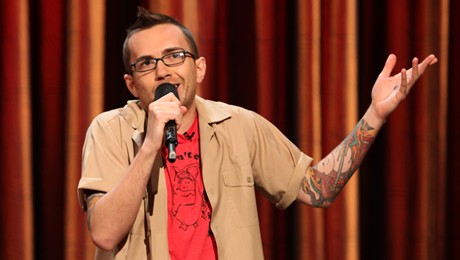
Jamie Kilstein

By Professor Corey Lee Wrenn

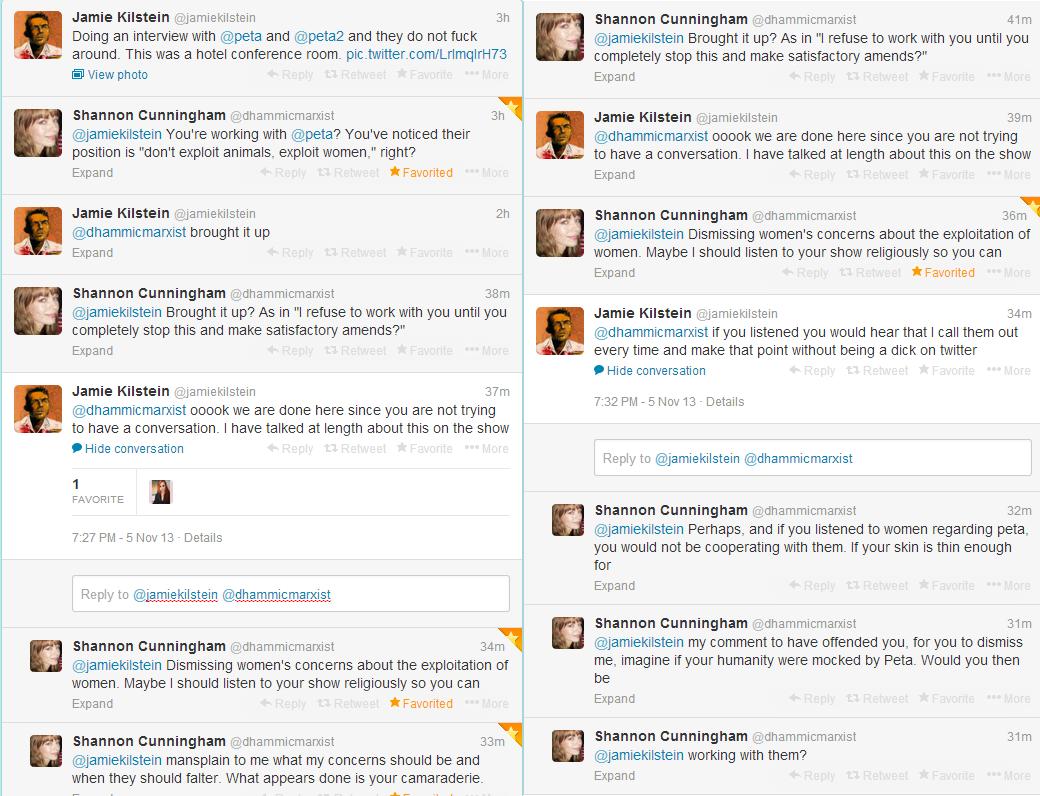
Jamie Kilstein, comedian and co-host of Citizen Radio, announced that he would be doing an interview with PETA and PETA 2.  A feminist questioned him on this, asking why he chooses to collaborate with a notoriously misogynistic organization.  He then proceeded to dismiss her and berate her.

KilsteinIn the middle of the above interaction, Kilstein peeked into her profile, which listed her interest in Marxism.  He then referenced it, insinuating that she was “dumb.”

Kilstein 3

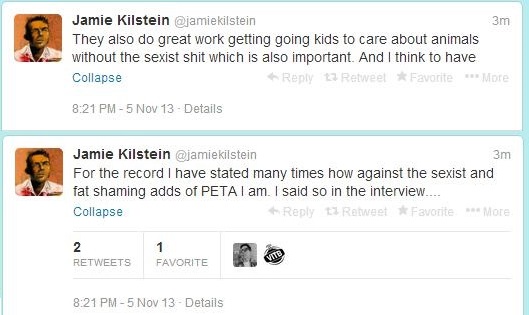
Kilstein then reminded readers that he’s discussed PETA’s sexism and fat-shaming on the show.  For that matter, PETA has done awesome things for the kids.  His dismissive and aggressive reaction insinuates that women who continue to have a problem with his position are demonstrating ignorance and simply don’t understand the wonderful things PETA has done.

Kilstein-21

PETA promotes violence against women and girls by regularly using pornified images of women and girls to represent either violence against women and girls or violence against animals. How many episodes of his show do we have to listen to before we understand that supporting PETA is consistent with feminism?  How many episodes until we find his behavior towards women acceptable?

Kilstein 4

This is not the first time I’ve gotten an uneasy feeling about Kilstein.  He once posted that he found men’s rights advocates (a hate group) “funny.”  I replied saying that, as a woman,  I didn’t find them very funny at all, but rather quite terrifying. He responded with condescension, gas lighting, and mocking.  Like the woman above, and he also told me that I must not listen to his show. Again, he positions feminist criticisms as a matter of ignorance or irrationality.

This man has made a career from feminism, but he approaches honest feminist criticism of his decidedly anti-feminist behavior with abuse and aggression.  This behavior is what is referred to as tokenizing. Tokenizing is when men use women’s experiences for their own personal gain while simultaneously doing little to challenge gender oppression.  Kilstein makes fun of sexism in his stand-up, then signs on to Twitter after the show and berates women who find it problematic that he collaborates with organizations that routinely hurt women.

When men self-identify as feminists, this is generally the result. Too often, they have little understanding about women’s experiences, and, sometimes, are the very perpetrators women are seeking to escape. Self-identified male feminists generally use this feminist identity to shield their sexist behavior (and there is also a frightening trend in men using feminism to sexually harass and assault women). Read more on why I argue that men cannot be feminist here and how men can be better allies here.


Corey Lee WrennMs. Wrenn is the founder of Vegan Feminist Network and also operates The Academic Abolitionist Vegan. She is a Lecturer of Sociology with Monmouth University, a part-time Instructor of Sociology and Ph.D. candidate with Colorado State University, council member with the Animals & Society Section of the American Sociological Association, and an advisory board member with the International Network for Social Studies on Vegetarianism and Veganism with the University of Vienna. She was awarded the 2016 Exemplary Diversity Scholar by the University of Michigan’s National Center for Institutional Diversity. She is the author of A Rational Approach to Animal Rights: Extensions in Abolitionist Theory (2015, Palgrave Macmillan).

Male Entitlement, Meat, and Sports

Not long ago, the Vegan Feminist Agitator published a piece on rape, meat,1 and “taking what is not ours.”  Marla writes:

In both rape and our role in oppressing animals, both can be framed as a birthright (“They were born for me to use as I wish,”) and as what is one’s due (“I spent money and this is what is owed me,”) and also presented in a way that completely belittles the experience of the victim (“Come on, don’t be so melodramatic; it wasn’t that bad.”). Only a sadistic psychopath would use such terms to justify violating another person, but we accept those terms without question on a daily basis involving the animals we consume. Underpinning both rape and eating animals, though, is the conceit that because we can do something, this confers the right to do it, no matter who is harmed or killed in the process.

Under patriarchy, that is, under male rule, feminized bodies (women, nonhuman animals, people of color, the environment, etc.) are understood to be resources.  Under patriarchy, the male ruling class is socialized to internalize their entitlement over their subjects.  Women exist to give sex, if they don’t give it, then it should be taken from them.  Animals exist to use and eat, we take that from them.  People of color exist as cheap or free labor, and that is also taken from them.  The environment is reframed as our “natural resources,” something to be freely taken.  In other words, the world is man’s oyster.  Notice even this phrase frames Nonhuman Animals and the environment as a birthright to men!

Remember in The Lion King when Mufasa explained to baby Simba that everything the light touches is theirs?  That’s kind of how male supremacy works.  It’s an unrestricted entitlement to everything, and it’s an entitlement that is taught.

Mufasa and Simba overlook their kingdom

This afternoon while I was working, football was playing on the television in the other room.  One of the commercials caught my attention.  I was hearing a man yelling at another man, “Are you a little baby boy, or are you a BIG STRONG MAN?”  Hearing this male-on-male gender policing is always disconcerting, but in the context of football, a hyper-masculinized activity, I was especially bothered.  Upon investigation, it turned out to be a commercial from Buffalo Wild Wings, a sports bar and restaurant chain that attracts groups of men who want to watch the game, gawk at young underpaid waitresses, and stuff themselves with the body part of chickens glazed with various sauces (BWW is really just a less sexist, less atrocious version of Hooters).  In this commercial, there was one piece of chicken body left, and the male subject was afraid to take it and offend his friends who were distracted and watching the game.  A football coach had sidled in and was belittling him for not living up to his masculine role.  The man reacts and stands up to reassert his masculinity.  He announces that he is a MAN and takes the piece of chicken.

Jackson Katz has written extensively on the dangers of male gender policing, that is, pushing men into tiny boxes that equate manhood with aggression, violence, and domination.  Not only do fathers, brothers, and other male peers take it upon themselves to teach and enforce “manhood” to other boys and men, but our media is constantly bombarding us with these norms (and the subsequent shame and other consequences associated with failing to uphold those norms).  Katz argues that masculinity (like all gender roles) is something that is taught.  It is not an innate, testosterone-driven tendency towards oppression (oppression is often naturalized, thus making it difficult to criticize).  Rather, it is a socially supported, systematic reinforcement of a male supremacist social rule.  Vulnerable groups are not only taught to submit, but privileged groups are taught to dominate.  Both are encouraged to view it as natural and normal, that is, if this largely invisible power structure is ever jostled into view in the first place.

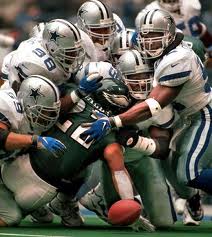
Football Violent

In the BWW commercial, the coach firmly reminds the male subject, “You know that one’s yours, right?”  He asks if he is just a slow eater or if he is “not man enough to claim what’s rightfully yours?”  This is sending a very clear message to male viewers:  You are entitled, so if you don’t get what is rightfully yours, then be a man and take it.  As men come together to celebrate the highly competitive and violent American football games (with grossly underpaid cheerleaders in bikinis with pompoms happily bouncing around for their enjoyment), the game and the commercials remind them that manhood is defined by fighting for one’s entitlement to absolute ownership.  The chicken is yours, it is rightfully yours.

The preoccupation with meat in this context is not coincidental.  Carol Adams’2 theory on the sexual politics of meat suggests that Nonhuman Animals, a highly feminized group, are fetishized as the ultimate “man food.”  Men kill, grill, and stuff themselves with corpses with great celebration.  It is the taking of something (once a someone, someone who was quite unwilling, though often portrayed as very willing indeed) that gives them pleasure.  Male domination is seen as an entitlement, as something enjoyable and natural. A bonding experience.  Maria Veri and Rita Liberti tackle the sexual politics of meat in the sport wellspring of male supremacy in their 2013 publication “Tailgate Warriors: Exploring Constructions of Masculinity, Food, and Football.”  They write:  “[ . . . ] the mediated pairing of food and football in TWs [a football cooking show] action on the blacktop reinforces hegemonic masculinity as it displaces and marginalizes women and femininity” (242).  Meat, they suggest, is a symbol of this male supremacy and women are largely excluded from sports-related meat rituals (like cook-offs and tailgating).

Stacked plates of cooked chicken wings

In all the hoopla over male greatness embodied in plates of dead chickens, pornified women, football games, beer, and yelling, the voices of the tortured dead are conspicuously silent.  No one hears the hen and no one sees the hen.  She is invisible.  According to Carol Adams, she is an absent referent.  We know we are eating something of course, but we are completely oblivious to the someone she once was.  And who cares anyway?  “It’s” rightfully yours, isn’t “it”?

Sickly looking chickens in a factory farm setting

Notes

1.  It is important to note that “meat” is a euphemism for animal flesh.

2.  See our recommended reading section to learn more about Adams’ theory.


Corey Lee WrennDr. Wrenn is Lecturer of Sociology. She received her Ph.D. in Sociology with Colorado State University in 2016. She received her M.S. in Sociology in 2008 and her B.A. in Political Science in 2005, both from Virginia Tech. She was awarded Exemplary Diversity Scholar, 2016 by the University of Michigan’s National Center for Institutional Diversity. She served as council member with the American Sociological Association’s Animals & Society section (2013-2016) and was elected Chair in 2018. She serves as Book Review Editor to Society & Animals and is a member of the Research Advisory Council of The Vegan Society. She has contributed to the Human-Animal Studies Images and Cinema blogs for the Animals and Society Institute and has been published in several peer-reviewed academic journals including the Journal of Gender Studies, Environmental Values, Feminist Media Studies, Disability & Society, Food, Culture & Society, and Society & Animals. In July 2013, she founded the Vegan Feminist Network, an academic-activist project engaging intersectional social justice praxis. She is the author of A Rational Approach to Animal Rights: Extensions in Abolitionist Theory (Palgrave MacMillan 2016).

Receive research updates straight to your inbox by subscribing to my newsletter.

The Sexual Politics of Halloween Meat

Halloween has earned a nasty reputation for perpetuating oppression.  Women are encouraged to wear “slutty” costumes that leave little to the imagination and also leave women to freeze in the late October weather (for Northern Hemisphere folk), generally for the enjoyment of men.  Caricatures of Native Americans, disabled people, people of size, Mexicans, Chinese, Japanese, Indian, Arabs, etc. all become fair game for costumes.  In other words, Halloween has become a celebration of white male Western dominance, and anyone who has a problem with that “can’t take a joke.”

Gender, class, ability, size, and race all intersect in the multitude of horrendous, problematic costumes, so we should not be surprised to find the same for species.  There are countless costumes that degrade other animals.  One of the most horrific is a strap-on sheep that is made to appear as though she is being raped by a stereotypical “hillbilly” (a derogatory caricature of Appalachian peoples).

Man in red long johns with hat and full beard wears a toy sheep attached to his groinThere are many variations of this costume for men.  But, for women?

Woman dressed in small tight fitting black dress with sheep's earsNotice how the male version, while horribly classist, still demonstrates male superiority over the feminine.  The female version demonstrates female vulnerability/animal vulnerability.  In both cases, the “sheep” is feminized and portrayed as a male sexual resource.  See also American Apparel’s “zookeeper and animals” costumes.

There are several costumes that also juxtapose femininity with animality, sexual availability, and the desire to be consumed.  Check out sexy bacon, sexy pepperoni pizza, and sexy hamburger and hot dog:

Woman in tight fitting mini dress patterned like bacon

Woman in tight fitting mini dress patterned like pepperoni pizza

Two women in tight fitting mini dresses, one patterned like a hamburger, the other like a hot dogThese are brilliant examples of Carol Adams’s sexual politics of meat theory:  Women are animalized, animals are feminized, and living persons become dead objects.  They become fragmented pieces of flesh for those in power to pleasurably consume.  These pieces of meat are made sexy.  They want you to eat them.

In researching this article, I actually came across several “sexy” women’s costumes that sexualized non-animal food items as well.  While sexy hamburgers and hot dogs are especially problematic because they intersect sexism and speciesism, I’m not convinced that sexy corn-on-the-cob, sexy chewing gum, or sexy watermelon is much of an improvement.

Woman in tight fitting mini dress patterned like watermelonSexualized food costumes for women reinforce the notion that women are resources to be consumed.  They are non-persons, they are objects, they are here at your disposal.  At least these costumes leave Nonhuman Animals out of it, but they’re still pretty darn  problematic.


Corey Lee WrennDr. Wrenn is Lecturer of Sociology. She received her Ph.D. in Sociology with Colorado State University in 2016. She received her M.S. in Sociology in 2008 and her B.A. in Political Science in 2005, both from Virginia Tech. She was awarded Exemplary Diversity Scholar, 2016 by the University of Michigan’s National Center for Institutional Diversity. She served as council member with the American Sociological Association’s Animals & Society section (2013-2016) and was elected Chair in 2018. She serves as Book Review Editor to Society & Animals and has contributed to the Human-Animal Studies Images and Cinema blogs for the Animals and Society Institute. She has been published in several peer-reviewed academic journals including the Journal of Gender Studies, Feminist Media Studies, Disability & Society, Food, Culture & Society, and Society & Animals. In July 2013, she founded the Vegan Feminist Network, an academic-activist project engaging intersectional social justice praxis. She is the author of A Rational Approach to Animal Rights: Extensions in Abolitionist Theory (Palgrave MacMillan 2016).

Receive research updates straight to your inbox by subscribing to my newsletter.

Veganism is Not “Food Ethics”: Veganism is about Social Justice

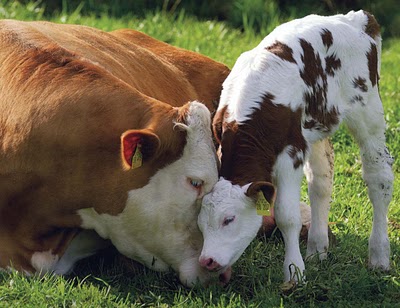
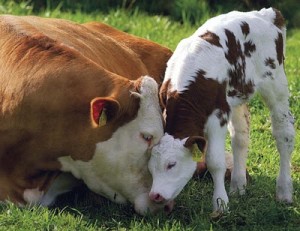
Mother cow and calf nuzzling

I was beyond disappointed after reading Olivia’s (from Skepchick) recent post and the discussion that followed in the comments section concerning veganism. First of all, there was absolutely no serious conversation about the connections between atheism and veganism. I am always at a complete loss to explain the lack of interest in veganism in atheist spaces. Atheists appear to be critical as long as they remain within the tiny sliver of conversation surrounding God-beliefs but lose all capacity for this critical thinking when it comes to narratives that those God-beliefs underpin. I would argue that the consumption narrative, with respect to animals, is one such narrative. Second, and the subject on which I will comment today, the conversation was carried out in an overly simplistic manner, which has been a depressing trend lately, even among other vegans.  As usual, this overly simplistic treatment of veganism was derived from the assumption that veganism is individually based ethical action rather than a proper social justice position and movement founded on particular ethical beliefs.  Key features of this myopic construal of veganism are:

(a)   At its root, veganism is an ethical matter grounded in the individual.

(b)   Veganism is an unattainable ideal. It is a guide rather than a realizable goal.

(c)   Veganism is a food practice, a food ethic, and/or a diet.

(d)   The bulk of veganism is to try “the best one can”.

(e)   Veganism naturally entails moments of “guilt” because one cannot be a “perfect vegan”.

(f)    Veganism is a practice conceptually isolated from other social justice practices.

Throughout her post, Olivia consistently referred to veganism as “food ethics” or a “diet” (c) and the rest of (a) through (f) can be seen in just one passage:

“We can see that not every abstract ethical conclusion demands perfect compliance because our own well-being should be part of our ethical calculations. Each of us has a finite amount of time, money, and energy, and we have to decide which arenas to focus those resources in. There are an amazing number of things we could do to improve ourselves and our communities, and we simply cannot do all of them. If changing our diet deeply depletes our resources, it may hurt us, or leave us anxious, angry, unhappy, and incapable of acting ethically towards the people around us (as an example I know that I am a cranky bitch when I don’t get adequate protein). If one particular ethical choice leaves us without anymore energy or resources, it may not be the most effective way of improving the world.”

Let me address (a) through (f).

(a) Veganism, at its root, is a social justice position grounded in the political collective.  This means that mass exploitation and torture of animals can be eradicated only with social and political restructuring. Notice that we demand social and political restructuring also to address the plight of other oppressed groups . . . because to be anti-racism, anti-sexism, anti-homophobia, etc is to take a social justice position. These are not individual ethical stances (although they are founded on ethical concerns and ethical implications do follow). There is no talk of “do you!” when it comes to social justice positions because to take a social justice position is to make some sort of claim about rights. Rights are a universal notion, not a “do you!” notion.

Not only is veganism a social justice position but also it is one grounded in a critical stance. It is a position funded by the critique of our inherited consumption narrative with respect to animals.  We take issue with the assumption that animals must belong in the consumption narrative and we hold that it is partly because of this flawed assumption that animals remain without rights. If animals are simply beings for us to consume and use, whether as food, clothing, entertainment, research subjects, etc, then it is contradictory to also hold that they are beings deserving of protection from violation.  As long as we assume that animals belong in the consumption narrative, they will never be granted rights. (Refer to my past post to read why I believe animal rights are the proper end goal for vegansim).

(b) Achieving vegan goals is certainly a realizable project. The only obstacle in the way of seeing this is the tendency to misconstrue veganism as an individually based ethical project! Obviously, ethical efforts made by isolated individuals cannot possibly dismantle the myth about animals’ place in the current consumption narrative. The consumption narrative is a systemic story complete with, economic, cultural and political forces; thus, if we are going to find a good strategy to tackle the problem, it will have to be at the systemic level. The abolition of chattel slavery was not the mere sum of individually based ethical projects. Rather, it was the result of calls for social and political restructuring. Abolition would have certainly been an unattainable ideal had abolitionists failed to see that the root of this oppressive tradition was based in a narrative systemically sustained. In other words, our great social injustices do not exist simply because there are “bad” people who are not willing to strive for abstract, unrealizable ideals. Great social injustices exist because structures are built and kept in place that function to perpetuate those very injustices. These structures are the very things giving rise to the illusion that ridding ourselves of particular social injustices are “abstract” ideals devoid of reality or mere phantoms of optimism that human nature can never accommodate.

(c) Veganism is not merely a food practice or food ethics or a diet. This is not to say that food practices are not social justice issues. They certainly are and deserve more attention. However, veganism is a social justice position with the aim of securing animals rights and, as such, is not exhausted by what we eat or wear. It grates me to even hear the phrases “veganism”, “food practice” and “food ethics” in the same sentence. If, as I’ve argued, vegans properly come to the social justice position by critiquing the assumption that animals must belong to the consumption narrative, then it follows that vegans do not conceptually regard animals as food. Calling veganism a “food ethic” or a “diet” or “food practice” is a lazy misnomer.

(d&e) Feeling guilty only makes sense when viewing veganism myopically as an individually based ethical project. I will have to support this claim by way of an example. One of my favorite films unfortunately has one short scene with needless misogynistic crap. When the dreaded scene approaches, I -as a staunch feminist- do not feel guilty. Rather, I feel frustrated and -at most (and at worst)- powerless as an individual. As a vegan, I am aware that I cannot currently live a life free from animal exploitation. As mentioned above, our society has systematized and institutionalized human dependence on animals and animal exploitation and torture. When I learn that my wall contains (most likely) exploited animal product, it seems inappropriate to feel guilt. I am not culpable in this matter. Rather, I feel frustrated at how pervasive the problem is and -at most (and at worst)- powerless. The feeling of powerlessness ebbs away after a while and the frustration that remains reminds me where the proper site is for my activism: at the systemic level. Momentary realizations of powerlessness, which is naturally grounded in individual powerlessness, and frustration are productive emotions because they indicate that the problem transcends the individual. Guilt is not productive because it indicates that the problem stems from the individual.
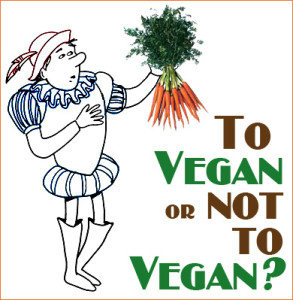
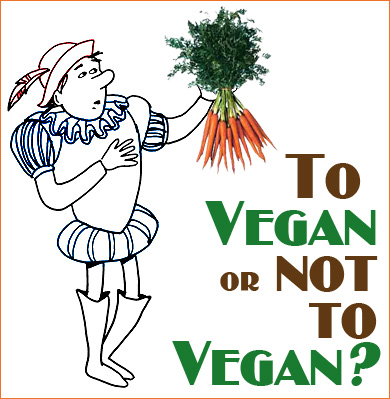
Shakespeare character holding a bunch of carrots asks, "To vegan or not to vegan?"

Some might object that I have given little to no attention to feeling guilty when it comes to “slip ups” or being “lax” in certain company or to those in dire situations who -regardless of social justice positions- must rely on animals for food and clothing. Regarding the first: as I’ve already stated, I think veganism is properly understood as a critique of the consumption narrative and animals’ place in it, which means that animals no longer conceptually qualify as “food” and that it is a social justice position, which means a vegan actually thinks animals are rights-deserving subjects. I think adopting the critical stance makes impossible “slip ups” or “laxity”. I (controversially) believe the “slip up” and “laxity” phenomena have a lot to do with adopting the individual-ethical-stance, which rely on vague notions of moral statuses and “cruelty” and does not do much to conceptually or critically alter the person.

I (again controversially) don’t consider situations that involve dire straits to be of any immediate concern to vegans. As vegans, we should be concerned with the consumption narrative; we are concerned with the story we as a society tell about animals and how they fit into our consumption routines. When people are eating or using animals for basic survival, they are not interested in creating a consumption narrative that gives animals the short end of the stick because of some perceived privilege. They do not have the power to institutionalize these notions. They are simply trying to stay alive. Professor Will Kymlicka refers to such a situation as residing outside of the “circumstances of justices”.  This is a different issue than what vegans should take issue with. (Similarly, when you spray an insect in your kitchen with roach spray, subsequently killing it, this is a different issue than what vegans should be taking issue with.  Such isolated incidences have nothing to do with maintaining the current consumption narrative in the same way that spraying an intruder’s face with the same roach spray has nothing to do with current human rights violations.)

(e) Veganism is not a social justice issue isolated from other social justice issues. Above Olivia states, “Each of us has a finite amount of time, money, and energy, and we have to decide which arenas to focus those resources in.” Such a view is rampant among both vegans and non-vegans. According to this “single-issue” mindset, activisms are structured to address one issue and it addresses this issue as being fundamentally independent of and different from other issues. As a result, we have to prioritize issues. The single-issue approach obscures the reality of how racism, sexism, classism, ableism, homophobia, speciesism, ecocide, etc are all not only connected but dependent on one another to form what I call a ‘pernicious holism’. If one sees this reality, the single-issue approach appears completely incoherent. If all of the issues we wish to fight against are enmeshed in a deep, interconnected web, then it makes absolutely no sense to structure your activism as if they are not connected and interdependent. Isolating one issue from the web is to misjudge the root and depth of the problem, in which case any further activism from this isolation is futile. Most times, single-issue approaches are espoused simply due to lack of diversity. It can be difficult to spot how particular issues are connected if you lack the relevant experiences.

For instance, feminist movements have historically focused solely on the gender aspect of their struggle simply because their members and the women they targeted and spoke for were all white women of a particular class.  Until recently, it never occurred to mainstream feminist organizations that race and class are social forces that shape gender. This illumination was afforded by the voices of women of color and women from lower socioeconomic rungs.  Although vegan organizations like to draw upon the likeness of human and animal exploitation, rarely do they take it to the next logical step to conclude that these likenesses have something to do with the same structure underpinning these exploitations. The anatomy of this structure on which all exploitations hinge is the pernicious holism that exists among all of the regressive –isms. To make a commitment in the right way to veganism, then, is not to take away time, money and energy from other valuable commitments. Making a commitment to veganism is just to make a commitment to attack the underlying structure of speciesism, which is structurally embedded with all of the other regressive –isms.

As I’ve mentioned elsewhere, this is not to say that vegan activism is feminism is anti-racist activism, etc. However, to take on the force that shapes animal exploitation requires also taking on the social forces that shape and intersect with that force. Gender, race, class, ability, sexual orientation, and other forces are so wrapped up in animality that tackling animality and how it undergirds speciesism requires taking into account gender, class, race, ability, sexual orientation, etc. This is the multi-issue approach or as it’s sometimes referred to as “intersectional activism”. For a good demonstration of this approach, consider this point Dr. Breeze Harper makes when she argues that there is something inconsistent about calling vegan products “cruelty-free” when they are made by child slaves!

Conclusion. The take away from all of this is that viewing veganism from the individual perspective as a practice that exhausts itself in personal ethics is diametrically opposed to the aim of veganism, which is to eradicate the myth that animals belong in the consumption narrative. Since legal protections are the only things that could meaningfully prevent the exploitation of vulnerable beings and since rights-language is the only language that can ensure formal vulnerability and violability of beings, our task as vegans is to secure animals rights if we are to meet our aim.  The ethical implications which follow from this view do just that: they follow the critical stance that give rise to our social justice position and subsequently fix our practices. We need to insist that we are involved first and foremost in the business of social justice. Morality talk merely tells us something about us- about our character, about whether we are good or bad. Rights-talk tells us something about animals– about what they deserve and what they still don’t have.

By Syl 

Vegan Porn is a Barrier to Egalitarianism

A new study in Psychology of Women Quarterly, reports that people who admitted to watching pornography were less likely to support affirmative action for women in a subsequent interview.  Why?

“[ . . . ] sexual media activate abstract social scripts, which may then be used to inform opinions about social issues.”

“Pornography often presents women as sexual objects deserving of degradation, and even aggression.”

“In alignment with these depictions, prior studies have found that pornography viewers are more likely to hold a variety of antisocial attitudes towards women.”

Countless studies similar to this one have supported the link between exposure to pornography and a rejection of egalitarian values.

So, my question is: Why does the Nonhuman Animal rights movement (PETA, James McWilliams, CUFA, 269Life, VOKRA, VGirls|VGuys, Animal Liberation Victoria, Vegan Pinup, LUSH, etc.) use porn?  How can “sex sell” Nonhuman Animal rights if it fosters anti-egalitarian attitudes?  If pornography fosters female objectification and degradation and aggression against women, why would we expect that reaction to magically transform to respect for other animals?  And do we not have a duty to protect the safety and dignity of the women who compromise 80% of our movement?  How can we build a strong collective if we’re giving the green light to antisocial attitudes against our largest demographic?

This post was originally published on  The Academic Abolitionist Vegan on September 16, 2013.


Corey Lee WrennDr. Wrenn is Lecturer of Sociology. She received her Ph.D. in Sociology with Colorado State University in 2016. She received her M.S. in Sociology in 2008 and her B.A. in Political Science in 2005, both from Virginia Tech. She was awarded Exemplary Diversity Scholar, 2016 by the University of Michigan’s National Center for Institutional Diversity. She served as council member with the American Sociological Association’s Animals & Society section (2013-2016) and was elected Chair in 2018. She serves as Book Review Editor to Society & Animals and has contributed to the Human-Animal Studies Images and Cinema blogs for the Animals and Society Institute. She has been published in several peer-reviewed academic journals including the Journal of Gender Studies, Feminist Media Studies, Disability & Society, Food, Culture & Society, and Society & Animals. In July 2013, she founded the Vegan Feminist Network, an academic-activist project engaging intersectional social justice praxis. She is the author of A Rational Approach to Animal Rights: Extensions in Abolitionist Theory (Palgrave MacMillan 2016).
Receive research updates straight to your inbox by subscribing to my newsletter.