“Sexism is Nuts” says company that enslaves animals, children, and uses disableism in slogans

Feminists were in a fury over a new Australian Snickers ad that makes a mockery of street harassment and gender equality. For some time now, Snickers’ commercials have been based on people acting really strange or belligerent because they are hungry.  Once fed a Snickers bar, they are satiated and return to normal. In this Australian commercial, construction workers are acting out of sorts from hunger. We know this because they are yelling egalitarian slogans at female passerby that sound straight from the mouth of feminist Ryan Gosling.

Hey Girl: Gender is a social construct but everyone likes to cuddle

Feminist men: It’s funny because it would supposedly never happen.

In the commercial, we see that most women are afraid at first (and this is supposed to be funny), because we have been conditioned our entire lives to expect and to fear strange men yelling at us. However, the women in the commercial appear to be pleased and amused when they realize they are hearing pro-feminist calls.  Lisa Wade at Sociological Images describes the cruelty of playing on these gender scripts:

And then the commercial ends and it’s all yanked back in the most disgusting way. It ends by claiming that pro-feminist men are clearly unnatural. Men don’t respect women — at least, not this kind of man — they’re just so hungry they can’t think straight.

Wade finishes her piece by declaring that she would never be buying Snickers again. But I’d like to know what feminist would be eating them in the first place.

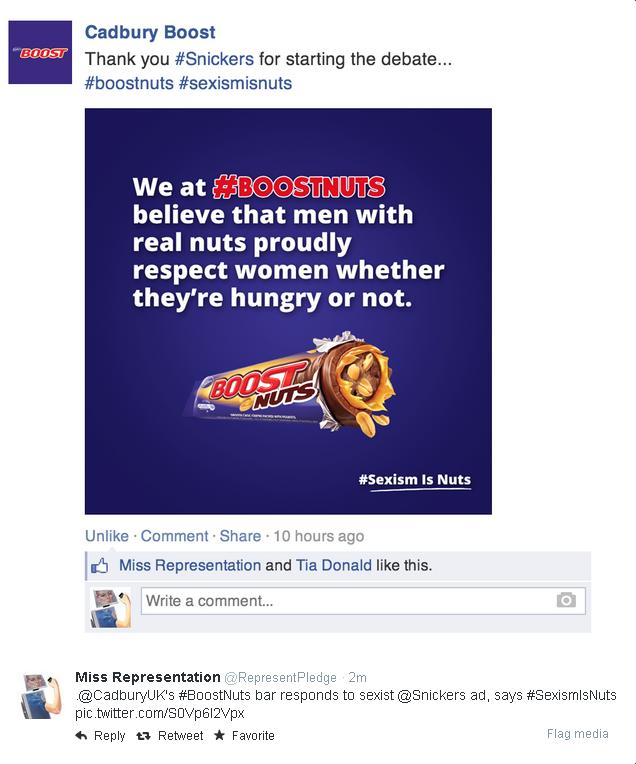
Today Cadbury jumped on the bandwagon with an ad for their Boost bars that reads: “We at #BOOSTNUTS believe that men with real nuts proudly respect women whether they’re hungry or not. #Sexism is Nuts.”  Then MissRepresentation retweeted it.  Now I’m really confused.
Cadbury Slaves Vegan Feminism

So far as I am aware, both Mars (who makes Snickers) and Cadbury source their chocolate from child slaves in Africa.  Their chocolate also contains dairy products from enslaved and tortured cows who are eventually killed.  Cadbury suppliers rip the newborns from their mothers, throw them in the back of a corpse-laden truck, and blast them in the face before feeding them to dogs.  The calf pictured managed to survive a bullet to the head and struggled his way across the bodies of his family members to the corner before he was finished off.  Additionally, Mars has been testing their products on animals for years–so they can tout the healthy properties of their chocolate.  It appears Cadbury was purchased by Kraft Foods, which likely conducts animal testing as well.  So, really, as a feminist against the oppression of others, I would never, ever purchase from Mars or Cadbury, and I’m really quite disgusted that large feminist collectives would promote either.

Cadbury Calves

Male calves are considered “by products” of the dairy industry and meet brutal deaths. Cadbury was under fire for shooting calves in the head. Though this image is disturbing, this calf’s torture and death is considerably less brutal than that of most male calves (who enter the veal industry).

These are capitalist enterprises–sexist or not sexist–they are out to profit by exploiting the vulnerable. Nice try Cadbury, but aside from being a slave industry, you also managed to maintain cis-normativity in presuming real men must possess “real nuts.” And using “nuts” as a pejorative is also disableist! “Sexism is nuts” reads like “People who are sexist are bad people, just like mentally ill people.”  Fair-traded vegan chocolate for me, please.

Veganism, Vulnerable Women, and Organ Trafficking

In the Winter 2014 issue of Contexts, a magazine published by the American Sociological Association, Anne T. Gallagher reports that trafficking for organ removal is on the rise:

Trafficking of persons for organ removal is not an urban myth, but an increasingly common means by which the global shortage in organs is being met. Recipients are generally independently wealthy or are supported by their governments or private insurance companies. Victims are inevitably poor and from poorer countries, often unemployed and with low educational levels, which makes them vulnerable to deception about the nature of the transplant procedure and its potential impacts.

She furthers that many are forced to comply, are bribed or manipulated, and threatened into silence. Many become dangerously ill or die from complications from hastily performed procedures and inadequate (or absent) follow up care. Some are simply left to die with no intention of them surviving. Compensation promised is rarely paid in full, and is generally a tiny fraction of the promised price. Debt bondage or extortion often pressure individuals to “donate.” In many cases, organs are outright stolen.

Both men and women are victims of organ trafficking, but women tend to be especially vulnerable, as victims come from areas where women are still considered second-class citizens or property. Women are also more likely to be illiterate and have fewer opportunities and resources at hand. Sex trafficked women, not surprisingly, are especially vulnerable to organ trafficking as well. Just like other animals, women’s bodies are literally fragmented, butchered, bought and sold, and consumed by those with more power. Both women and other animals exist as (temporarily) living resources waiting to be harvested.

Veganism Diabetes Kidney Failure

Not surprisingly, this horrific industry is rooted in patriarchy. As diet-related diseases increase as a result of our growing consumption of other animals, the demand for organ transplants rises. Kidneys are one of the top organs in demand, and the primary reason for transplant is diabetes. Diabetes is one of many diseases directly related to a non-vegan diet. The masculinization of meat and the association of animal foods with wealth fuels this irrational demand.  Traditional plant-based (and feminized) diets become devalued and are quickly disappearing as Westernization spreads. Patriarchy not only influences the deterioration, but also the access to solutions. Not everyone enjoys equal access to a transplant. It is generally those in wealthier Western nations and usually men with this privilege.

In a previous essay, I discussed the ethical considerations behind organ donation as a vegan. I do not think it is appropriate to punish individuals who are suffering for systemic problems rooted in Western imperialism, patriarchy, and speciesism. I believe everyone should register as an organ donor, not only for the interests of the individuals in need, but also those animals (used as “donors” and in vivisection) and vulnerable humans who might be spared exploitation and death.

Kidney Scar

But it should not end there. Veganism is an ethical imperative for deconstructing these systems of oppression. While Westerners poison their organs with the death of Nonhuman Animals, poor women in India, Africa, and Asia suffer and die to replenish the bodies of the global rich. Of course, their poverty is also intimately linked with the West’s resource-intensive need to extort massive amounts of grain and water to funnel into livestock. The resulting pollution from this animal-industrial complex further weakens third world regions struggling to survive under the weight of colonialist and capitalist oppression. The consumption of other animals entails widespread global violence against all vulnerable groups for the pleasure, convenience, and privilege of a small few. Sadly, organ trafficking is but one of many cruel injustices bound to gross power imbalances. Anti-capitalist vegan feminism must be at the root of our activism. We must take an intersectional approach if we are to have any hope at success.


Corey Lee WrennDr. Wrenn is Lecturer of Sociology and past Director of Gender Studies (2016-2018) with Monmouth University. She received her Ph.D. in Sociology with Colorado State University in 2016. She received her M.S. in Sociology in 2008 and her B.A. in Political Science in 2005, both from Virginia Tech. She was awarded Exemplary Diversity Scholar, 2016 by the University of Michigan’s National Center for Institutional Diversity. She served as council member with the American Sociological Association’s Animals & Society section (2013-2016) and was elected Chair in 2018. She serves as Book Review Editor to Society & Animals and has contributed to the Human-Animal Studies Images and Cinema blogs for the Animals and Society Institute. She has been published in several peer-reviewed academic journals including the Journal of Gender Studies, Feminist Media Studies, Disability & Society, Food, Culture & Society, and Society & Animals. In July 2013, she founded the Vegan Feminist Network, an academic-activist project engaging intersectional social justice praxis. She is the author of A Rational Approach to Animal Rights: Extensions in Abolitionist Theory (Palgrave MacMillan 2016).

Receive research updates straight to your inbox by subscribing to my newsletter.

Vegan Feminist Conferences and Sacrifice

Although Vegan Feminist Network initially worked as co-host for this conference, we stepped down from the task in January due to some discomfort with the way the conference was being organized and were subsequently dropped as speakers. We are excited that so many advocates supported the event, but we are concerned about a few shortcomings.

We did not attend the conference, but did receive some interesting feedback that one attendee has offered us to present here (she prefers to remain anonymous). The presenter who discussed “sacrifice” was speaking to maintaining traditions within the context of colonization. We recommend checking out the work of Margaret Robinson, who offers an important counter-argument to this position.

Sacrifice Cows

Vegetarianism entails large-scale institutionalized violence against billions of other animals. Furthermore, these animals are not able to consent to their exploitation, rape, and murder as they are victims of systemic oppression.

So, I saw the last few hours of the Neither Man Nor Beast: Patriarchy, Speciesism and Deconstructing Oppressions. All lectures focused on the interesectionality between veganism and feminism; and how misogyny in the vegan community and speciesism in the feminist community work against each other and themselves. I’ve been excited about attending, and was definitely impressed.

Although I found many of the speakers intelligent and insightful, I was disappointed by the words “veganism” and “vegetarianism” often being used interchangeably. In fact, one speaker used the word “vegetarianism” more than “veganism”. She seemed to identify as vegetarian rather than vegan. Given that this discussion is about intersectionality, I found this a bit difficult to overlook.

In my opinion, vegetarianism is a form of carnism and is nothing to do with animal rights. Let alone its connection to women’s/female issues. I do not think vegetarianism should be promoted in such a sphere as a vegan feminist discourse. When deconstructing nonspeciesist ethicism and feminism, it is imperative we not promote an industry which functions by raping, torturing, and breeding animals for psychopathic justifications. Given that the word “vegetarian” implies a level of animal exploitation, I would have preferred if it wasn’t represented.

There was also a carnist speaker who claimed to have an animal spirit, and that animals can consent to being scarified. As a survivor, I was triggered by this “entitlement” mentality. The very notion of some animals “consenting” to be sacrificed reminded me of the claim that some women “ask for it”.

How is this speaker relevant to animal rights and feminism? Why did ALO feel this person was appropriate to academic lectures? Veganism is about eliminating violent, archaic traditions. Not condoning or upholding such violence. I feel there are ways to talk about sensitivity to other cultures, without appeals to animal oppression.

However, there were some concepts I hadn’t yet considered and was exposed to various cultures I wouldn’t otherwise know. Although I fear this conference may have set a precedence I personally cannot condone, it was encouraging to see so many people interested in the concept of intersectionality. I hope they upload the lectures to YouTube so that others have access to these important talks. I asked the MOD, twice, but wasn’t obliged a response.

As Long As It’s Vegan? Single-Issues, Silos, and Social Justice

Not Safe for work:  Contains semi-revealing images of nude woman.

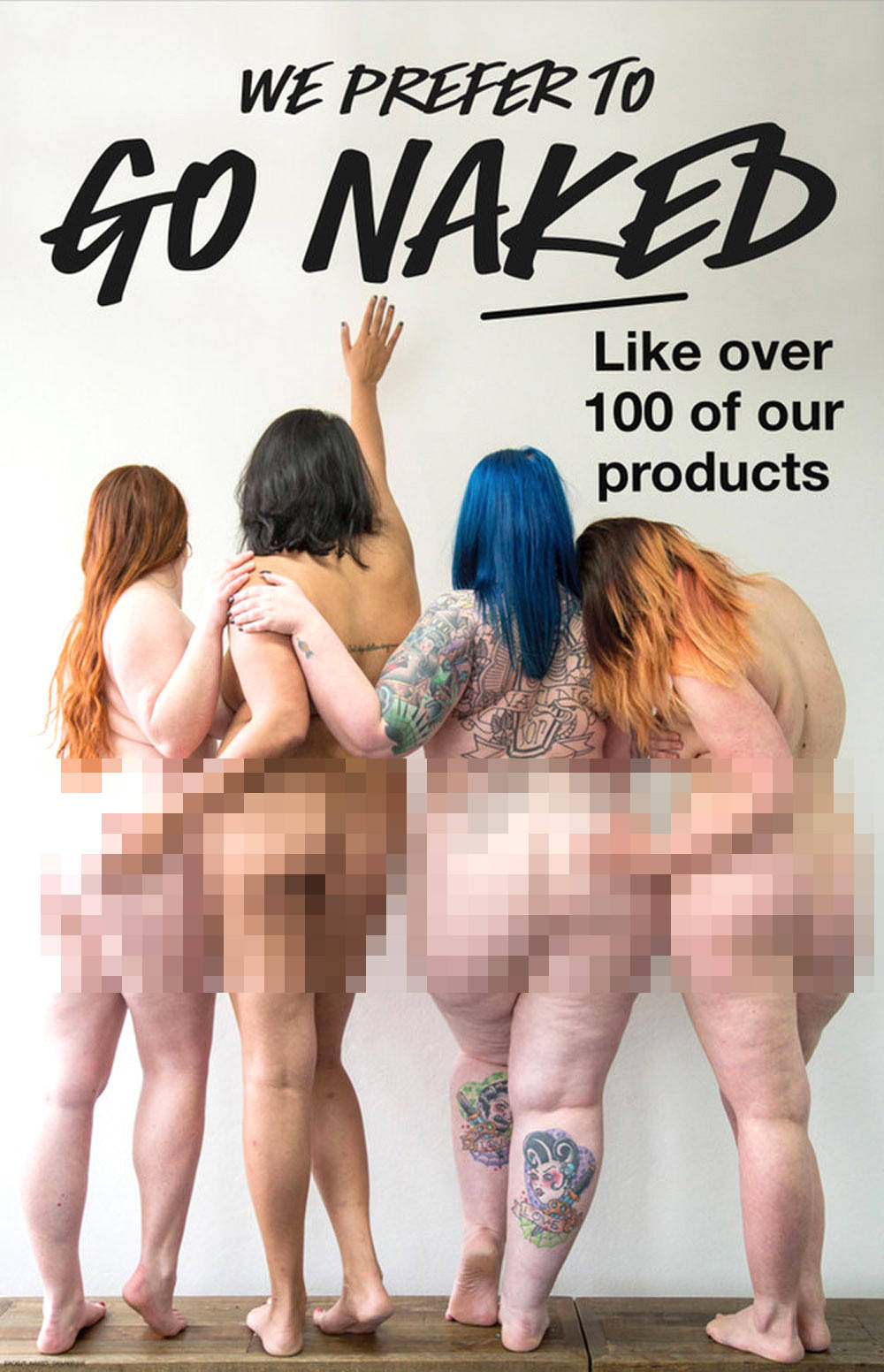
LUSH "Go Naked" ad featuring four women standing naked, exposing their bottoms. Reads, "We prefer to go naked, like over 100 of our products"
LUSH Cosmetics advertisement

Single-issue campaigning and social movement siloing are toxic for social justice. Despite the veganism’s collective identity as a movement for love and compassion, it has a remarkable tendency to dismiss human injustices under the banner of “nonhumans first.” The “as long as it’s vegan” ideology has been used to protect nazism, rape, racism, and other manifestations of bigotry in the Nonhuman Animal rights movement, stifling critical thought and eliminating any chance for coalition-building.

What makes this ideology so insidious is that its adherents often believe themselves to be a compassionate activist committed to Nonhuman Animals at any cost. While this is, of course, admirable, it is also a self-concept which inhibits self-reflection. Because the movement is white-centric and post-citizen (meaning that most vegan activists already have a number of essential rights and privileges established for themselves), it becomes very difficult for them to acknowledge how many humans still lack these rights.

Woman used in LUSH demo pictured with cords attached to her head, she is gagged and wearing a nude suit

In one of several misogynistic live action advertisements, LUSH hired a street performer in a nude bodysuit to enact gruesome scenes of vivisection for approximately 10 hours.

This is aggravated by segregation; when privileged groups do not have to interact with disenfranchised groups, it is easy for them to ignore or downplay the experiences of others. Membership in a white-centric, middle-class social movement only reinforces these walls of separation.

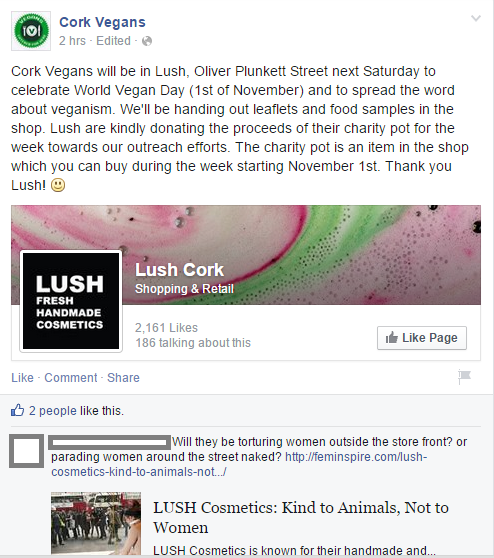
Consider, for instance, this Irish grassroots group’s promotion of LUSH Cosmetics products on World Vegan Day. LUSH is known to regularly engage misogynistic tactics to scare or shame women into buying its products.  It also mirrors People for the Ethical Treatment of Animals in prostituting women’s bodies to grab media attention and sell goods. The group announced that it would be leafleting outside the Cork LUSH store and accepting donations from LUSH for every “Charity Pot” lotion product that is purchased.

Please email for transcript of image

When confronted with LUSH’s misogynist business ethic, this local vegan community predictably employed a number of tropes to restore its positive self-image. First, it suggested that as long as individual women “choose” to participate, this supposedly absconds the organization that hosts the event as well as all involved parties from any responsibility for the negative consequences for women as a class.

Second, it is mistakenly argued that the inclusion of “men, too” would eliminate the misogyny of these tactics. But this falsely presumes that society is gender-neutral and that sexualized violent imagery of women would be interpreted equally with equal impact.

Third, for the purposes of this essay, this group also highlighted that the supposed animal-friendliness of the company trumped any misgivings about its misogyny. Nonhumans first.

As these deflections illustrate, there is a profound disconnect between the oppression of women and the oppression of other animals. The logic that normalizes the commodification and sexualization of violence against women is the same logic that normalizes the commodification and fetishization of violence against animals.

The vegan movement’s confusion over this intersection is all the more evident in its bizarre alliance with LUSH. LUSH is not a vegan company. It is a speciesist industry that profits from the the sale of Nonhuman Animals’ bodies, products, and labor. Bizarre though this relationship may be, it exemplifies how a movement culture that devalues intersectional awareness can undermine Nonhuman Animal interests. Putting “nonhumans first” may unwittingly be putting nonhumans last.

LUSH employee wearing nothing but an apron as part of an advertising campaign

LUSH often holds in-store promotions that feature its mostly female staff unclothed.

That activists appeal to the marketplace to support their single-issue focus is not surprising. I am of the persuasion that intersectional failure is intimately bound to capitalism and its intentional fanning of individualism and false consciousness. This ignorance is key for the perpetuation of an oppressive system. It undermines efforts for equality.

Any movement, faction, organization, or activist that fails to acknowledge the root cause of capitalism in manifesting inequality will never achieve its goals. By participating in capitalist enterprise, vegans only contribute to the humane-washing of an inherently violent economic system. For resource-starved grassroots groups, it is all too tempting to partner with speciesist industries who trade attention and platform for community approval and immunity from protest.

This trade-off is not a wise one. “As long as it’s vegan” does Nonhuman Animals no favors if it destroys the movement’s ability to be taken seriously as a social justice effort. Neither is it helpful if it normalizes frameworks of oppression, as these frameworks are not species-specific but universally dangerous.


Corey Lee WrennDr. Wrenn is Lecturer of Sociology. She received her Ph.D. in Sociology with Colorado State University in 2016. She received her M.S. in Sociology in 2008 and her B.A. in Political Science in 2005, both from Virginia Tech. She was awarded Exemplary Diversity Scholar, 2016 by the University of Michigan’s National Center for Institutional Diversity. She served as council member with the American Sociological Association’s Animals & Society section (2013-2016) and was elected Chair in 2018. She serves as Book Review Editor to Society & Animals and has contributed to the Human-Animal Studies Images and Cinema blogs for the Animals and Society Institute. She has been published in several peer-reviewed academic journals including the Journal of Gender Studies, Feminist Media Studies, Disability & Society, Food, Culture & Society, and Society & Animals. In July 2013, she founded the Vegan Feminist Network, an academic-activist project engaging intersectional social justice praxis. She is the author of A Rational Approach to Animal Rights: Extensions in Abolitionist Theory (Palgrave MacMillan 2016).

Receive research updates straight to your inbox by subscribing to my newsletter.

Speaking of Logical Fallacies…A Response

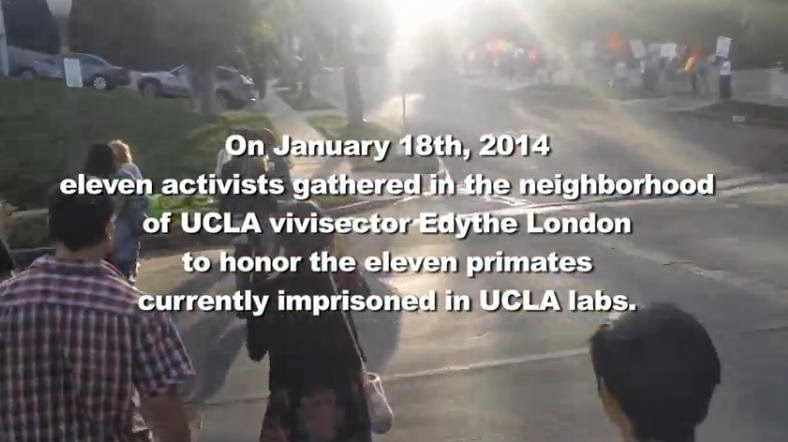
My buddy and colleague Cheryl Abbate recently commented on an activist demo which involved several folks stalking out (or “staking out” depending on your perspective) the private residence of a female vivisector.  Activists staged a silent vigil outside this woman’s home, and a bunch of counter-protesters were waiting to greet them. The animal advocates maintained their nonviolence, but were screamed at and spit upon.  Cheryl and others have been understandably shocked by the event, and because it was caught on camera, it offers an excellent opportunity for a little sociological analysis…

My first reaction to this event is to recognize that framing the animal advocates as “nonviolent” is not wholly accurate. These are people who have staked out a woman’s private home. That is in itself a violent action. Many vegan feminists, myself included, do not view this as a nonviolent tactic. Carol Adams has even recounted her own experience on the other side of a protest, as her home had been picketed once. It not only terrified her, but it terrified her children. You can read Marti Kheel’s analysis of “direct action” by clicking here.

Violent tactics only continue to give us a bad name and support our negative stereotype. Tom Regan has identified this negative stereotype as one of the  primary reasons why our movement has been stunted and fails to flourish (see Empty Cages). For that matter, this tactic represents your classic single-issue campaign. As I have argued before, single-issues are a waste of time and a waste of resources. They ignore the root of the problem, and they single out particular (popular) species at the expense of others. They also detract from vegan education. You can read more about this in an article I’ve recently published in Food, Culture & Society.

On the other hand, I recommend Cheryl’s essay on this bizarre interaction between activists and counter-activists. Sociologically speaking, it is interesting to see how the social problem is defined and how the power of patriarchy and science is used to dismiss anti-speciesist claimsmaking. Pay attention to how both sides frame the issue, and how both seek to capitalize on the perceived vulnerabilities of each. Jasper & Poulsen (1993) have published an article on this very topic: “Fighting Back:  Vulnerabilities, Blunders, and Countermobilization by the Targets in Three Animal Rights Campaigns.” They make the argument that blunders can be capitalized on to achieve success. The disgusting behavior of the vivisectionists and their supporters captured on film might easily be perceived as a blunder.

However, two caveats: 1. How are we defining success? I don’t think single-issue campaigns are strongly correlated with dismantling oppression (instead, they have more to do with fundraising and activist morale/ego); 2. We need to recognize the context of these interactions. We live in speciesist world. We also live in a world that has branded animal activists as terrorists. A bunch of strangers stalking out someone’s home is only going to be perceived as a threat, even if they are “silent.” If a bunch of “silent” people showed up at my home, I’d be dialing 911, I don’t care what their moral position is. It’s threatening.  Especially as a woman.  And the vivisector they were stalking was indeed a woman. Even male vivisectors who are targeted have families that activists should consider.

Neither can we ignore the white privilege inherent to these kinds of tactics. There is a reason most of these protesters are white. People of color are heavily harassed by the police: they are more likely to be reported, stopped, and arrested. Once arrested, they receive heavier penalties. In a society with a grossly racist criminal justice system, these tactics are inherently white-centric. So, when people parise these types of tactics, I read that as praise for white male approaches to social change. Using white maleness to fight white maleness, not surprisingly, isn’t getting us anywhere.

So, in sum, I think the activists have no reason whatsoever to be surprised at what happened to them. I also think tactics like this aggravate our bad reputation and squander resources. We have limited time, money, and personpower…we should be investing what little we have into vegan education…not stunts like these that are bound to backfire. These stunts are about two things 1. Fundraising and 2. Giving activists the feeling that they’re “doing something” for the animals…because, frankly, vegan education isn’t glamorous work, it’s feminized, and it won’t get you a bunch of Youtube hits.  But it’s the necessary foundational work that we must embrace if we want to enact change.

– Corey Lee Wrenn

This post originally appeared on the Academic Abolitionist Vegan. You can follow Ms. Wrenn on Facebook and Twitter.

The Sexual Politics of Vegan Food

Cover for "Crazy Sexy Diet"

Carol Adams has written extensively on the sexual politics of meat, arguing that women and other animals are both sexualized and commodified to facilitate their consumption (both figuratively and literally) by those in power. One result has been the feminization of veganism and vegetarianism.  This has the effect of delegitimizing, devaluing, and defanging veganism as a social movement.

But I argue that this process works within the vegan movement as well, with an open embracing of veganism as inherently feminized and sexualized.  This works to undermine a movement (that is comprised mostly of women) and repackage it for a patriarchal society.  Instead of strong, political collective of women, we have yet another demographic of sexually available individual women who exist for male consumption.

Take a browse through vegan cookbooks on Amazon, and the theme of “sexy veganism” that emerges is unmistakable.

Cover for "Ms. Cupcake:  The Naughtiest Vegan Cakes in Town!" Pictures a piece of cake with a tiny woman in a bikini sitting on top

Ms. Cupcake: The Naughtiest Vegan Cakes in Town!

Cover for "Skinny Bitch: Ultimate Everyday Cookbook" Shows author posing with food dishes

Cover for "Skinny Bitch in Love:  A Novel"

Oftentimes, veganism is presented as a means of achieving idealized body types.  These books are mostly geared to a female audience, as society values women primarily as sexual resources for men and women have internalized these gender norms.  Many of these books bank on the power of thin privilege, sizism, and stereotypes about female competition for male attention to shame women into purchasing.

Cover for "Become a Sexy Vegan Beast:  The Guide to Vegan Bodybuilding, Vegan Nutrition, and Body Fat Loss" Shows woman in a sports bra and shorts with hands on her hips looking behind her

Cover for "Skinny Bitch Fitness:  Boot Camp"

Cover for "Eat Yourselve Sexy", Shows a topless woman with her arms up and behind her head, looking seductively at the camera

Eat Yourself Sexy

Cover for "Appetite for Reduction" A vegan weight loss book. Shows an illustrated woman in vintage style

To reach a male audience, authors have to draw on a notion of “authentic masculinity” to make a highly feminized concept palatable to a patriarchal society where all that is feminine is scorned.  Some have referred to this trend as “heganism.”  The idea is to protect male superiority by unnecessarily gendering veganism into veganism for girls and veganism for boys.  For the boys, we have to appeal to “real” manhood.

Thankfully Meat Is For Pussies (A How-to Guide for Dudes Who Want to Get Fit, Kick Ass and Take Names) appears to be out of print.

Cover for "Skinny Bastard:  A Kick-in-the-Ass for Real Men Who Want to Stop Being Fat and Start Getting Buff"

Skinny Bastard: A Kick-in-the-Ass for Real Men Who Want to Stop Being Fat and Start Getting Buff

Cover for "Eating Veggies Like a Man"

Cover for "Real Men Eat Tofu"

Then there is the popular tactic of turning women into consumable objects in the exact same way that meat industries do.  Animal rights groups recruit “lettuce ladies” or “cabbage chicks” dressed as vegetables to interact with the public.  PETA routinely has nude women pose in and among vegetables to convey the idea that women are sexy food.  Vegan pinup sites and strip joints also feed into this notion.  Essentially, it is the co-optation and erosion of a women’s movement.  Instead of empowering women on behalf of animals, these approaches disempower women on behalf of men.

Image shows two white, tan women back to back wearing lettuce bikinis and opening their mouths wide to insert veggie dogs. Woman facing camera is wearing a Playboy necklace.

Alyssa Milano dressed in vegetables. Reads: "Let Vegetarianism Grow on You."


Corey Lee WrennDr. Wrenn is Lecturer of Sociology. She received her Ph.D. in Sociology with Colorado State University in 2016. She received her M.S. in Sociology in 2008 and her B.A. in Political Science in 2005, both from Virginia Tech. She was awarded Exemplary Diversity Scholar, 2016 by the University of Michigan’s National Center for Institutional Diversity. She served as council member with the American Sociological Association’s Animals & Society section (2013-2016) and was elected Chair in 2018. She serves as Book Review Editor to Society & Animals and has contributed to the Human-Animal Studies Images and Cinema blogs for the Animals and Society Institute. She has been published in several peer-reviewed academic journals including the Journal of Gender Studies, Feminist Media Studies, Disability & Society, Food, Culture & Society, and Society & Animals. In July 2013, she founded the Vegan Feminist Network, an academic-activist project engaging intersectional social justice praxis. She is the author of A Rational Approach to Animal Rights: Extensions in Abolitionist Theory (Palgrave MacMillan 2016).

Receive research updates straight to your inbox by subscribing to my newsletter.