The Politics of Attraction

By Marv Wheale                                             

Evolutionary biologists claim that romantic inclinations are nature’s way of perpetuating the human species.  But who we choose, in societies where selection is allowed, is said by liberal and conservative-minded people to be based on free choice among the options before us.

What about the social determinants of allurement?

Learned or socialized yearnings within amorous relationships are not seriously explored by society. The chemistry of bonding is perceived as a natural attraction to someone – “the heart wants what the heart wants”. The culture of marriage, family, peers, popular love songs, Hollywood romance cinema, and social media influencers is constantly pushing the narrative.

However, interacting social conditions of attraction and disinterest complicate pure nature and emotion.  These factors are multifaceted and vary according to individual circumstances, including gender, sexual orientation, body shape and size, porn, race, colonialism, class, religion, health, ability/disability, age, geography, nationality, ethnicity…  This is not to say that inner wants and yearnings are unreal, only that external circumstances greatly inform them. 

These features are shaped by patriarchal organized power in an interconnected way.

While a full intersectional analysis is impossible to explore in this brief article, and probably beyond my ability, I would like to at least interpret gender relations as the built meaning society attaches to biological urges, learnt from social movements’ praxis.  

Binary gender differences in social roles, self-expression, clothing styles, makeup, mannerisms, etc, are not inborn programming or simply freely chosen. Our lives are bound up with patriarchal structural forces that take a primary place in defining and governing our minds, hearts, and bodies.  This includes assigning masculinity and femininity to bodies at birth and beyond.  These stereotypes, although not absolute, became learned and accepted over the course of acculturation and domestication (outliers notwithstanding). Patriarchal binary prominence distorted the diversity of authentic inner longings for communion with others with its opposites-attract ideology. The institutions of marriage and porn ritually and physically sanction this state of oppression.

Because of the grooming process of culture and economic systems, the gender division of functions like care work, housekeeping, apparel and employment (with some overlap), was entrenched as normal life, making outright coercion mostly unnecessary, except towards those who were characterized as unacceptable dissidents.  

The gender system demonstrates little to no intrinsic value to LGBTQIA2S+, disabled, elderly, and fat bodies, and they are commonly frowned upon. 

Queer, gender fluid, nonbinary, self-aware straight and nonhuman persons, in many ways, contradict rigid gender categories, even though they are just trying to live comfortably within themselves and in the world, having no intention of challenging gender authoritarianism.  

In cases where the deviants are relatively recognized by mainstream culture, it appoints itself as diversified without admitting the unfair position of minorities, and without scrutinizing the fault lines of the normative gender system.  

That the majority of males and females designated at birth remain uncritical of structurally hetero male supremacist organized gendering because they are politically habituated to it certainly implies it has nothing to do with personal failure. No individual is to blame for their socialization, but with liberatory knowledge comes an obligation for men to take collective action for renewal.

Vegans, too, who have the advantage of knowing how social conditioning created institutionalized speciesism, are prone to gender conformity training as much as nonvegans.

Gender hierarchy tying social roles and fashion to genitals, dressed up as natural differences, is imposed before children are even aware of gender (similarly, racism, class, ableism, speciesism…). Males, unlike females, are trained not to wear dresses, heels and makeup, or play with baby dolls; girls are socialized not to use hand and power tools, are a few obvious examples. 

We need to critically examine compulsory heterosexual and gender binary identity markers rather than simply move over to give space to a minority of nonconformists. Presently, for the most part, we remain stubbornly stuck in gender encasement, consciously or unconsciously loving inequality.  

The more gender conformity indoctrination persists, the more men and women deny it or say it’s a biological imperative, because the truth is too unsettling to face. The fear of violence from men when gender rules are publicly questioned and transgressed is also a deterrent. The result is that systemic masculinized power is maintained in both its malevolent and benevolent forms. 

One wonders if hierarchical social training in what meaning and identity are to humans is harder to recognize and change than so-called human nature. Biosignatures have more plasticity than sociosignatures will permit.  

Adopting a vegan feminist intersectional way of life is the alchemy of Transfiguration. And what a huge leap forward to liberation we could achieve if there were numerous songs, concerts, poetry and movies inspired by vegan feminism everywhere. Gorgeous music and art of inter-person communion through equality would exalt all.  

Take courage and dream big!

As sort of an appendix, here are some other elements entwining gender binary blueprinting to take away: 

  • Inter-racial-class-abilities emotional ties do not in themselves undermine ableism, colonialism, or white and upper-class supremacy as systems of power. These relationships are used by antagonists to narrow structural inequalities to individual mutual respect, treating material institutional barriers as irrelevant, even unseen. We also see this reductionism in male and female relations under male supremacy.
  • Mainstream society is extremely couple and nuclear family-oriented as the place to make meaningful connections—Indigenous tribal societies model group bonding as central to individual fulfillment.
  • Patriarchal capitalism, with its isolating liberal individualism and glorification of private property, keeps gender privatized rather than scrutinized. The economic system shapes our search for intimacy to be overly centered on coupling and children. Moreover, aside from high divorce rates, many couples don’t want to live with their partners, are subject to social pressure to stay, are afraid of male violence to leave, and/or can’t afford it due to economic inequalities.  
  • Overvaluing heterosexual pairing relationships places platonic friendships as second-rate. Few imaginative storylines in films and songs put non-sexualized bonds at the center of the plot.  Heterosexuality almost always receives the spotlight. Plus, living single, whether celibate or not, is undervalued as a joyous way of life. Institutionalized marriage remains a major barrier to uplifting these alternatives.
  • Veganism is sometimes noted in the entertainment industries, but presented as a personal choice, not a social justice duty to end oppression against animals by human animals.  No explanations are given about the correlation between gender and speciesism, or for advocating a non-speciest inclusion of other animals in the definition of family.  The very words, “man”, “woman”, “mankind”, “rational man”, “mother earth”, “meat”, “butcher”, “hunter”, “rancher”, “fisher”, “pet”, were forged in the patriarchal gender binary speciesist paradigm.


Frances Power Cobbe: Unapologetically Feminist, Disabled, Fat, Gay, and Antivivisectionist

There were many feminists of the Victorian era who tackled the horrors of vivisection, but perhaps none was so outspoken as Frances Power Cobbe. Born of landed gentry in Ireland, she was well educated, philosophically minded, motivated by morality, dedicated to reform, and a prolific speaker and writer. She was also unapologetically fat, more or less openly gay, and grappled with disability most of her life. Cobbe loved to eat, she loved a laugh, and she loved a good fight. Louisa May Alcott, upon meeting her, was taken aback by her presence, and pleased to find such a powerful advocate for justice who also happened to thwart the old maid stereotype that befell single women such as themselves.

Cobbe had been for some years heavily involved in anti-poverty efforts, religious and educational reform, and feminism, but the assault on Nonhuman Animals in vivisection laboratories and medical theaters would come to define her career. For her, there was a clear link observed between the ideological and material treatment of Nonhuman Animals and other marginalized groups. For instance, the heavy use of vivisection in medical training, she believed, was socializing a culture of cruelty in doctors. She and her colleagues saw the inhumane treatment of women (who were often made doubly vulnerable by poverty) as not dissimilar to that faced by other animals. Even the same disciplinary lexicon and utilitarian devices devised for vivisection would be reworked for medical treatments and experiments on women (Lansbury 1985). Cobbe was also aware that institutional prohibitions on women’s healing (midwives were outlawed by the 19th century and women were not allowed to attend medical school to become professional doctors) meant that patients were denied a kinder, more individualized approach to care. It was an intentional disarming of women to maintain their ignorance and dependence.

Vivisection, for Cobbe, was the exemplar for human immorality in a modernizing society; it was the bedrock for many social ills. Many tried to convince her that she was making much of nothing, that vivisection was rarely practiced and, for that matter, mostly harmless. Cobbe would have none of it, barrelling forward and drawing heavily on her scholarly training, gift for debate, and vast social connections to launch a campaign that she would fight until the end of her life. Kramer (1992-1993) credits her for organizing the first protest against vivisection, in fact. In 1863, she collected the signatures of 800 persons who insisted that exiled German physiologist Moritz Schiff cease his torturous experiments, leading to the formation of the Florentine Society for the Protection of Animals. Campaigners were particularly disturbed by the prolongation of violence against other animals in wholly unnecessary experiments conducted by scientists who dissected and mangled Nonhuman Animals without pain relief for purposes of curiosity and career advancement.

Back in Britain, Cobbe appealed to the RSPCA to intervene on the growing industry, quite unsuccessfully as the RSPCA was not wholly against speciesist scientific practices given its own class bias. Cobbe pushed ahead, gathering support where she could. Illustrations she collected from her research in medical journals were reproduced in a variety of campaigning materials, including color posters mounted in cities and railway stations across London and wider Britain. She had even hoped to include morally shocking images in a magic lantern show intended for family audiences (though, after much debate with her colleagues on the efficacy of such a tactic, was likely persuaded against it) (Williamson 2005).

Bolstered by the sympathies of Queen Victoria, Cobbe began to push for legislative regulation of the practice. With the encouragement of her colleagues, she formed the Victoria Street Society, what would become the National Anti-Vivisection Society (NAVS). This effort culminated in the passing of a parliamentary bill in 1875, but the considerable compromises necessary to move it forward manifested the 1876 Cruelty to Animals Act which effectively legitimated the practice and encouraged its rapid growth. Cobbe, a pragmatist, had been committed to restricting, rather than abolishing abolition. Considerable persuasion from her fellow abolitionists eventually moved her to adopt abolition herself, necessitating that she form a new organization, the British Union for the Abolition of Vivisection (BUAV).

The fight continued for the rest of her life. Indeed, it continues to this day. Cobbe, at the time living with her longtime partner, Welsh artist Mary Lloyd, died at the age of 81, leaving quite the legacy. Both NAVS and BUAV are still in operation today, and vivisection, while still well entrenched in scientific and pharmaceutical research, is declining in other industries, such as cosmetics, largely due to consumer pressure like that initiated by Cobbe almost 200 years ago. Technological advancements have created a number of ethical, more scientifically accurate alternatives to vivisection, furthermore, suggesting the possibility of a future cessation.

Cobbe’s legacy, however, is a complicated one. She was against “hunting and rejected the popular millinery fashion of wearing birds’ plumage, but she was not a vegetarian. Being both an advocate for women and an epicure (she claimed to have attended more than 2,000 dinner parties), she thought “meat” a necessity for good living, a necessity that was wrongly discouraged of girls and women. She was also known to be quite the bully, harassing colleague (and vegetarian) Anna Kingsford to the point of causing Kingsford ill health and necessitating her husband intervene with threats of litigation.

Cobbe was a stereotypical upper class Victorian whose wealth and wellbeing were made possible from colonial exploitation (her own family owned land in rural Ireland where her father worked as Dublin’s High Sheriff). She had some rather disparaging attitudes toward the colonies as a result, as well as some rather conservative ideas about gender roles despite her own independent lifestyle. Although she certainly advocated a much less restrictive set of expectations for women (championing their access to education, medical training, martial separation, and child custody), she took issue with women in certain leadership positions. She stocked her Victoria Street Society with men, for instance, to improve its credibility, and viciously attacked Kingsford (a wife and mother) for not restricting her campaigning to the domestic sphere.

For all her complexities, Cobbe is part of a rich history of queer anti-speciesist advocacy that informs a robustly diverse vegan feminist movement today. She certainly was not perfect, but she was a true force of righteousness that championed all sorts of causes. She lived an intersectional life and she recognized the intersectionality that shaped social inequalities. Her fortitude in the face of considerable patriarchal institutional violence and intimidation is nothing short of awe-inspiring.


References

Kramer, M. 1992-1993. “Frances Power Cobbe: Anti-Vivisectionism in Victorian England.” Feminists for Animal Rights Newsletter 7 (1-2): 5-17.

Lansbury, C. 1985. The Old Brown Dog. Madison: The University of Wisconsin Press.

Williamson, L. 2005. Power and Protest. London: Rivers Oram Press.


Corey Lee Wrenn

Dr. Wrenn is Senior Lecturer in Sociology at the University of Kent. She received her Ph.D. in Sociology with Colorado State University in 2016. She was awarded Exemplary Diversity Scholar, 2016 by the University of Michigan’s National Center for Institutional Diversity. She served as council member with the American Sociological Association’s Animals & Society section (2013-2016) and was elected Chair in 2018. She is the co-founder of the International Association of Vegan Sociologists. She serves as Book Review Editor to Society & Animals and is a member of the Research Advisory Council of The Vegan Society. She has contributed to the Human-Animal Studies Images and Cinema blogs for the Animals and Society Institute and has been published in several peer-reviewed academic journals including the Journal of Gender Studies, Environmental Values, Feminist Media Studies, Disability & Society, Food, Culture & Society, and Society & Animals. In July 2013, she founded the Vegan Feminist Network, an academic-activist project engaging intersectional social justice praxis.

She is the author of A Rational Approach to Animal Rights: Extensions in Abolitionist Theory (Palgrave MacMillan 2016), Piecemeal Protest: Animal Rights in the Age of Nonprofits (University of Michigan Press 2019), Animals in Irish Society: Interspecies Oppression and Vegan Liberation in Britain’s First Colony (State University of New York Press 2021), and Vegan Witchcraft: Contemporary Magical Practice and Multispecies Social Change (Routledge 2026).

Receive research updates straight to your inbox by subscribing to my newsletter.

Lesbianism in 2nd Wave Vegan Feminist Advocacy

From the Papers of Marti Kheel Archive, Harvard University

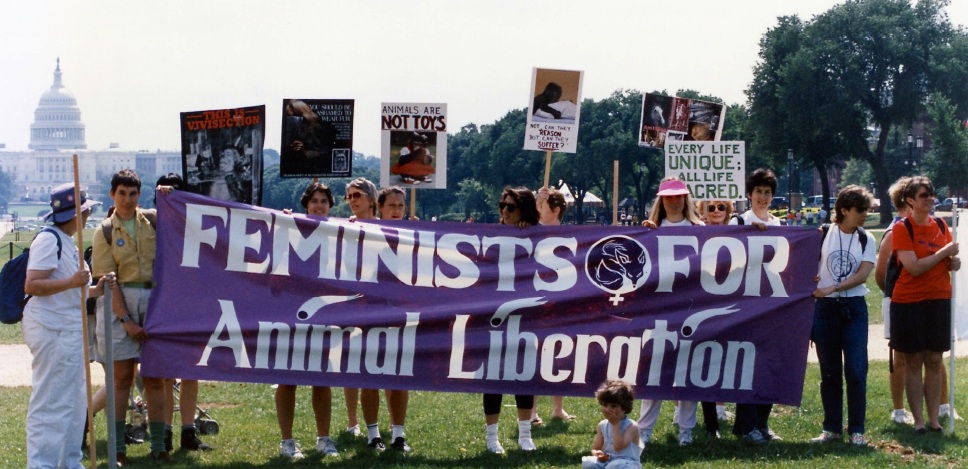
Formed in the early 1980s, Feminists for Animal Rights (FAR)1 was typical of radical feminism in the latter half of the 20th century, embracing lesbianism in a larger social justice space (the Nonhuman Animal rights movement included) that more or less adopted a “don’t ask don’t tell” that approach. Founder Marti Kheel openly identified as gay and gender “deviant” (Kheel 1998: no page), and FAR participated in LGBT+ events from its beginning.

In its first year of official operation, FAR participated in the San Francisco International Lesbian/Gay Freedom Day, its table ironically placed next to a “burger” stand. FAR also marched in the Boston Gay Pride Parade with its banner as well as signs that read “Extend the Circle of Compassion: Go Vegetarian,” “Subvert the Dominant Paradigm,” and “Vegetarians Taste Better.” The latter was apparently the “crowd favorite” (Solomon and Stone 1999: 10). Regular engagement is listed throughout the twenty years of FAR’s newsletter publication, including attendance at the East Bay Lesbian and Gay Celebration and the Lesbian Empowerment Conference in Florida.

The Georgia Lesbian Ecofeminists, a branch of FAR, explains the centrality of this intersectional thought to the vegan feminist approach:

When the group formed we decided to call ourselves Ecofeminists because the term underscored for us the connection between feminism, animal liberation, and ecology. We also chose to include Lesbian in our name because most (but not all) of us are lesbians, and we see our visibility as lesbians as a political issue. We also identify the oppression we face as women and homosexuals as intricately related to the exploitation of animals and the earth by the same patriarchal mentality

(Georgia Lesbian Ecofeminists 1991: 4)

One FAR article, “‘So, What Do You Eat’ and ‘What Do You Do (In Bed)?’,” draws connections between veganism and lesbianism in how they are marginalized and how their personal relationship with their own body is scrutinized:

What do I eat? Anything I want, as long as it tastes good, is nutritious, is accepted by my body, and does not directly harm, or indirectly support harm, to any other creature on the planet. What do I do (in bed)? Anything I want that feels good, with or without a partner, is accepted by my body, and does not perpetuate hetero-patriarchal structures or beliefs.

(Post 1993: 13)

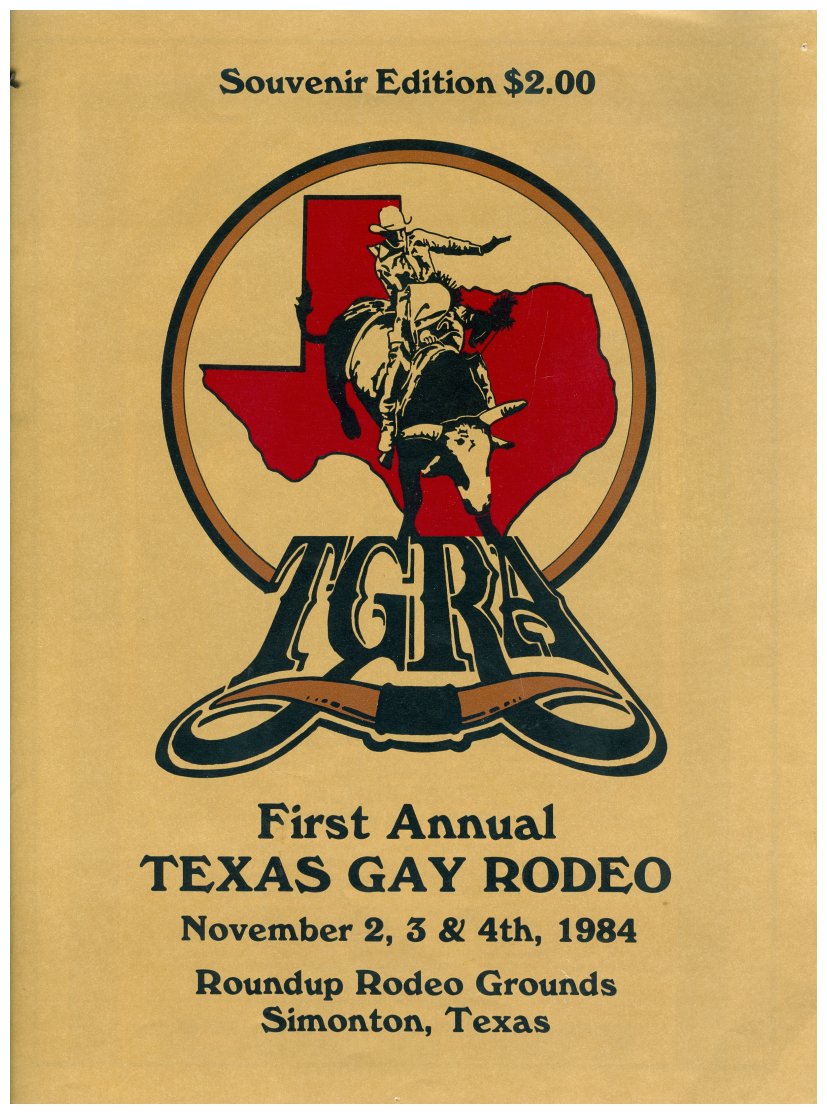
The connections were not always apparent. FAR members were regularly frustrated by the intersectional failure between anti-speciesism and gay rights. FAR organizer Batya Bauman (1990) notes, for instance, the regular occurrence of individuals claiming to be “animal lovers” in singles classifieds in popular lesbian magazines that also mention personal interests that include “fishing” and eating “meat.” FAR (1984) took issue with the “Gay Rodeo” as well, distributing protest literature on the event and sending letters of complaint to the gay publication, Coming Up.

Houston LGBT History.org

Likewise, FAR was adamantly opposed to AIDS research conducted on Nonhuman Animals, insisting that all progress in AIDS research had been achieved through nonanimal experiments (Todd 1991-1992). Kheel reiterated this value, insisting that the “best cure lies in prevention,” as animal-based testing is “morally bankrupt” and “scientifically invalid” with high failure rates and unintended side effects (1984: 4). “As a gay person,” she continues, “I sincerely hope that the gay community will question the type of research being done on their behalf and condemn all research that inflicts pain and suffering on innocent beings.” (4).

It would not be until the 2010s and 2020s that the professionalized Nonhuman Animal rights movement began to openly acknowledge and respond to sex and gender diversity and queer vegan theory established itself in scholar activism. These developments in visibility may reflect the larger successes of the gay rights movement, but it should be clear that the thoughts and actions of vegan feminists were aligned with these issues for many decades prior. Although third wave vegan feminism is often presented as an important countervoice to heteronormative feminist theory of the 20th century, the truth is that vegan feminists of that era were also explicitly engaged in queer activism, recognizing and responding to important intersections (and intersectional failures).


Notes

Although FAR was perhaps the most well known (or at least well remembered) of the lesbian-inclusive vegan feminists groups, it was certainly not the only one. In Britain, for instance, Lesbians for Animals’ Irreducible Rights surfaced in the late 1970s, bringing speciesism (vivisection, in particular) to the attention of the gay community through publications, leaflets, and participation in rallies (Adams and Gruen 2022).

References

Adams, C. and L. Gruen. 2022. “Ecofeminist Footsteps.” Pp. 1-43, Ecofeminism, C. Adams and L. Gruen (Eds.). London: Bloomsbury.

Bauman, B. 1990. “What is Loving Animals All About?.” Feminists for Animal Rights Newsletter 5 (3-4): 1.

Feminists for Animal Rights 1984c. “Gay Rodeo—A Sad Event.” Feminists for Animal Rights Newsletter 1 (1): 3.

Georgia Lesbian Ecofeminists. 1991. “Georgia Lesbian Ecofeminists.” Feminists for Animal Rights Newsletter 6 (1-2): 4.

Kheel, M. 1984. “The Monkey Business Behind AIDS Research.” Feminists for Animal Rights Newsletter 1 (2): 4.

——. 1998. Untitled talk. Papers of Marti Kheel. Schlesinger Library, Radcliffe Institute. Archive item sch01622c00397—MC962_4.17.

Post, L. 1993. “‘So, What Do You Eat’ and ‘What Do You Do (In Bed)?’.” Feminists for Animal Rights Newsletter 7 (3-4): 13.

Solomon, S. and R. Stone. 1999. “Taking Action in Boston.” Feminists for Animal Rights Newsletter 11 (1-2): 10.

Todd, B. 1991-1992. “AIDS & Animal Research: False Hope, Wasted Lives.” Feminists for Animal Rights Newsletter 6 (3-4): 1-9.


Corey Lee Wrenn

Dr. Wrenn is Senior Lecturer in Sociology at the University of Kent. She received her Ph.D. in Sociology with Colorado State University in 2016. She was awarded Exemplary Diversity Scholar, 2016 by the University of Michigan’s National Center for Institutional Diversity. She served as council member with the American Sociological Association’s Animals & Society section (2013-2016) and was elected Chair in 2018. She is the co-founder of the International Association of Vegan Sociologists. She serves as Book Review Editor to Society & Animals and is a member of the Research Advisory Council of The Vegan Society. She has contributed to the Human-Animal Studies Images and Cinema blogs for the Animals and Society Institute and has been published in several peer-reviewed academic journals including the Journal of Gender Studies, Environmental Values, Feminist Media Studies, Disability & Society, Food, Culture & Society, and Society & Animals. In July 2013, she founded the Vegan Feminist Network, an academic-activist project engaging intersectional social justice praxis.

Queer Appalachia and Vegan Activism


Photo Credit: Raymond Troumbly

By Z. Zane McNeill

People always assume that growing up queer in West Virginia was difficult, but I always tell them that I was bullied more for being vegan than being LGBTQIA+. I went vegetarian around the same time I realized that I had a crush on my best friend who was a girl. She was vegetarian too, and I was head over heels for her.  At 14, I went vegan after learning more about factory farming and the suffering that is connected to dairy and egg production. In high school and early college, influenced by Carol Adams, Josephine Donovan, and Alice Walker, I was an adamant believer that in order to be a feminist I needed to be vegan. This later extended to queer liberation as intrinsically intertwined with animal liberation.

In my early 20s, I found queer community in Appalachia thanks to the zine, artist, and activist project Queer Appalachia. Through their social media accounts, I found other queer southern projects that I  discovered, and subsequently collaborated and contributed to, like Bible Belt Queers, a community book project led by and for Southern queers, and Queering the Mountain, an art exhibition highlighting the work of Appalachian queers.  Inspired by these, I eventually started my own zine project called Marx in the Mountains, have been working on a community book project on queer(ing) Appalachia, and have recently released a collection highlighting queer vegan voices around the world under Sanctuary Publishers, a resource activism focused vegan book publisher.

People who weren’t raised in this part of the world tend to not fully understand the way in which Appalachia is not simply a place. ‘Appalachia’ is in and of itself a contested definition. Appalachia is a space containing around 25 million people, or around 8% of the US population. It stretches through thirteen states following the Appalachian mountain range from New York to Alabama. Beyond a stretch of land, it is an area historically comprised of marginalized people—Indigenous folk, immigrants working for the coal companies, and other impoverished people tied into a form of serfdom in late-stage capitalism. In What You’re Getting Wrong About Appalachia, Elizabeth Catte explains that Appalachia is “a political construction, a vast geographic region, and a spot that occupies an unparalleled place in our cultural imagination.”[1] She herself is hesitant to label the concept of Appalachian identity and usually works with those who self-identify as Appalachian instead, as historically who self-identify as Appalachian instead, considering that, historically, who counted as Appalachian was decided by those in power or with massive amounts of capital. It is more than a geographic region—it is an environmental space with a history of toxicity from natural resource extraction, a cultural construction fashioned by conservatives to support revisionist arguments of what ‘America’ is and what bodies represent ‘America’, and a politically contested space that pushes disadvantaged voices to the margins.

When I was growing up in Appalachia, I was mostly bored but managed to pick up activism from my family. My stepfather was a well-traveled kayaker, and my mother was an HIV+ advocate in West Virginia.  They were both schoolteachers, and I was lucky to grow up in the fun environment of music and books. However, to the dismay of the stepfather, I was more interested in reading Twilight than Marx. During the invasion of Iraq, my parents brought me with them to protests. The military practiced their maneuvers over our town, so my stepfather mowed a peace sign into our backyard. He delighted in knowing military pilots would gaze upon his anti-war protest while they performed their exercises. Both of my parents had a lot of gay friends and I was raised in the queer punk and art scenes in Morgantown—an environment a lot of people would be surprised existed in the mountains. Truthfully, growing up queer in West Virginia shaped my identity and understanding of self. I don’t feel the same way about my gender or sexuality as someone from the city might.

Coming to terms with being queer and coming out was awkward, but that was really it. In high school, when I came out as bi, I didn’t face discrimination—but people loved throwing their cafeteria food at me, showing me frogs they dissected, and stepping on bugs in front of me once they realized I was also vegan. At the same time, however, my friends and I had a Vegetarian Awareness Club and got a two-page spread in the yearbook. So, I would say that growing up vegan and queer in Appalachia was a weirdly empowering and isolating experience that informed my work in various animal welfare NGOs and queer grassroots organizing. My day-to-day life was continuously impacted by poverty, lack of transportation, and devastation by corporate greed. An area gutted by addiction, natural resource extraction, and neoliberalism left shadows on my friends’ faces and cuts on their arms. A lack of employment opportunities pushed the privileged out of the state to the cities, further pushing the marginalized into their homes with needles and pills. Being queer only makes sense to me with this as a backdrop. Constant violence has seemingly queered us all who are “from around here”.

I have seen progress as the years have passed, which is exciting in itself. In 2017,  Queer Appalachia released the zine Electric Dirt, and since its release, a community of LGBTQIA+ folks from Appalachia, the South, and the Rust Belt has sprung up around it fighting to show that the discourse surrounding Appalachia leaves queer, Indigenous, Black, POC, femme, and leftist voices out. Queer challenges normative generalizations about the culture of Appalachia and explores how queer folks define themselves and the region “within the intersections of coal mines and class, race and religion, food justice and colonialism.” Queer Appalachia, as an overarching work, has benefitted the marginalized folk of Appalachia, giving a wide-ranging audience to those too often denied a platform. Yet, despite this progress, I still felt alienated by some of the content produced by the LGBTIQA+ Southern and Appalachian community. I was disappointed that collectives focused on the intersections between queer life, the opioid epidemic, the carceral system, Indigenous and Black liberation, and leftist organizing but did not also embrace animal welfare and veganism. This continued to shadow my experiences growing up queer and vegan.

In Appalachia, corporations see people as expendable, just as nonhumans are seen as objects to be used. I felt strongly about the work of scholar-activists like Dr. Breeze Harper, Adams, Julia Feliz Brueck, and Aph and Syl Ko who have illustrated that nonhuman oppression is inherently intertwined with our own. Specifically, Feliz Brueck coined the term ‘consistent anti-oppression’ to describe how marginalizations are inherently connected and should be equally fought against, which makes sense to me.

Fueled by this framework, I approached Feliz Brueck, who also runs Sanctuary Publishers, about an anthology that would invite folks who identified at LGBTQIA+ and vegan to meditate on how their identities intersect, how being LGBTQIA+ affects their vegan activism, and what they would like to say to non-vegan LGBTQIA+ folk. The end result, which was recently released, was a book project that includes over 25 contributors—activists, scholars, artists, and writers who identify as LBTQIA+ and vegan—who explored the interconnections between social justice groups, building bridges between movements, and dismantling hierarchies between oppressed groups through consistent anti-oppression in this volume. In the book, known activists like Jasmin Singer speak about their initial work with AIDS Awareness, while scholar Margaret Robinson discusses how veganism ties into her decolonization as a two-spirit person, and Shiri Eisner speaks to her journey of coming out as a bisexual, genderqueer Mizrahi vegan. However, the focus is not on known activists, and that’s what makes this book and the work of Sanctuary Publishers different. Voices often denied a platform are able to have one if they choose to in written form.

Growing up queer and vegan in Appalachia was an experience that challenged metronormative stereotypes—happily queer in the holler, organizing Earthlings showings in West Virginia, and going on queer dates to a vegan-friendly co-op. Yet, I find a special kind of comfort knowing that those in other parts of the world from different cultures and life journeys understood me in a way that I had not felt before. Since embarking on the road to publish the queer vegan anthology, I found myself validated in both these identities—being vegan and queer—and in recognizing that they were always inherently connected to me, and that being vegan has informed my queer activism and vice versa. Queer vegans across the globe share this sentiment, perhaps because we have historically faced an otherization that has led to our own violence and marginalization.

I hope that vegans recognize the importance of embracing a veganism that is consistently against all oppression in an effort to ensure we recognize that the movement has work to do regarding how we avoid marginalization of others at the expense of nonhumans. I also hope that non-vegan LGBTQIA+ folks, especially my friends in the queer Appalachian community, recognize that our marginalization extends to others through our daily choices, and that in order to fight for our queer liberation, we must also fight for nonhuman animal rights.

[1] Catte, Elizabeth. What You Are Getting Wrong about Appalachia. Cleveland, OH: Belt Publishing, 2018, 10.


Zane McNeill is an independent scholar-activist from Appalachia. Their newly published book Queer and Trans Voices: Achieving Liberation Through Consistent Anti-Oppression edited by themselves and Julia Feliz Brueck explores the interconnections between social justice groups in order to consistently and effectively achieve liberation for all.

You can read more on intersections of queer activism and veganism in Queer and Trans Voices, available for purchase through Amazon website or Sanctuary Publishers Instagram.

We Need More Pro-Intersectional Activism in the Animal Rights Movement

Aris Austin

Content Warning: Rape mention, ableism, racism, misogyny

People tend not to respond well when individuals outside of a group criticize said group. So I’m here, a dedicated member of the animal rights community, to say this: we need to do better on inclusivity. Way better.

I’m not saying this to argue, and I’m not saying this to accuse anyone. I’m saying it because it’s absolutely necessary if we want to think of ourselves as good, compassionate people. I’m saying this because it’s the right thing to do. It can make us—and our movement—better.

Many of the animal rights activists I know do an excellent job of supporting other social justice movements and recognizing oppression. But some of us are so awful at it that it makes me cringe. I don’t believe that the vegan movement as a whole is intentionally racist, or sexist or ableist. But when so many of us say or do hurtful things and then don’t own it when called out, I can see why those outside of our movement say that. When we uphold activists with racist messages, or organizations that use (intentional selection of the word use) women’s bodies for media attention, I understand why so many people see our movement as uninterested in helping humans.

I remember a time when I was part of an online group dedicated to mentoring new vegans. One of the other mentors—a person of color—took issue with the fact that so many other mentors were alright with spreading the message of a very well-known activist who is particularly racist and sexist. I agreed, and thought it would be pretty straightforward for the rest of the mentors to listen. After all, this person took the time to explain why they, as a person of color, often felt marginalized within their own movement because of people’s willingness to support this activist. I was shocked by the response.

People immediately leaped to defend this activist, claiming that he “had done so much for the animals” and therefore was a good person. Others said that this was “about the animals, so those kinds of issues aren’t important here.” One person even told us to “take our intersectional veganism somewhere else.”

Newsflash: being vegan doesn’t give you a free pass to be an awful person. Fighting one form of oppression while actively supporting other forms of oppression makes absolutely no sense.

Let’s do a quick thought experiment. Imagine you’re at dinner with your family, and you are the only vegan at the table. Your uncle eyes your plate and decides to ask why you don’t focus on something more important, like human rights. You stare at him for a moment, stunned. How can he not understand this? You explain the many intersections between animal rights and human rights—connections between meat and environmental racism, farm worker abuse, the language used to make both animals and people seem like objects—the list goes on. You explain that animals also have lives that matter to them, and that regardless of whatever else we advocate for, being vegan minimalizes violence and is the right thing to do. He calmly apologizes and explains that he meant no offense, but that human rights are more important, so the animals will have to wait. And then he goes back to eating his steak.

Angry? I’d be angry.

Let’s imagine a second scene now. You’re at a coffee shop, explaining the moral inconsistency in loving dogs but eating chickens. Your friends are surprisingly interested, and you throw out an ableist term than many vegans still use: “moral schizophrenia.” One of your friends seems taken aback. She explains that she understands the point you’re trying to make. However, she also asks you not to use that term, because it implies that individuals with schizophrenia are inherently violent and immoral. She reminds you that she herself has been diagnosed with schizophrenia, and like many with schizophrenia, she has never acted violently. She is, frankly, hurt.

So you “apologize” to your friend, but you don’t actually own up to the hurt you caused. Instead, you explain what the term is meant to imply, that you mean no harm in using it, and that sometimes we need offensive language to explain such an important issue. Then you continue the conversation, using the term “moral schizophrenia” again. You probably even expect your friend to listen to your message and be totally okay with it.

Oops. You just became the uncle who made you so angry a minute ago.

This is exactly what happens when people blow off human rights violations with the excuse that the animals are worse off, or use controversial language like “slavery,” or “rape” to describe the abuse endured by farm animals. We can argue all day about what does and what does not constitute rape, but the important thing so many people miss is this: it has been explained over and over that using this term in animal rights issues is offensive and even hurtful to many rape survivors. Several rape survivors have asked for the use of the term rape to be left out of these conversations. And since we can use other language to describe the reproductive manipulation and forced impregnation of farmed animals (I just did it twice) this hurt is unnecessary. That alone should be enough of a reason to stop using the word rape in those conversations. In fact, we ought to be willing to turn animal rights communities into safe spaces and fight all forms of oppression, simply because it’s the right thing to do.

Doing the right thing alone should be enough motivation. Our movement—a movement built on love and justice—ought to be concerned with all forms of oppression, not just the forms we know the most about. If you truly need another reason to be kind and inclusive though, here it is: making our spaces safe for people of all marginalized groups is one of the best possible things we can do for our movement. Not only is it right to stand in solidarity with people fighting their oppression, but our acts of solidarity will also help them feel welcome in our spaces and more open to our message.

For example, Collectively Free, a pro-intersectional animal rights group, counts New York Pride among their followers on Instagram. Now, I don’t know the exact reasons NYC Pride has for following CF, but I might speculate that this has something to do with CF’s continuous support of the LGBT community. In the words of Raffaella Ciavatta, one of CF’s co-founders:

“When you have groups like Pride NY follow you on Instagram, you must be doing something right. Unless of course, you simply don’t want to make the AR movement accessible to minorities…”

Building a pro-intersectional AR movement is the right thing to do, and it makes us better. Imagine what would happen if every vegan fought for LGBT rights? Not with any kind of ulterior motive, but simply to support our fellow human beings. We would add millions of voices to their cause. And what if the LGBT communities in turn supported us and joined our movement, simply to support the animals? They would add millions of voices to our cause. And when we join with even more groups, then what happens? What happens when animal rights and racial equality and feminism and LGBT rights and disability rights groups all join forces? Ideally, we could throw off our oppressions together. It suddenly becomes something more than fighting the issues facing each of us. It becomes an issue of liberation for everyone.

We’re stronger together. So let’s stand together.


This is part one of a series of posts on animal rights and social justice. Part two will outline some tips for being a better pro-intersectional advocate.


meAris Austin is an author, student, and activist who writes fiction and nonfiction that aims to dismantle oppression. Their fiction has previously been awarded with honors at Colorado State University, where they attend school and serve as president for the university’s animal rights group. Aris can be found on Facebook page and more of their writing is available on their website.

I’M ANGRY. And It’s My Right.

Content Warning: Discussions of hetereosexism.
Not Safe for Work: Contains strong language.
Jaguar roaring or yawning

By Raffi Ciavatta

I came out when I was 13. The world before then was vampiresque, hollow and dark to me but after coming out of the closet, it became even more apparent to me how angry I really was when I started to experience systemic oppression through every pore of my body.

My first contact with activism was through the LGBTQ+ community. However back then I worked solo and not only mocked but despised and regarded LGBTQ+ activists as conformists and tame. The thought of anyone wanting to build bridges or work with heterosexuals was beyond my understanding.

“My voice and my anger were the only weapons I had against homophobia and I intended to use them as loud as I possibly could. I, was a lone gay warrior in a world that hated women and LGBTQ+ folks.”

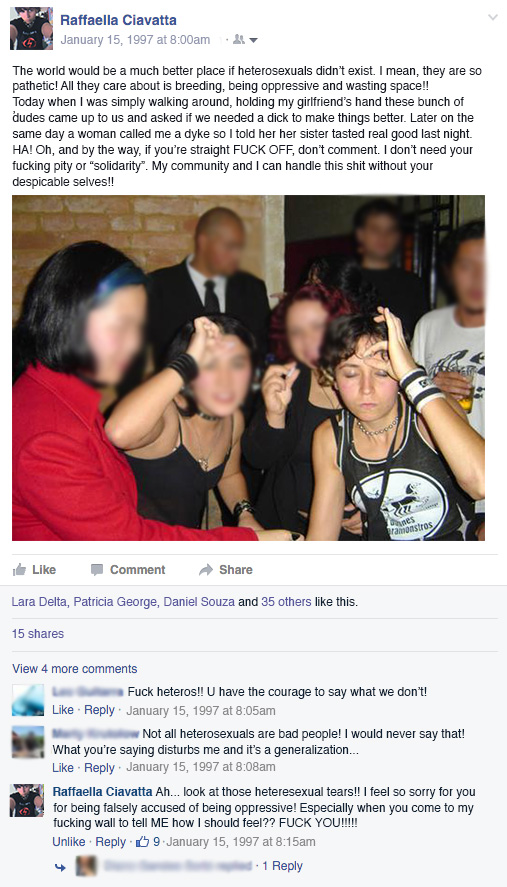
My “no-sugar-coating” attitude and blunt anti-heterosexism soon began to be noticed in the small LGBTQ+ community of Sao Paulo through Orkut, a predecessor of Facebook (does anyone remember it?) and Fotolog.net. If I were to transport my Orkut account to Facebook this is what it would have looked like:

Facebook post from 1997 that shows author with friends making mocking faces. Says, "The world would be a much better place if hetereosexuals didn't exist. I mean, they are so pathetic! All they care about is breeding, being oppressive and wasting space!! Today when I was simply walking around, holding my girlfriend's hand these bunch of dudes came up to us and asked if we needed a dick to make things better. Later on the same day a woman called me a dyke so I told her her sister tasted real good last night. HA! Oh, and by the way, if you're straight FUCK OFF, don't comment. I don't need your fucking pity or "solidarity". My community and I can handle this shit without your despicable selves!!"

I bet many of you now are “appalled” by my behavior and perhaps many of you would have defriended me then, called me names or felt sorry for me. But listen up. I want to challenge the dynamics of this relationship.

My voice and my anger were the only weapons I had against homophobia and I intended to use them as loud as I possibly could. I, was a lone gay warrior in a world that hated women and LGBTQ+ folks.

When you live in a system where you cannot go one single day without being called a dyke, offered a dick by cis men (as if lesbians never date trans women who have dicks), being mocked at, laughed at, sexualized, physically assaulted, bombarded with images of straight happy couples, living a perfect life – you either break, become apathetic, find some strength to deal with all of it positively or you become angry. I chose the latter.

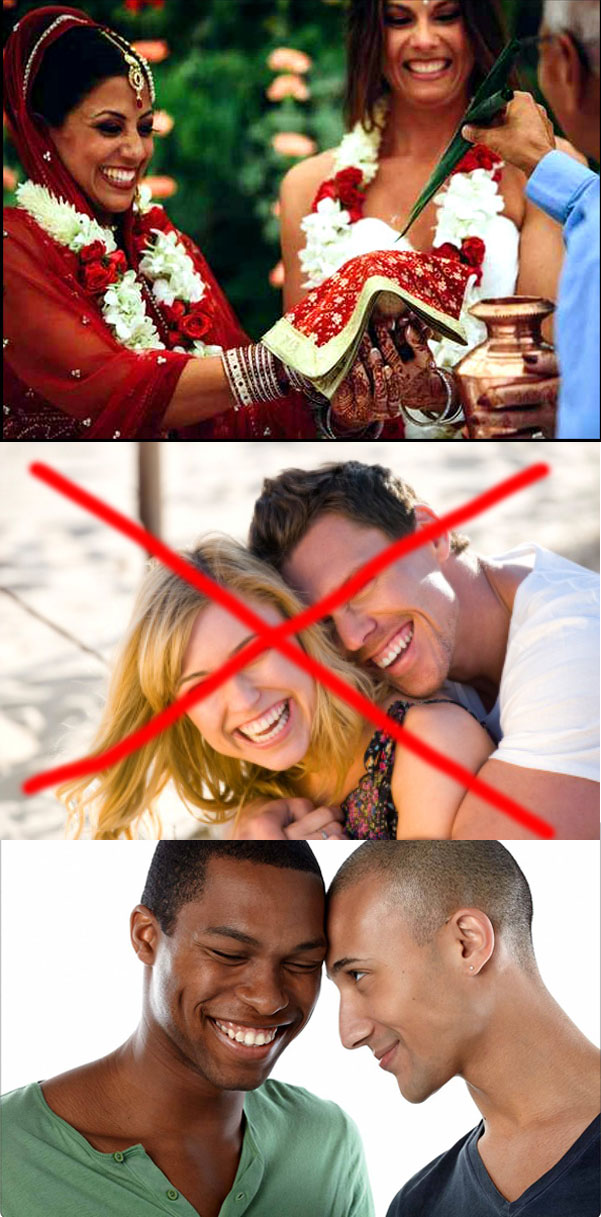
Three couples are pictured, the heterosexual couple is scratched out with a red x

For the longest of time I never fully trusted straight folks. I always thought there was an underlying reason why they wanted to be friends with me – either because they needed to feel better about themselves with their “Look, I’m not like them!” argument or because they wanted something from me, like men getting aroused from my stories or similar things.

The truth is that no matter how loud I was, the chances of the world ever being LGBTQ-only was nearly impossible. So I ask that we pause and analyze the power dynamics that we have here: no matter what I said, by the end of the day the chances of me being verbally or physically assaulted were still very high. No straight person will ever have to worry about being beaten up over their sexual orientation. End of story.

It is my right, as someone who has been systematically oppressed, to let my rage breathe. No matter if the things I say are violent or offensive, it is not for straight folks to tell me how to deal with my anger.

Is exterminating all heterosexuals going to make the world a better place for LGBTQ+ people? No. I do not believe so and deep down I think I never believed it! The truth is that back then straight folks terrorized me, I said and did things that may not seem the most logical or effective.

But were my feelings justifiable? Yes. They were a perfectly natural response to oppression and it was the best I could have done at the time where I literally had no more energy left to keep fighting.

Could I have dealt with things differently? No. Not at the time. My spirit had been so broken that anger was the only way I found to vent. I have talked about how I don’t believe in misanthropy or how attitudes similar to mine are perhaps not beneficial to anyone or any movement. The toxicity of it actually hurts us. But we have to understand where they come from sometimes and let this rage breathe.

I worked really hard to break my cycle of anger and distrust but I don’t think it will be something I will ever fully overcome due to the various traumatic experiences I suffered and still suffer from! However, today I’m able to deal with homophobic situations much better and usually anger becomes secondary in the process of coping. I have found other things that help me deal with anger like working out, poetry, talking it out, and music, etc.

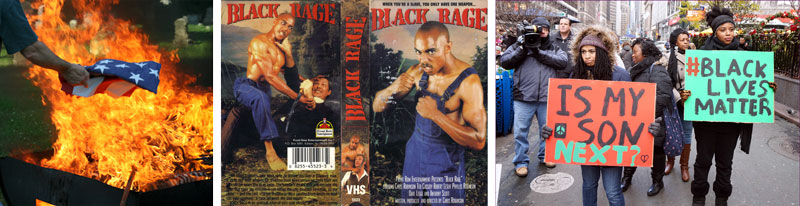
Three images juxtaposed: An American flag being burned; a picture of a Black muscular man threatening a white man and posturing at the camera; Black Lives Matter protesters holding signs in the street

That is not to say I deserve sympathy or a medal. I have had moments where I snapped and I still never hold my tongue when people want to be oppressive towards me. The difference is, I have found other ways to put people in their place. And it makes me happier that I am able to fight back without self-destructing.

Next time you see someone with similar behavior, don’t be “appalled”. Don’t stop being friends with them, don’t call them names, and certainly don’t pity them. Let their rage breathe. Don’t try to say “It gets better,” especially if you’re not part of their community. Sometimes the best allies are the ones that know when to remain silent. If you make these mistakes, own up and apologize.

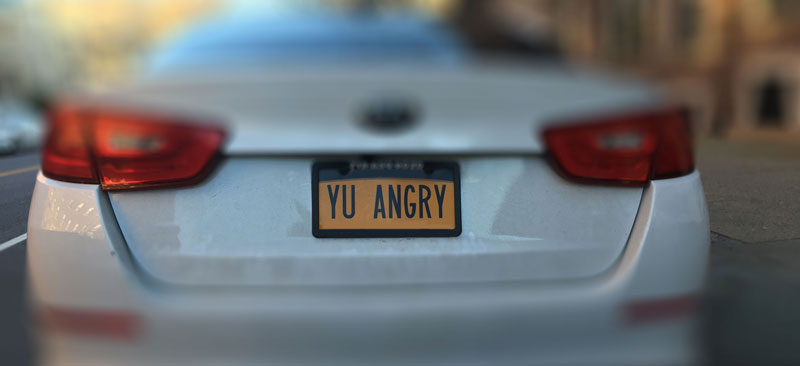
License plate of an automobile that reads, "YU ANGRY"

Anger is a way of resistance! Anger has been used by many people, movements, and countries! Think of Brazil’s (and Latin America in general) blunt anti-American stance: one of the ways a country built on colonialism has found to defy imperialism is by publicly  “hating” on Americans. I included Brazil here and qualified it as rage since I observe a clear anger from Brazilians in relation to the US. Think of Black Rage: a book which focused on the racial crisis in the US. Think of Black Lives Matter: a movement which emerged out of the rage and mourning that accompanied George Zimmerman’s acquittal for the murder of Trayvon Martin.

Let’s do our best to support oppressed peoples in our communities the best we can. And when they get angry, let their rage breathe!


This essay originally appeared on Collectively Free.


Raffaella

Co-founder of Collectively Free, Raffi Ciavatta is vegan animal liberation activist, art director, poet, photographer wanna-be, DJ in some past live and most importantly… a big dreamer who makes things happen.