Gary Yourofsky: Is The Backlash Warranted?

By Michele Kaplan

TRIGGER WARNING: The following article is in response to a video posted by Gary Yourofsky. It contains quotes from Yourofsky that reference violence, sexual abuse and rape. The video also contains ableist language and makes the inaccurate claim that every person on death row is guilty. (#FreeLeonardPeltier! #FreeMumia!) Lastly, it contains a great deal of macho posturing, aggressive, graphic and at times disturbing language which may be triggering for many people.

NOT SAFE FOR WORK: Contains foul language.

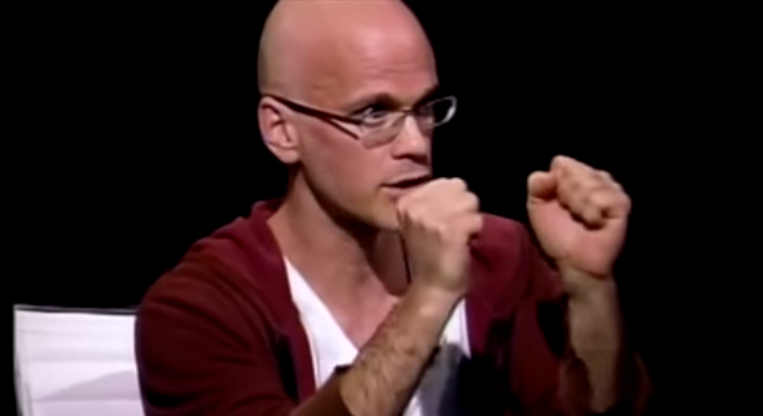
Screencap from video showing Yourofsky explaining himself

“After 18 years on trial, the verdict is finally in!” Gary Yourofsky recently declared on social media. “I’ve been found INNOCENT on all charges of supporting rape!”

This being in reference to the backlash from his infamous quote: “Every woman ensconced in fur should endure a rape so vicious that it scars them forever.” The “testimony” (which was in the form of a 28 minute video) goes into great detail as to why he feels he has been treated unfairly.

It should be noted this is not an actual trial. Yourofsky has also declared himself “the judge” (thus his innocence) and ends his testimony by saying “Vegan love to all my supporters who refused to believe these psychotic defamatory lies about me. And finally, to all the organizations and people who have attacked me, claiming that I support rape. I hear by challenge you to top my anti rape position. Go ahead. I dare ya.” He pauses for a moment and then continues in an aggressive posturing “What?! Yeah, I thought so. As usual, I win! Checkmate! You lose!! Fuck you!!”

Yourofsky goes to great lengths in the video to show just how much he despises rapists: “This is what I think should happen to rapists.” He says “Even somebody who rapes a woman in a fur coat (if that ever happens).”

According to Women Organized Against Rape, 1 in 4 human women and 1 in 6 human men will be raped by the age of 18. Considering how much of the norm wearing fur is in our culture, the chances that a fur wearing human being raped, is highly likely.

He continues:

I think his penis and balls should be seared off with a cuticle remover slowly, and then I think two skewers should be shoved into their eye sockets, dragged into another room. And then I think their penis and balls should be dipped into diarrhea and puke. They should be given the option of eating that and then they can save their lives. And if they do eat it, I want to take a gun, put it between their eyes and say ‘I was just kidding’.

In another quote he states that, “Since 1997, thousands of people (mostly vegans) have accused me of condoning rape” and that he has been “continuously harassed with false statements for 18 years.” Okay, so it is clear he does not like rapists. Is he also saying that he never said the infamous rape quote?

Yourofsky

“I need all of my supporters to start condemning the liars and deceivers,” he says in the video “who claim that I support rape because I wished it. And I repeat: wished it, upon men and women who actually support rape and murder by draping themselves in fur coats.” He then goes on to say that there isn’t one person on this planet (including a rape victim) who is more against rape than he is.

And while it’s safe to say that someone who has actually survived rape would disagree with that last claim, let’s just move on and focus on what he is actually saying. He does not condone the actual violent act of rape. He merely wishes it upon certain people who he feels are deserving or “evil”

And while I agree that there is a difference between saying “I wish this person gets raped” and actually physically raping someone, I find it odd that he does not understand the consequences of language, let alone the consequence of when a man talks about raping a woman (even if “it’s just talk”). That when he uses rape as a means to punish a person (even if it’s “just talk”), that this still contributes to the collective rape culture, which also impacts the animals such as the dairy cows, who are repeatedly forcibly impregnated (aka raped) in the name of a product. That he doesn’t understand how when an aggressive sounding man starts talking about his rape fantasies, that this can be incredibly triggering to victims of rape. And thus, it is odd that he doesn’t understand how this could possibly create and warrant backlash.

“Wish”

He wishes evil things upon evil and violent people. (And while this includes rapists, domestic abusers and child molesters, none are more violent in his eyes, than the people who partake in the animal agriculture industry.)

“Propose”

“Nobody disagrees with my position on violence, they only disagree who I propose to be violent for.”

“Hope”

“Deep down, I truly hope that oppression, torture and murder return to each uncaring human tenfold!” And lastly he uses the word:

“should”

“Every woman ensconced in fur should endure a rape so vicious that it scars them forever.” As far as rape is concerned, this is what should happen to people (as he also comments on men) who support the fur industry.

This is why people accuse him of supporting rape, and yet he fails to see that.

In his eyes, why are people focusing on his words, when the animals (deemed as food) are being murdered, tortured and in many cases forcibly impregnated (aka: rape) on a daily basis? This would not occur if there weren’t people who were financially supporting the industry. This should be the focus, not something he says.

And in this regard, he is right. There is a deep social conditioning in our society that has raised us to believe that violence against certain animals are okay. That says certain animals are here to be our food and clothing and have no other purpose. The animal agriculture industry goes to great lengths to encourage this disconnect, by hiding the truth of the factory farms and putting the image of the jolly animal on their package, to give off the impression that the animal is happy to be your food.

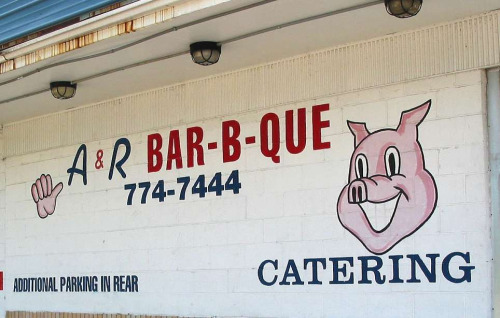
Advert for barbecue catering service with a cartoon pig face that is smilingAnd when we see the packages of meat, the appearance is so far removed from what the actual animal looks like, that it becomes very easy to ignore and even forget the origin. The animal agriculture industry is so freaked out about their customers learning the truth of their industry, that they have gone to great lengths to lobby the government so it becomes illegal to expose the cruelty. Furthermore, how else will you ever get your protein and calcium? We are raised to believe that we can not be strong and healthy, if we do not consume animals, which is yet another myth perpetuated by the animal agriculture industry.

And I will also agree that there is a huge disconnect regarding the issue of rape and speciesism and that many anti-rape advocates and feminists do not know (or do not make the connection) between the dairy cow and the collective rape culture. They don’t know (or are taught not to care) that the only way a cow will continuously produce milk, is if she is repeatedly impregnated against her will (aka: rape), only to have her babies stolen from her time and again. Because to the industry, her baby is nothing but veal. This happens over and over until the mother cow is so emotionally and physically run down, that she is unable to produce babies (and thus milk), and then she is slaughtered. But we are taught to not worry about that because we are told that cows (and other farm animals) are unfeeling, unloving, creatures who do not respond to their environment, which is yet another myth perpetuated by the industry.

When he makes those particular points, he is correct. However, he remains confused as to why people are so distracted by his statements and they don’t just focus on what is a far worse situation. The truth is just because something is worse, doesn’t negate the consequences. I could say, “Oh, I hope you get shot and die a miserable slow painful death”. Meanwhile genocide is occurring in another part of the world. Yes, the latter is worse, but that truth does not remove the fact that there are still consequences to what I said.

Granted, Yourofsky will sometimes clarify his message and say that he only wishes violence upon people who indirectly or directly partake in the animal agriculture industry, because he feels that maybe if humans experienced the level of violence that the animals experience, then they would cease to contribute to the violence. However, he only clarifies some of the time. And when he does, people have to first get past his initial statements of wishing, hoping, and proposing violence against them to get to that point. Other times he just goes off on a graphic rant about what he thinks should happen to people who are evil.

The truth is, verbally advocating for the violence against a person who isn’t vegan only works against the cause of liberating the animals. Furthermore, it is hypocritical since unless you were born vegan, you too were once contributing to the violence. I know I was. And even now as vegans, when the grains, fruit and veggies are harvested, insects and field mice are often killed in the process. When the homes that we live in are constructed, harm is also done to the animals who were already living on that land. Many vegans require medications that were tested on animals. And yes, let’s work to change the system that makes it nearly impossible to not harm animals, but the present truth is that not one person is completely innocent of this.

Lastly, as activists we must remember that there is a difference between what feels good and cathartic to express, and what makes for an effective tactic and argument. The difference between what is best to share in a diary or in a private conversation, and what we share to the rest of the world, especially to people who we’d like to join us. Because, yes the animals need as many people on their side as possible, so that the goal of animal liberation can be achieved.

Gary Yourofsky has since put out another video entitled “Palestinians, Blacks and Other Hypocrites” where he addresses the issue of people in the community “unfairly” accusing him of making racist statements. Hmm, I wonder why.


This essay originally appeared on Rebelwheels’ Soapbox on May 17, 2015.


me in wheelchairMichele Kaplan is a queer (read: bisexual), geek-proud, intersectional activist on wheels (read: motorized wheelchair), who tries to strike a balance between activism, creativity and self care, while trying to change the world.

“Sexy at 70” and “Grumpy Old Vegans”: Ageist Stereotypes in the Vegan Movement

By Dr. C. Michele Martindill

“Ageism? Who cares about old people anyway? I volunteer with a group of white women over the age of 50. They are so behind the times and not helpful at all,” said a vegan.

“Why was it important for you to mention their age or gender?”

“Um…I don’t know.”

Vegans seem to at least recognize the words racism, sexism, classism, ableism and speciesism, but ageism is consistently left off that list of oppressions. Erasure. Silencing. Stereotyping older people as useless, past their prime, set in their ways and not able to contribute to the vegan movement. As one vegan once posted on Facebook, “Taking a stand against ageism feels too much like a single issue campaign, not really worth the effort. People need to just go vegan.” Really? Ageism is just a single issue campaign?
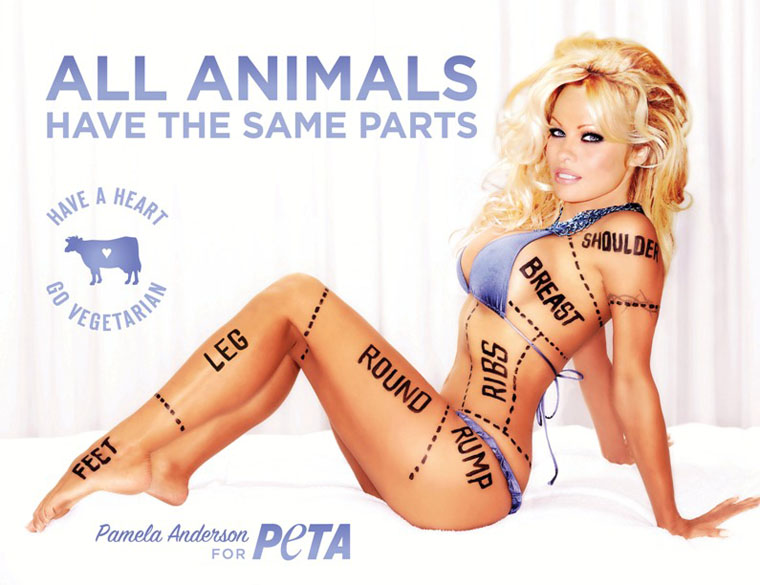
PETA ad featuring Pamela Anderson posing in a bikini with her body marked with meat cut names. Reads: "All animals have the same part"

PeTA is well known for its sexist advertising campaigns involving young women who pose partially or completely nude in an effort to get the public to stop eating or otherwise harming animals, e.g. celebrity Pamela Anderson posed in an almost non-existent bikini with her body marked off in the same way a butcher marks off the body parts of a cow—just to make the point that “All Animals Have the Same Parts.” Few would be surprised to learn that particular ad was banned in Montreal, Canada over the blatant sexism (Cavanagh, 2010), but how many people are aware that PeTA sponsors a Sexiest Vegan Over 50 contest? Judging is based on the entrant’s enthusiasm for their vegan lifestyle and “PeTA’s assessment of your physical attractiveness (PeTA, 2014).” Through a contest that objectifies women aged 50 and older, the public learns that a vegan lifestyle and diet should lead to what really matters in life—physical attractiveness. As if women don’t face enough pressure when they’re young to conform to standards of beauty created and institutionalized by men, they now have to face those same sexist standards as they age.

Actual avatar for Grumpy Old Vegans as described in text.

Of course, there are other stereotypes of older women in the animal rights movement. The Grumpy Old Vegans (GOV) Facebook page continues to use an avatar or logo depicting an older man and older woman with pronounced wrinkles, unfashionable clothing, grey hair, sour expressions and the woman is wearing pearl jewelry, a most un-vegan adornment (Grumpy Old Vegans, 2015). The representation of this pair as perpetually grumpy serves to stereotype older people, women in particular, as crotchety and is a form of ageism. While there is little doubt that if the GOV Facebook page used a logo featuring a couple in blackface or Native Americans as r-skins there would be a great public outcry, to date few have spoken up against the ageism of the wrinkle-bound couple logo.

Considering that vegans claim veganism is against all oppression, it is distressing to see them rank order which oppressions matter the most and which ones don’t even make the list, namely ageism. At the very least a definition of ageism is needed, explaining why and how it affects women more than men. Ageist stereotypes of older women affect the way they are stigmatized and contribute to their erasure from public concern. It is also important to explore how it is that men in leadership roles of the vegan animal rights movement can be so dismissive of older voices, particularly the voices of women.

AGEISM: The definition of ageism is straightforward–it is discrimination and prejudice against people based on their age, and is directed toward the very young as well as those who are considered old or elderly. Ageism is structural or systemic in our social world, meaning people learn it and enact it through social institutions, language, and organizations. People often don’t notice when they’re socially reproducing ageism, e.g. it is commonplace when someone forgets where they put something to say they’re having a senior moment, as if aging is universally defined by memory loss. Ageism is a relationship of power in that the dominant group in society uses ageism to oppress, exploit and silence those who are very young or much older. Just as the vegan animal rights movement stands against racism, sexism, ableism, classism, and speciesism, it stands against ageism—or at least some movement members claim it does. That remains to be seen.

STEREOTYPING: The tools of ageism are stereotyping and attaching stigmas to older people. Stereotypes are overly simple, fixed, rigid or exaggerated beliefs about an entire group or population of people. Stereotypes can lead to and be used to justify prejudice and discrimination. Aging women experience stereotyping more than men. Their bodies are criticized based on wrinkles, weight, hair color, posture, incontinence and overall loss of beauty; men may be similarly criticized, but are most likely regarded as distinguished in their later years and have the social capital—kinship, friendships, co-workers—to slough off negative stereotypes. Some of the most often used stereotypes of older people include:

1) All old people get sick and have disabilities, including hearing loss, urinary incontinence and blindness.
2) Old people are incapable of learning anything new; they are set in their ways.
3) Old women are a burden on everyone.
4) “Old people are grouchy and cantankerous.” (The Senior Citizen Times, 2011)

These and other stereotypes are communicated in multiple ways throughout the vegan animal rights movement. In a recent Facebook discussion of how PeTA uses young blonde white women in their advertising campaigns several women pointed out the sexism and racism of such a tactic. None mentioned ageism. One man stepped in to ‘mansplain’ and defend PeTA:

Humans are sexual beings and there’s nothing wrong with that. This doesn’t degrade women the same way half-naked male models don’t degrade men. It just looks like you’re actively looking for sexism, racism, or some sort of discrimination in an effort to be politically correct. I don’t think that’s a good approach. (Toronto Vegetarian Association, 2015)

When told by a woman that it degrades women to be reduced to the sum of their body parts and that they are only heard if they are considered sexy, this same man responded:

How exactly does it suggest that being sexy is the only way people will hear you if you’re a woman? That’s just ridiculous. People listen to not attractive people. Look at Hilary Clinton for godsake. [Emphasis added] That’s just a weird argument with no validity. I’ve never seen someone turn down a conversation with a woman based on their attractiveness.

How exactly does looking at and LIKING someone’s body disrespecting them? It seems like YOU are the one degrading women here. And it’s funny – aren’t feminists about women having freedom to wear what they want without being judged? Double standard much?

Oh my. If it’s not degrading to use half-naked men in advertising, then it’s okay to use half-naked women? What this man does not understand is how men have the power to deflect attempts at objectification. Women do not, not at any age. Please note there’s no mention of ageism in his reasoning, but Hilary Clinton, current presidential candidate in the United States, is held up as an example of “not attractive people” who can still get attention. Furthermore, this man calls out the women in the conversation for being bad feminists since they failed to support his admiration for attractive young women. The explicit ageism in this conversation was never mentioned, and it served to socially reproduce acceptance of ageism, acceptance of making disparaging remarks about women based on their age and appearance.

Clinton Sexism Ageism

STIGMA: Stereotypes lead to stigmas. Sociologist Erving Goffman (1922-1982) defined stigma as society attaching an undesirable attribute to an individual and then reacting negatively to that individual in such a way as to rob them of their identity, their ability to function or fully participate in society (Link & Phelan). In our social world, age is seen as an undesirable physical attribute, a stigma that is attached to women through man dominated ideologies which favor younger women for their sexualized bodies. Whenever a person or group displays a stereotypical representation of women as wrinkled, grouchy, or set in their ways, they contribute to the stigma of aging and socially reproduce ageism.

Criticism of a stereotypical ageist logo on the GOV Facebook page was met with dismissiveness on the grounds that people have a right to identify themselves as old and grumpy, and then the author, who was a man, made an ad hominem attack on the person who challenged his group:

…if you truly believe that people who identify themselves as old, grumpy and vegan and run a page with that title, using caricatures to represent themselves, are ageist for those reasons alone then your thinking is as muddled as that of those who made the allegation originally.

The man continued to defend his group’s ageist logo by dismissing sociological research and by stating that since the majority of the group “liked” it on Facebook, the logo could not possibly be ageist:

sociology is not an exact science. For that reason, it would be foolish to regard every utterance from sociologists as gospel. The rebuttal of this allegation issued on the page was ‘liked’ by a large number of people, many of whom expressed appreciation for a page they identified with, as they often felt invisible in a movement that celebrates youth. There were no adverse comments. In short, there is no substantive evidence to support the allegation.

What some vegans fail to see is how their actions affect others outside of the group. A logo or mascot is not ageist based on the vote of a membership who benefit from the stereotyping; ageism is grounded in any action that stigmatizes people based on their age.

Kyriarchal or Interactive Systems of Oppression: Kyriarchal social justice addresses all forms of oppression—racism, sexism, ageism, classism, ableism, and speciesism—and focuses on the dynamics of how these systems are interactive, crisscrossing and layered oppressions in the lives of individuals and groups (see below for a definition of kyriarchy—what was formerly referred to as intersectional). All oppressions are socially reproduced and linked by social institutions, through the economic, medical, legal, educational, religious and any other type of social institutions people navigate on a daily basis.

Too often when women in the vegan animal rights movement point out institutional ageism they are told by movement leaders that drawing attention to oppressions such as ageism is wrong, that kyriarchal social justice means we should just get along and go vegan for the animals because ending speciesism is all that matters. These vegans seem fine with claiming they care about humans and readily assert they are opposed in a general sense to things like racism, but they rank order oppressions and try to cherry pick the oppressions that matter most to them, leaving the rest to sit unnoticed. Why? In part they fear doing harm to the vegan animal rights movement and its organizations; they fear attention will be drawn away from ending speciesism or that outsiders will not join the movement if they have to stand against all oppressions. It is also difficult for the movement to envision how to address kyriarchal social justice when most of the leaders are men and eighty percent of the followers are women, when most of the membership is white, cis-gendered, young, without disabilities and not living in poverty. By not addressing ageism vegans socially reproduce and reify the stereotypes and stigmas associated with aging in our society.

AGEISM DOES REAL HARM: What harm is there in ignoring ageism? Plenty. In a recent study, researchers at the University of Southern California found that negative stereotypes about aging can potentially impair the memory of older people. “The study found that a group of older people asked to perform memory tests after reading fictitious articles about age-related memory problems did less well than a group given articles on preservation of and improvement in memory with age (Shuttleworth, 2013).” The older people who experienced memory loss fell victim to a self-fulfilling prophecy and the cliché of older people losing cognitive function just because they are old.
Older Laotian women sewing rugs for market

In addition, stereotypes keep people from seeing the realities of aging; they erase and marginalize older voices. Telling older people—especially women—to just go vegan will not address the financial problems faced by an aging population. Older women are at particular risk to be living in poverty. A report from 2012 based on US Census Bureau data reveals that over half of elder-only households lack the financial resources to pay for basic needs. Sixty percent of women aged 65 and older who live alone or with a marriage partner cannot meet day-to-day expenses. Women of retirement age are hit particularly hard by economic insecurity. Their pensions are smaller than those of men, they own fewer assets, and lack the education and job skills needed for post-retirement employment. Some of this economic disparity is the result of women leaving their careers to care for families and for their own elderly parents, and thereby losing opportunities for promotions as well as building up Social Security income. Also, women outlive men, leaving them alone with a single income and having to exhaust assets just to have shelter and food (Wider Opportunites for Women, 2012).

Older women of color are more likely than white women to have sufficient retirement incomes. Almost 50% of white women have insufficient retirement incomes to afford daily needs, while nearly 75% of Black women, 61% of Asian women and 75% of “Hispanic” (see US Census Bureau definition of Hispanic below) women were in households that could not afford basic expenses—even with Social Security income and Medicare coverage (Wider Opportunities for Women, 2012). Vegans who stereotype and stigmatize older women as self-sufficient and out of touch with animal rights might want to consider how these women have more pressing concerns in their lives, e.g. how they will make the next rent payment or pay the heating bill. Keep in mind, too, these numbers do not take into account those who are homeless or who live in elder care of some sort.
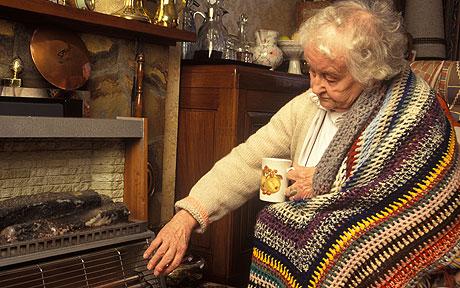
Cost of aging

STOP AGEISM in the VEGAN MOVEMENT: All vegans can work to eliminate ageism and extend empathic understanding to older people by considering how clichés and gaslighting—silencing someone with a barrage of questions and attacks—frame interactions with older people. Following are ten of the most often repeated ageist clichés found throughout the vegan animal rights movement and in vegan Facebook discussion threads:

1. “I feel old, so I know what you’re feeling even though I’m not really old myself.”
No, you don’t know what it means to feel old. You haven’t experienced it. Just as a white person has no way of knowing what it feels like to be Black, young people come across as dismissive and patronizing when they pretend to know how it feels like to be old.
2. “Age is just a number” or “You’re only as old as you feel.”
Condescending! Implicit in these statements is the view that young is better than old, so just don’t look at the number.
3. “I’m having a senior moment.”
This cliché is most often uttered when someone wants to explain a mental lapse of some kind or a moment of forgetfulness, and it stereotypes “seniors” as having diminished mental capacities. It’s not only ageist, but ableist!
4. “Ageism feels like a single issue campaign (SIC). Let’s keep the focus on the animals.”
Veganism is an effort to end the exploitation of all animals, including humans. Ageism in its many forms is exploitation. It misrepresents veganism to deny ageism exists or that its effects are harmless.
5. “I’m not ageist! You’re the one being ageist by bringing it up!!”
Here’s an example of reverse ageism. There is no such thing as reverse ageism, just as there is no such thing reverse racism. Only the group holding power can inflict oppression.
6. “I’m old, so I can say what I want about old people.”
Yes, old people can discuss aging in ways young people can’t, but remember disparaging remarks and stereotypes hurt ALL old people. Think about the big picture!!
7. “Jokes about aging are culturally relative. We poke fun at old people in the United Kingdom.” OR “Lighten up! Get over yourself!”
If a vegan anywhere in the world knows their words or actions will hurt others by contributing to ageism or any other oppression, then they can’t use cultural relativism as an excuse for their disrespectful behavior. It’s that simple.
8. “Old people discriminate against young people, so why can’t we make fun of old people?”
Yes, some older persons may be prejudiced against young people or discriminate against them, but stereotypes don’t stick to young people, don’t leave young people marginalized because of their age.
9. “You look like my grandma.”
While most likely meant as a compliment, these words stereotype women as being primarily in nurturing roles, especially later in their lives.
10. “The older generation let us down on social justice issues, so why should we care about them?”
Stop blaming the victims!!
Older man cuddling catIn a cis-gendered white man dominated society ageism is used to silence older women. It’s a continuation of the objectification that starts early in the life of every woman. Older women are regarded as the sum of their body parts, parts that are stereotypically seen as wrinkled, sagging, graying and useless. Men dismiss the educational achievements and work of older women as a means of devaluing the contributions they make. The vegan animal rights movement has yet to acknowledge ageism or speak out against it. Instead, the older women who are in the movement support its man dominated leadership, both denying ageism exists and acting as apologists for the leadership. They tell those who mention ageism to not take themselves so seriously. Ageism is not a joke to be laughed off and forgotten. Vegans seem to at least recognize the words racism, sexism, classism, ableism and speciesism, but ageism is consistently left off that list of oppressions. At best, it is seen as a single issue campaign within the vegan movement, an object for disdain that distracts from the mission of saving other animals. Mark these words: The vegan social movement will not survive as long as it practices oppression against one group in order to elevate the needs of another group.


Notes
1 Kyriarchy is used in this essay to refer to networks or systems of interactive oppressions. The word emerged from the work of Elisabeth Schussler Fiorenza. It is taken from the Greek kyrios, meaning lord or master, and archo, meaning to govern. It is considered a more inclusive and expansive term than patriarchy.

2 The use of “Hispanic” in this reference is based on the US Census Bureau definition: “People who identify with the terms “Hispanic” or “Latino” are those who classify themselves in one of the specific Hispanic or Latino categories listed on the decennial census questionnaire and various Census Bureau survey questionnaires – “Mexican, Mexican Am., Chicano” or ”Puerto Rican” or “Cuban” – as well as those who indicate that they are “another Hispanic, Latino, or Spanish origin.” Origin can be viewed as the heritage, nationality group, lineage, or country of birth of the person or the person’s ancestors before their arrival in the United States. People who identify their origin as Hispanic, Latino, or Spanish may be of any race.” While it is not an optimal definition, it was all that was available for this data set. Much work needs to be done in defining and mapping the use of such categories. http://www.census.gov/population/hispanic/

References
Cavanagh, K. (2010, July 15). Pamela Anderson’s sexy body-baring PETA ad gets banned in Canada. Retrieved from NY Daily News: http://www.nydailynews.com/entertainment/gossip/pamela-anderson-sexy-body-baring-peta-ad-banned-canada-article-1.463753

Grumpy Old Vegans. (2015, May 12). Grumpy Old Vegans. Retrieved from Facebook: https://www.facebook.com/GrumpyOldVegan?fref=ts

Link, B. G., & Phelan, J. C. (n.d.). On Stigma and its Public Health Implications. Retrieved from http://www.stigmaconference.nih.gov/LinkPaper.htm

PeTA. (2014). PeTA’s 2014 Sexiest Vegan Over 50 Contest. Retrieved from PeTA Prime: http://prime.peta.org/sexiest-vegan-over-50-contest/details

Shuttleworth, A. (2013, July 8). Are negative stereotypes about older people bad for their health? Retrieved from NursingTimes.net: http://www.nursingtimes.net/opinion/practice-team-blog/are-negative-stereotypes-about-older-people-bad-for-their-health/5060639.blog

The Senior Citizen Times. (2011, November 23). Top 20 stereotypes of older people. Retrieved from The Senior Citizen Times: http://the-senior-citizen-times.com/2011/11/23/top-20-stereotypes-of-older-people/

Toronto Vegetarian Association. (2015, April). Toronto Vegetarian Association. Retrieved from Facebook: https://www.facebook.com/groups/torontoveg/permalink/10152808399662686/

Wider Opportunities for Women. (2012). Doing Without: Economic Insecurity and Older Americans. http://www.wowonline.org/documents/OlderAmericansGenderbriefFINAL.pdf.

Wider Opportunities for Women. (2012). Doing Without: Economic Insecurity and Older Americans. http://www.wowonline.org/documents/OlderAmericansGenderbriefFINAL.pdf.


Michele Spino MartindillDr. Martindill earned her Ph.D. in sociology from the University of Missouri and taught there in the Sociology Department, the Peace Studies Program and the Women’s and Gender Studies Department. Her areas of emphasis include political sociology, organizations and work, and social inequalities. Dr. Martindill’s dissertation focuses on the no-kill shelter social movement and is based on ethnographic research conducted during several years of working in an animal shelter. She is vegan, a feminist and is currently interested in the stories women tell through their needlework, including crochet, counted cross stitch and quilting. It is important to note that Dr. Martindill consistently uses her academic title in order to inspire women and members of other marginalized groups to pursue their dreams no matter what challenges those dreams may entail, and certainly one of her goals is to see more women in academia.

Practicing Healing and Self-Care

We Are Not Advocacy Robots

Woman in golden field and white dress holding heart shaped pink balloons

At the 2015 Sistah Vegan conference, Dr. Breeze Harper featured an amazing talk on self-care by Jessica Rowshandel, LMSW (the conference recordings are available for purchase on Dr. Harper’s website). What I enjoyed about the talk was that it offered a few clear suggestions (most notably, the importance of friendship and community), but it was also realistic about the barriers many social justice activists face in practicing self-care.  Self-care really can be a luxury for some, and sometimes, we just can’t afford to engage it (financially, time-wise, ability-wise, etc.).

Sometimes it’s more than physical or material barriers that prevent us from prioritizing the self. Sometimes, it can be a matter of female identity or our current position in the activist journey. Women are socialized to be givers, to be selfless, to expect abusive behavior, and to be objects for the resources of others. This feminine identity, then, can really get us into some tough spots in our activism, especially when the activist space is patriarchal, as the Nonhuman Animal rights movement is.

But also, the typical activist, I think, experiences an identifiable growth cycle. We learn about injustice, we get angry, and we stay in a rage. We get involved in the movement, we build connections with others, and we learn that social movements are highly contentious spaces with lots and lots of in-fighting and abusive behavior (particularly by men). We rage some more. And then, as the years pass, either we drop out or we start to adopt a sort of activist wisdom. We learn that the schisms and abuse are normal parts of collective behavior, just as they are normal parts of the outside world we wish to change. That doesn’t make it okay, it simply means that we need to prepare for this inevitability. Women and especially empathetic people are going to very sensitive to this constant negativity (and these are the very types of people attracted to the movement). At some point, we have to make changes in how we choose to expend our energy in order for our activism to be sustainable and in order to remain healthy.

For those of you who have pre-existing issues with depression, anxiety, and abuse (if you are female-identified, statistically, this probably includes you, my dear reader), the added stress and vulnerability created by our activism can really become a huge burden. There are a lot of things in this world that we cannot control, but activism is one thing that we can. And while many of us do not want to cut out activism from our life (especially because it can be extremely rewarding to give back through pro-social behavior and because our activist networks can be a positive addition to our lives), we need to recognize that there must be boundaries.

Woman at her desk raising a hammer to her laptop

Photo from The Frisky

Finding boundaries and having the mental strength to reinforce those boundaries is something that I’ve really been working with. I have to stay out of vegan groups, because I know that internet spaces invite vitriol and aggressive behavior. I have to disable comments on my blogs, because, again, the anonymity of the internet and my female identity makes my online activity a beacon for vitriol and aggressive behavior. I have to reevaluate how I will spend my time blogging: will I use the space to vent my frustration on yet another abusive person or corrupt organization? Sometimes that is necessary. But it’s also important to start engaging positive contributions.

As the summer begins to settle in this year, I’m finding myself emerging from a very gloomy winter and spring, wondering what I can do to heal from these past few months. I’m trying to find my grounding after the death of my best friend, the death of my dog, the brutal academic job market, the poverty of graduate school, revising my book, finishing my dissertation, being apart from my partner for many months, a very toxic family situation, and waves of harassment from anti-feminists, neo-nazis, and sexist or racist vegans. I mean, woah. That’s enough to bring anyone down. It’s time to come up for air. With so little out of my hands, it is prudent to ask myself: what exactly can I control?

It’s really important for us to recognize that we are humans. We are not advocacy robots: we have feelings and weaknesses. We get run down, we get tired, we get our feelings hurt, and we find it hard to trust.  Doing what we do is hard work. Let’s be honest about the reality of activism. It’s totally okay to acknowledge that sometimes it becomes too much to take.

My plan for Vegan Feminist Network this upcoming summer is a little bit in the air. I’m spending the next three months in Ireland with my partner, and I hope to stay off the internet as much as possible. I want to reconnect with him, cook healthy vegan food, squeeze in some hiking and a 5k, explore the pubs, and just allow myself to live (though I couldn’t help but pack some vegan leaflets!). Again, self-care can often be expensive. I have the privilege of taking the summer off because I am an online instructor, and we were fortunate enough to “afford” (i.e. go broke on purchasing) an expensive plane ticket (which is several months salary for many graduate students like myself). Some people might have financial security, but no loved ones to spend time with. Some people have families depending on them, and time is just not available. I know everyone has barriers, but we need to do what we can with what little we have to nourish our mental health.

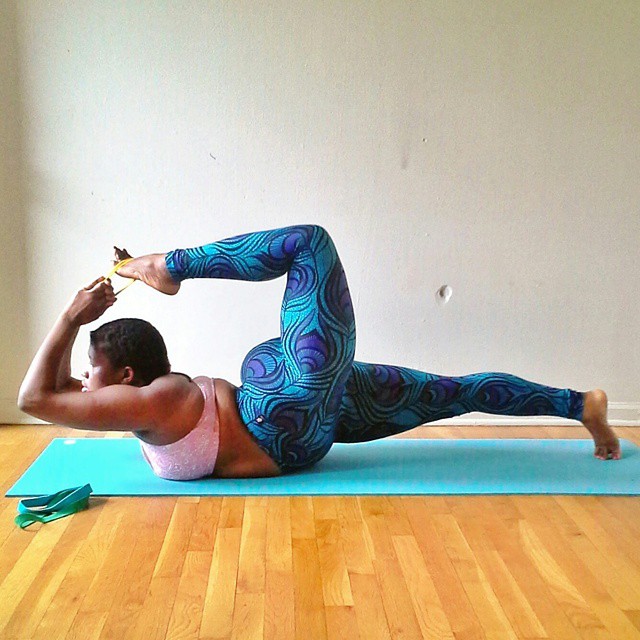
African American woman of size Jessamyn Stanley demonstrates a complex yoga stretch.

Jessamyn Stanley; Photo from Jessamynstanley.com

I have discovered that yoga is one of those concrete ways that we can actually do something to repair ourselves from the damages of patriarchy and toxic activism. And it’s inclusive. There are variations of yoga for all body types and ranges of ability. In activist spaces, so often we focus on the mental emancipation through critical theory, learning, reading, and studying. Yoga is the other half of that–it helps us regain awareness and control over our bodies. Much like veganism, yoga is feminist praxis. For someone like me that has suffered with anxiety for my entire life, I have found that it is an amazing reward to my battered self to just take some time on the mat to stretch and breathe.

And you don’t need any expensive equipment–just comfy clothes and bare feet. I finally splurged on a mat, but it’s not necessary for yoga, just a nicety. For those who cannot afford yoga classes (like me!) or who are geographically isolated (like me!), yoga is freely available online (and allows you to practice from the peace and privacy of your own home). I have found Yoga with Adriene to be an amazing gift. Particularly helpful is her 23 minute “Yoga for a Broken Heart,” which is a gentle, beginner’s level session that will relax and soothe. See also the Instagram and Tumbler of Jessamyn Stanley, who combats the white- and thin-centricism of yoga practice in the West with body-positive curvy yoga. Or, Chelsea Jackson, who integrates critical thinking in her yoga practice for Black-identified persons facing trauma. “I see yoga as a tool to dismantle structural oppression,” she says. “It can help us interrogate systems that are constantly putting us in boxes or marginalizing us.”

Chelsea Jackson; Photo from Yoga Journal

Chelsea Jackson; Photo from Yoga Journal

Finally, if you are fortunate enough to have a companion animal in your family, give them a snuggle. Research shows that interacting with them can lower blood pressure and ease anxiety.

A golden lab puppy and a chocolate lab puppy facing the camera and leaning on one another

If all else fails…flip to a random page and prepare as directed (with appropriate modifications for my gluten-intolerant and diabetic friends!). I have heard many say that cooking and baking is a calming experience. And cupcakes are happiness, no doubt about it.

Cover for "Vegan Cupcakes Take Over the World" cookbook

I agree with Jessica Rowshandel in the acknowledgement that self-care will differ for every individual, and sometimes it’s hard for us to really take it seriously and work it into our schedule. Most of us lack the space, money, freedom, or motivation necessary to take time for ourselves. I don’t have all the answers, but I do want to start a dialogue. Some of you reading this might be new on your activist journey and just want to saturate yourself in negativity and fight through it all, but I have a feeling you will reach a point where you must acknowledge that boundaries are necessary. When you reach that point, I hope your remember this post and revisit it. I may revisit this post as well, as I may have new ideas or experiences to share. In the meantime, you may want to take a peek at this step-by-step self-care guide presented by one of my favorite Black feminist blogs, For Harriet.

Take care and be well my friends.


Corey Lee WrennDr. Wrenn is Lecturer of Sociology. She received her Ph.D. in Sociology with Colorado State University in 2016. She received her M.S. in Sociology in 2008 and her B.A. in Political Science in 2005, both from Virginia Tech. She was awarded Exemplary Diversity Scholar, 2016 by the University of Michigan’s National Center for Institutional Diversity. She served as council member with the American Sociological Association’s Animals & Society section (2013-2016) and was elected Chair in 2018. She serves as Book Review Editor to Society & Animals and has contributed to the Human-Animal Studies Images and Cinema blogs for the Animals and Society Institute. She has been published in several peer-reviewed academic journals including the Journal of Gender Studies, Feminist Media Studies, Disability & Society, Food, Culture & Society, and Society & Animals. In July 2013, she founded the Vegan Feminist Network, an academic-activist project engaging intersectional social justice praxis. She is the author of A Rational Approach to Animal Rights: Extensions in Abolitionist Theory (Palgrave MacMillan 2016).

Receive research updates straight to your inbox by subscribing to my newsletter.

Lessons in White Fragility: When Vegan Abolitionists Appropriate Intersectionality

By: Dr. C. Michele Martindill

A recent blog post essay by Unfriendly Black Hottie (Hottie, 2013) should have prompted an open discussion of the appropriation of intersectionality in the so-called vegan abolitionist animal rights community. So far, that discussion has yet to happen. Why not? Is it another case of a white-centered social movement making Blacks invisible and silencing their voices? Are movement members who use the concept of intersectionality unwilling to or afraid to critically examine their understanding of the concept? To what extent does white fragility (Diangelo, 2011) (see definition of white fragility below) come into play as an explanation for the lack of discursive dialogue? Under the best of circumstances it is painful to examine values and beliefs we hold close to our hearts and to do so with the knowledge we may be wrong. Critical analysis can lead to that feeling of sickness in the pit of the stomach or an unwelcome feeling of embarrassment. It can lead to disorientation and loss of control, rare feelings for those who have long benefited from white privilege and who have the power to define concepts such as intersectionality, appropriation, racism, sexism and feminism to suit their purposes. It can alternatively lead to learning, to growth and the impetus to make social change happen.

Intersectionality is one of the current buzz words in the vegan abolitionist animal rights movement. Some people love it, others hate it. The meanings are varied, confusing and debated across countless online discussion threads. One vegan blogger tells us that, “…intersectionality does not mean that all forms of oppression intersect” and they go on to define it as, “in specific situations, multiple forms of discrimination can create specific situations for a group not described by the forms of oppression that intersect. The primary example is the failure of racism and feminism to describe their intersection for women of colour” (Unknown, Intersectionality and Abolitionist Veganism: Part 1, 2014). The reader is left to wonder if the blogger is suggesting that racism alone or feminism alone cannot explain the “discrimination” experienced by women of color so then it is important to look at the interactive effect of these oppressions. While the blogger provides a brief history of how intersectionality “started to be used frequently in the 1990s and has become something of a fashion in academic circles, rather like “queer theory” in the 1980s,” no direct connection is made to Patricia Hill Collins and Kimberle Crenshaw, the originators of the concept, and queer theory is shoved to the background as nothing more than a trend.

Patricia Hill Collins - "Black Sexual Politics" cover

Random comments sprinkled throughout the rest of the essay serve mainly to keep any discussion of intersectionality white-centered and to argue that veganism will bring everyone together to end all oppressions:

If people are really interested in intersectionality and ending human-on-human oppression, it seems to me that sexism in developed countries might be less urgent (and I say this as a woman) than wholesale slaughter of people, men, women, and children, in Gaza, Afghanistan, Yeman [sic], Syria, and Iraq and the culture of hatred that supports this destruction.

So, intersectionality in this instance becomes a method for rank ordering the form of oppression that most needs to be addressed, but in the next breath all of these oppressions are dismissed in favor of getting people to understand how only a commitment to being vegan will stop the large number of deaths:

Ending war, sexism, racism, oligopoly is important but change will only happen when society as a whole is affected. Veganism is something we can do now, and convince others to do now. It will only result in large social change when there are enough of us, but every single vegan has an impact on how many deaths occur, and it is something we can all do, right now.

Our blogger leaves us with a rationalization of how and why veganism is white-centered and why it such white-centeredness is not a problem:

Veganism is not the province of any race. Just because a majority of online vegans are “white”, that does not make it a “white” issue. I’d guess the majority of people commenting on police killings in the US are also “white”, even though the victims are generally “black”. I’d guess that’s an artefact of internet participation and availability of time, …and it’s changing.

Apparently, if Blacks are not visible online it is simply an “artefact of internet participation and availability.” White centeredness is not a numbers game. It specifically refers to how whites dismiss, ignore and otherwise make invisible the presence of Blacks. Did this blog author even look online for Black vegans? Our author continues:

I look at this issue, the current scurrying to shame abolitionist vegan advocates as racist, with dismay. The promotion of the idea that there are “exceptional” circumstances for people of colour, and that it is racist not to address these circumstances, is not helpful, …and I think it holds a certain contempt for people of colour. The issues of veganism are not different for people of colour. Our thinking is not different. We either recognise the autonomy, the moral personhood, of other animals, and respect them enough not to use them as things, or we don’t. There are no “special” economies for people of colour. Plant-based diets are cheap diets, and traditionally the diets of the poor. There are no “special” cultural conditions for people of colour in most parts of this global consumer world. [emphasis added]

Never mind that Black men are being murdered by the police, that racial profiling is rampant or that poverty rates are at an all-time high among POC, the message here is we can and should ignore intersectionality and just go vegan. Indeed.

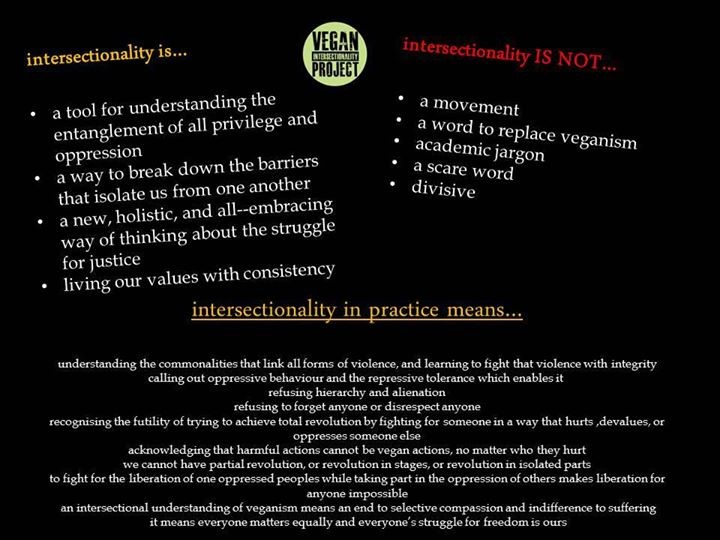
Another vegan animal rights Facebook page that was created specifically to promote intersectionality is The Vegan Intersectionality Project (Unknown, Vegan Intersectionality Project’s Photos, 2015). A single meme effectively sums up their definition of intersectionality:

Vegan Information Project poster about intersectionality

Anyone researching intersectionality on this Facebook page will learn via bullet points it is “a tool for understanding the entanglement of all privilege and oppression, a way to break down the barriers that isolate us from one another, a new, holistic, and all-embracing way of thinking about the struggle for justice, [and] living our values with consistency.” Nowhere on the meme is there mention of or credit given to Patricia Hill Collins or Kimberle Crenshaw, nor is there so much as a tip of the hat to the notion that the concept of intersectionality was never meant to be white-centered. The meme concludes with a statement that is perilously close to the white-centered claim that all lives matter:

Intersectionality in practice means…an intersectional understanding of veganism means an end to selective compassion and indifference to suffering, it means everyone matters equally and everyone’s struggle for freedom is ours [emphasis added]

The author ignores the #BlackLivesMatter campaign which aims to center the discussion of racism with persons of color, and then the author proceeds to suggest that the Black struggle for freedom is the property of whites, that the struggles of others are shared or even owned by whites. How is that even possible? Are whites now being pulled over by police for the crime of driving while white? Are white men now being incarcerated in the prison industrial complex at rates that exceed those of Black men? Whites can never know or share the struggles of Blacks. Also, whites seem incapable of acknowledging the Black discourse on intersectionality, much to the detriment of veganism.

We are at a point now where we have to ask what white vegans are missing when they close their ears and minds to the Black understanding of intersectionality, when the result is the erasure of the lived experiences of Black women. In the essay on intersectionality from the Unfriendly Black Hottie blog the author describes a meeting with Patricia Hill Collins, a Distinguished University Professor of Sociology at the University of Maryland and the first to theorize intersectionality (Collins, 2005). Collins was asked, “How do you feel about the ways white feminists have taken your work on intersectionality as a feminist way to be more inclusive while erasing the creations as part of a Black feminist tradition and without a dedication to Black women’s lives in any way?” While Collins did not use the word appropriation to describe what happened with her work, she related a story of how white musicians took the works of Black jazz and blues artists and imitated them without having the lived experiences that inform the music. Technically, the music is similar, but in the process whites erased Black lives from the music, the very heart and driving force of the music.

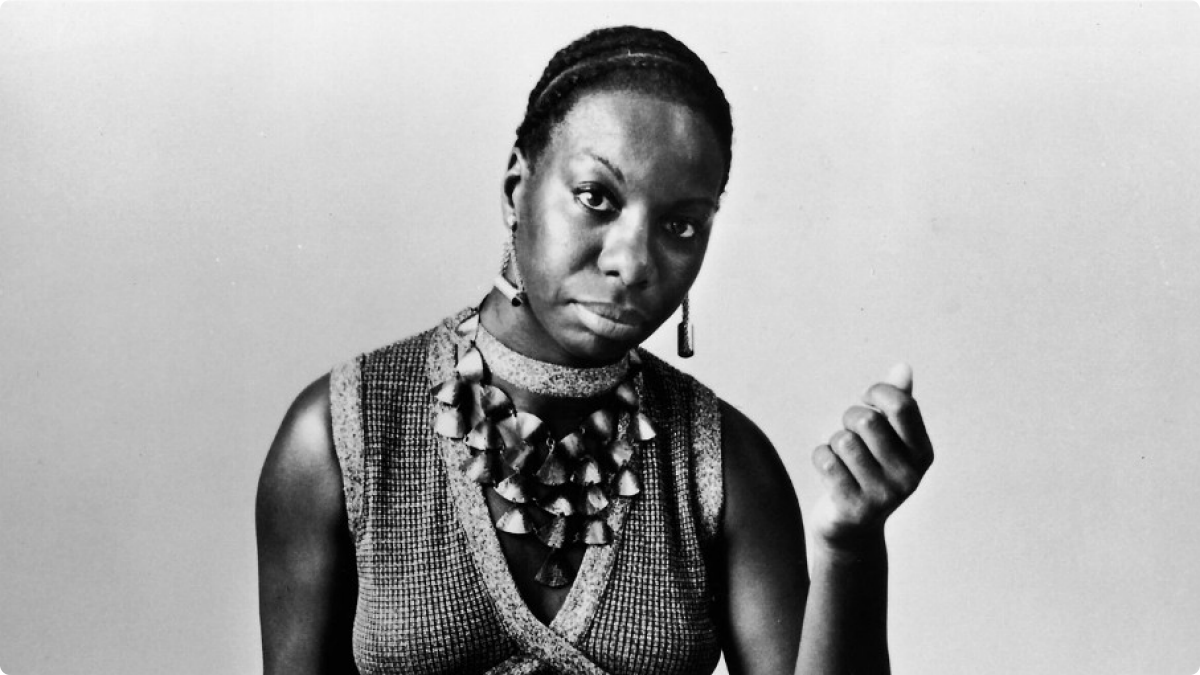
Nina Simone

The Unfriendly Black Hottie author goes on to summarize how Patricia Hill Collins views intersectionality:

intersectionality is meant as a bottom up approach, not a top down approach. those with power cannot be “intersectional”. you are also not living intersectional experiences. intersectionality was always about exposing the ways Black women are caught up in multiple systems of oppression, namely race, gender and class, but often many more. it is meant to help Black women understand their experiences in a white supremacist patriarchal culture like the U.S. or much of Western nations that have applied this model onto most cultures from the outside. most importantly, it is meant to help Black women see the ways their experiences are connected to one another and not a product of self-deficiency but structural real systems that have cultural and economic benefits for ruling/dominant classes. [emphasis added]

understanding Black women live intersectional experiences gives us insight into the ways race, gender and class, heterosexism and more all work together in ways that restrict Black womens access to resources. and access to resources is what is really one of the most important things needed in Black women’s lives. which white feminism is not committed to in any way. when Black women learn more about classism, sexism, racism, heterosexism and more (such as transmisogyny, islamophobia, convicted felon status, etc) and how they work, we learn more about how we can define ourselves without those systems imposing our identities onto us.

In other words, the white-centered, man-dominated leadership of the vegan movement cannot and should not be dictating the meaning and use of the concept of intersectionality. Vegan leadership has no direct experience of intersectionality. White men are a part of the very “white supremacist patriarchal culture” intersectionality is meant to challenge and thereby allow Black women to define themselves sans the systems of classism, racism, sexism and other oppressive systems. Whites are simply wrong to take intersectionality as their own:

when you’re white saying your an intersectional feminist, you are wrong. you are the white boy singing sad songs to a blues twang claiming to be a Blues artist. you are the miley who wears black womens bodies and perceived sexualities as fun identities to put on and off, without living within those experiences always and forever. it is erasure, it is warping, it is the continual narrative of whiteness as a dominant force, in opposing the creators and destroying the creators while then attempting to re-create those creations with whiteness firmly installed inside of it. which is false, warped, fake and without heart and soul. it is a lifeless imitation. and mostly, it isn’t REAL.

So, what is “REAL” as vegans come to terms with the white fragility born of realizing they appropriated a concept and misrepresented it? So far, silence or defensive posturing are the ‘go-to’ responses of vegan leadership, essayists and Facebook responders. They spout clichés such as “all lives matter” or “just go vegan” or “veganism is not about race” or “intersectionality shows the interconnectedness of all oppressions.” When anyone in the animal rights movement claims they are practicing intersectional veganism, defining it merely as wanting justice for all and being against all exploitation and oppression, they are operating under a misguided act of cultural appropriation. They are also working to insure that an upper class white cis gendered ableist man dominated ideology remains at the center of the vegan abolitionist animal rights movement. Intersectionality or pro-intersectionality is not a let’s-have-a-group-hug approach to social justice, nor is it simply a path to growing a revolution—increasing movement membership–that will end all oppressive social systems. If vegans want to be pro-intersectional, the term for those who support Black feminist intersectionality, then they have to acknowledge the history of the concept, stop trying to dismiss intersectionality as a distraction from veganism, and put an end to any practice that de-centers Blacks and inserts white dominance. Specifically, stop the following kind of commentary:

Abolitionist vegans are not being speciesist when they don’t let those raising issues of human oppression hijack a vegan forum. Abolitionist vegan advocacy forums are “non-human animal space” (Unknown, Intersectionality and Abolitionist Veganism; Part II, 2014).

The net effect of this message is to exclude Blacks from yet another white centered organization in much the same way they have been excluded for centuries and by making the all too familiar comparison of Black lives to those of animals, only this time Blacks are not as welcome as the animals.

Shouting Intersectionality

It is no wonder that veganism is now seen as an apolitical mish-mash of diet fads. When people are told to just go vegan or that veganism is only for the animals, then what they are really being told is vegans are not serious about pro-intersectionality, about becoming an inclusive movement. The whiteness of the abolitionist vegan movement isn’t an illusion based on white online involvement—the whiteness of the movement happens because vegans are known for their appropriation of Black culture and history, e.g. abolitionism was taken without permission:

Abolitionism as it was first conceived was built and mobilized to free oppressed humans who continue to be oppressed. For vegan advocates to completely appropriate the language and ideas of this movement and then forsake suffering humans, abandon them in their time of need, aggravate their hurting, benefit from their hurting, and then accuse victims and survivors of selfishness is deplorable. Without a doubt, this approach will only further alienate anti-speciesist efforts, tarnishing it as yet another a space of violence, oppression, and white male Western privilege (Wrenn, 2014).

Dismissing and ignoring the suffering of humans makes a mockery of anti-speciesism, of its aim to stop rank ordering others based on their perceived value. Vegans need to stop putting whites at the top of the ladder, granting them the power to tell others who matters and who doesn’t, who should be heard and who shouldn’t. White fragility, that roller-coaster-whooshy feeling in the pit of the stomach, can be a signal to stop rationalizing the status quo and to stop colonizing Black spaces in order to appropriate their language or whatever else abolitionist vegans deem useful. Stop appropriative behaviors. At the same time, know it is not putting humans over the animals when we practice pro-intersectionality; rather, it is centering and respecting the resistance of Black feminists, resistance to the racism, sexism, ageism, classism, ableism and speciesism of a white man dominated patriarchal society. Veganism was never meant to be a justification for white dominance or appropriation.


Definition of White Fragility:

White Fragility is a state in which even a minimum amount of racial stress becomes intolerable, triggering a range of defensive moves. These moves include the outward display of emotions such as anger, fear, and guilt, and behaviors such as argumentation, silence, and leaving the stress-inducing situation. These behaviors, in turn, function to reinstate white racial equilibrium. (Diangelo, 2011)


Michele Spino MartindillDr. Martindill earned her Ph.D. in sociology from the University of Missouri and taught there in the Sociology Department, the Peace Studies Program and the Women’s and Gender Studies Department. Her areas of emphasis include political sociology, organizations and work, and social inequalities. Dr. Martindill’s dissertation focuses on the no-kill shelter social movement and is based on ethnographical research conducted during several years of working in an animal shelter. She is vegan, a feminist and is currently interested in the stories women tell through their needlework, including crochet, counted cross stitch and quilting. It is important to note that Dr. Martindill consistently uses her academic title in order to inspire women and members of other marginalized groups to pursue their dreams no matter what challenges those dreams may entail, and certainly one of her goals is to see more women in academia.
 

References

Collins, P. H. (2005). Black Sexual Politics: African Americans, Gender, and the New Racism. Routledge.

Diangelo, R. (2011). White Fragility. International Journal of Critical Pedagogy, 54-70.

Hottie, U. B. (2013, November 6). Unfriendly Black Hottie. Retrieved from Unfriendly Black Hottie: http://femmefluff.tumblr.com/post/66233480328/like-being-very-clear-when-i-asked-patricia-hill

Unknown. (2014, December 14). Intersectionality and Abolitionist Veganism: Part 1. Retrieved from Abolitionist Veganism: Issues in the Movement: https://veganethos.wordpress.com/2014/12/14/intersectionality-and-abolitionist-veganism-part-i/

Unknown. (2014, December 26). Intersectionality and Abolitionist Veganism; Part II. Retrieved from Abolitionist Veganism: Issues in the Movment: https://veganethos.wordpress.com/2014/12/26/intersectionality2/

Unknown. (2015, April 17). Vegan Intersectionality Project’s Photos. Retrieved from Facebook: https://www.facebook.com/774093712704517/photos/pb.774093712704517.-2207520000.1430768357./774431842670704/?type=1

Wrenn, C. (2014, December 13). Intersectionality is a Foundational Principle in Abolitionism. Retrieved from The Academic Abolitionist Vegan: http://academicabolitionistvegan.blogspot.com/search/label/Intersections

LUSH Cosmetics: Kind(ish) to Animals, Not to Women

By Corey Lee Wrenn, M.S., A.B.D. Ph.D.

Lush Not Vegan

LUSH Cosmetics is known for its handmade and largely cruelty-free bath and beauty products. While not a vegan company, LUSH has expanded into the realm of Nonhuman Animal rights advocacy. Under its “Fight Animal Testing” campaign, for instance, LUSH has been pressuring governments to end vivisection, even offering a large cash reward to anyone who can develop a solution.

While a concentrated effort to improve the condition of Nonhuman Animals is commendable, LUSH unfortunately replicates many of the harmful, misogynistic tactics favored by full-time animal rights organizations like PETA. Offering some vegan products in its stores and getting active to end some forms of Nonhuman Animal exploitation is obviously a good thing, but the damage LUSH could be doing to women is alarming.

Take, for example, its anti-vivisection street demonstration that featured a young woman in a nude body suit enduring graphic reenactments of torture at the hands of a male “researcher” for ten hours. The woman was dragged about by a rope tied to her neck, forcibly pushed into various positions, and force-fed. She was pulled by her hair, injected with saline needles, and her head was shaved. While the woman was a consenting professional performer, the pain she endured was clearly real. This event took place in a store window and was fully visible to the public.

The use of a female actor was no coincidence. LUSH explains:

“We felt it was important, strong, well and thoroughly considered that the test subject was a woman. This is important within the context of Lush’s wider Fighting Animal Testing campaign, which challenges consumers of cosmetics to feel, to think and to demand that the cosmetics industry is animal cruelty free.  It is also important in the context Jacqui’s performance practice:  a public art intervention about the nature of power and abuse.  It would have been disingenuous at best to have pretended that a male subject could represent such systemic abuse.”

LUSH intentionally chose a female actor to endure 10 hours of torture in a public space to, in so many words, teach women a lesson. Incidentally, products marketed to women are much more likely to be free of animal testing, unlike men’s products. The next time you are in a store that sells toiletry items, check the packaging of men’s products. How many are cruelty-free? You will be hard pressed to find any. Furthermore, most animal testers, farmers, and slaughterhouse workers are men. Men are more likely to hunt and men consume more Nonhuman Animal products than women. It’s even men who are buying animal hair coats, as the ability to adorn women with “fur” acts a male status symbol. Is it really so disingenuous to question men’s role in the systemic exploitation of animals?

The truth is that women are easy targets. Women are LUSH’s primary customers, and I suspect that LUSH is hoping to frighten women into choosing LUSH products over its competitors. LUSH is drawing on and aggravating the reality of male-on-female violence to secure sales.

LUSH has hosted many similarly problematic promotional stunts. For instance, one anti-vivisection demonstration featured bound women on their knees lined up outside the store with their mouths taped over. A woman dressed as a scientist (drawing on male imagery) loomed beside them. At another store, female employees were dressed as foxes and coquettishly arched their backs, smiling as a man threateningly hovered over them with a kitchen knife.

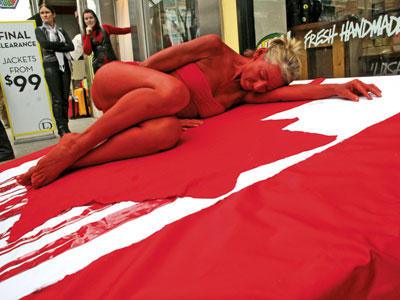
White woman covered from head to toe in red paint wearing only underwear laying in the center of a Canadian flag as though she was dead in front of a LUSH store

Nonhuman Animal rights organizations frequently use a woman’s body that has been sexualized in some way to represent an abused, tortured, or dead victim. The intentional conflation of sex and violence is particularly problematic.

One store featured a 24 hour storefront display of an anguished woman in a leg-hold trap. In another, a woman was suspended by hooks inserted through the skin in her back to protest shark fishing. In a French store, a woman dressed as a rabbit cried out in anguish as her “fur” was peeled away, displaying her raw flesh below. Her naked body had been painted to resemble bloodied muscles.

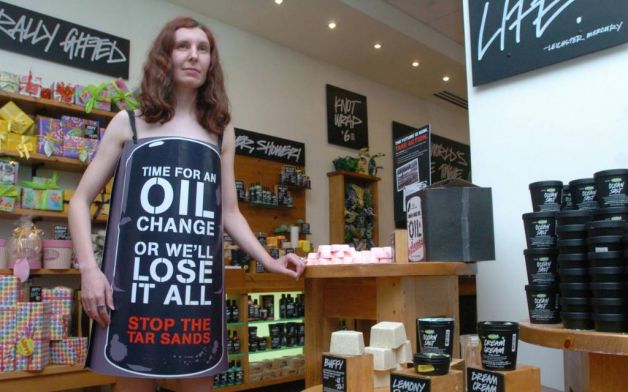
LUSH is not afraid to use nudity, either. Protesting oil dependency, naked store employees wore mock oil barrel signs that cheekily read, “Time for an oil change or we’ll lose it all.” In one worldwide event, LUSH employees (who are mostly female) were paraded outside the store wearing nothing but aprons and high heels to hand out leaflets announcing LUSH’s “reduced packaging.” For some stores, aprons read: “Ask me why I’m naked.” Encouraging nude female employees to approach gazing men with LUSH leaflets is unsettling. But, handing out soon-to-be-trashed leaflets to men who are probably not in the market for bathbombs to advertise reduced packaging is just confusing. What’s the real objective here?

White woman wearing barrel sign, nude underneath in LUSH store

Entering a LUSH store is a magical experience, I can’t deny that. Stores are fragrant and colorful, and the staff is friendly and knowledgeable. I love having more than one vegan product to choose from (although I’m still confused as to why LUSH refuses to go completely vegan). I actually wore Karma perfume for 6 years, but I can no longer shop with LUSH (I switched to Pacifica, which is 100% vegan and does not demean its female employees). I also informed my friends to find alternatives to the LUSH gift certificates I often receive.

It is clear to me that LUSH is exploiting the victimization and sexual objectification of women for profit. If LUSH is sincerely expecting these stunts to combat oppression, it might consider that aggravating normalized violence against women is counterintuitive to a campaign hoping to end violence against Nonhuman Animals. A message of peace and justice cannot be clearly articulated through oppressive actions.

There are many completely vegan and genuinely cruelty-free companies selling natural, hand-made cosmetic products that don’t throw women under the bus “for the cause” (or for the company). When (and if) LUSH decides to grant the same respect to women as it purports to grant to Nonhuman Animals, perhaps I’ll be smelling of orange blossom and patchouli again one day. In the meantime, I’m shopping elsewhere.


Corey Lee WrennDr. Wrenn is Lecturer of Sociology. She received her Ph.D. in Sociology with Colorado State University in 2016. She received her M.S. in Sociology in 2008 and her B.A. in Political Science in 2005, both from Virginia Tech. She was awarded Exemplary Diversity Scholar, 2016 by the University of Michigan’s National Center for Institutional Diversity. She served as council member with the American Sociological Association’s Animals & Society section (2013-2016) and was elected Chair in 2018. She serves as Book Review Editor to Society & Animals and has contributed to the Human-Animal Studies Images and Cinema blogs for the Animals and Society Institute. She has been published in several peer-reviewed academic journals including the Journal of Gender Studies, Feminist Media Studies, Disability & Society, Food, Culture & Society, and Society & Animals. In July 2013, she founded the Vegan Feminist Network, an academic-activist project engaging intersectional social justice praxis. She is the author of A Rational Approach to Animal Rights: Extensions in Abolitionist Theory (Palgrave MacMillan 2016).

Receive research updates straight to your inbox by subscribing to my newsletter.

Celebrating a Racist, Abusive Sheriff is Not Vegan

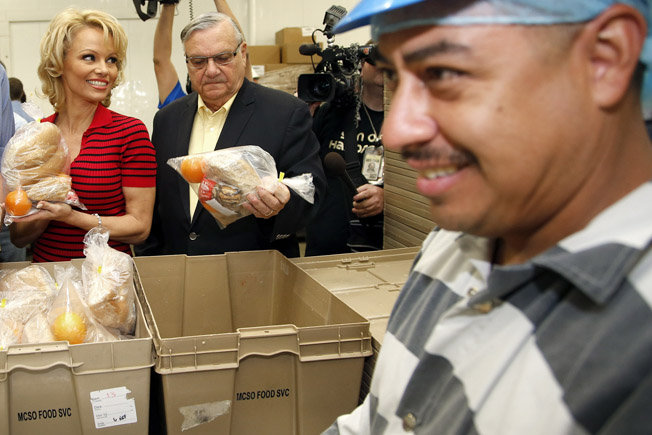
Pamela Anderson and Joe Arpaio inspect bags full of vegetarian meals that are being packed into boxes. A Hispanic inmate in the foreground smiles.

By Prison Isn’t Vegan

PETA and their celebrity spokesperson Pamela Anderson made headlines this week by traveling to Pheonix to promote Sheriff Joe Arpaio. For those that don’t know, “Sheriff Joe” has been widely criticized for racial profiling of Latinos, racist discrimination against inmates, abuse of power, illegal arrests and deplorable conditions in jail, including numerous wrongful deaths under his watch.  This criticism has come from traditional human rights organizations like Amnesty International and ACLU, along with the New York Times (who called him “America’s Worst Sheriff“) and the U.S. Department of Justice who sued him for “intentionally and systematically discriminating against Latinos.”

So why exactly did Pamela and PETA decide to showcase “Sheriff Joe?” Because he serves vegetarian food to the inmates at Maricopa County Jail.

Sheriff Joe and Pamela Anderson

PETA is trying to spin it as a way to protect animals and promote health, but it’s clear Arpaio’s decision to serve vegetarian food is because it’s cheaper. In attempt to save money, “Sheriff Joe” has moved toward only serving two meals a day,charging inmates for their own meals, serving green bologna and has cut out salt, sugar and condiments from meals.

Examples of Arpaio’s abusive treatment of inmates are too extensive to list here (including “Tent City” in 135 degree heat, use of chain-gangs, and many others). While Arpaio’s specific form of racist abuse makes PETA and Anderson’s gesture of support particularly egregious, support for any jail or prison is problematic for an organization promoting veganism from an animal rights perspective.

Veganism rooted in a desire to liberate all animals from captivity and exploitation is inconsistent with supporting prisons. Prisons encage and exploit human animals.

This is particularly true in the context of the prison-industrial complex. Inmates (human animals) are held in captivity and forced to work against their will, while others profit from this captivity and forced labor. Arpaio’s use of chain-gangs is an excellent example of this. Inmates are forced to work in order to get out of lockdown. They do not get paid, providing free labor to the County. If another species were exploited for the financial benefit of humans, animal rights organizations would actively oppose it (as they should). It would be easy to imagine PETA criticizing animal “chain-gangs” given their opposition to animal-based industries and their position on chaining dogs.

A likely response will be that the people in prisons did something to be there, unlike animals on farms or at zoos. As part of the press release, Pamela Anderson said “I believe people can be rehabilitated from the inside out. Jails are full of people wanting to change, to make amends, to learn healthier habits and understand compassion and empathy.”

But there are two things to consider about this:

First, PETA and Pamela went to a jail, not a prison. There’s a difference. The majority of people in jail are pre-trial, meaning they have not been convicted and are presumed innocent in our society. Those in jail are people awaiting trial who could not afford to post bail. So overwhelmingly, the people in Maricopa Jail and county jails like it are poor and working-class people who have not been convicted of any crime. The small percentage who are in jail after a conviction have been convicted of misdemeanors – lesser crimes including traffic violations, vandalism, minor drug possession, etc.

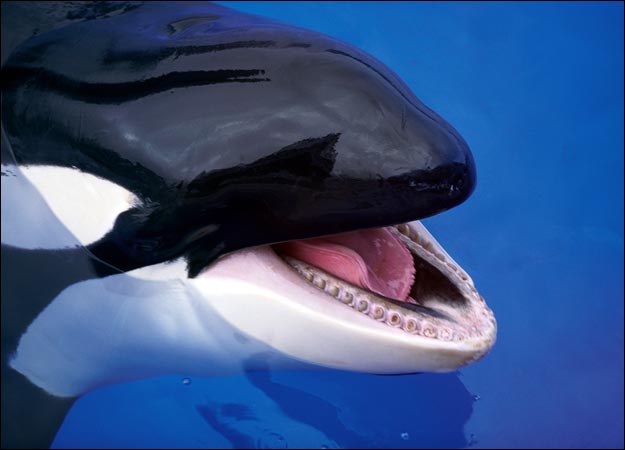
Second, incarceration doesn’t rehabilitate. The disconnect in the analysis of some animal rights activists is striking when comparing anti-social behavior among humans and non-human animals.  One example is Tilikum, the Orca held at SeaWorld who has killed three different trainers. The animal rights perspective has been to look at the trauma Tilikum suffered by being captured and held in captivity. No animal rights organization or activist would claim that the appropriate response is to continue to hold him in captivity in order to “rehabilitate” him.

Image of orca in aquarium

Similarly, animal activists embrace a thoughtful, nuanced and empathetic approach toward problematic behavior in dogs. (Something I’m familiar with from fostering and adopting rescued dogs). In addressing dog behavior, animal advocates encourage looking to the socialization, history and experiences of each individual animal: What in their background causes them to behave (or misbehave) in a particular way and how can you deal with the underlying cause? No dog trainer would suggest that locking a dog in a cage for years would be an effective way to get a dog to end their bad behavior. (Note that PETA takes a strong position against using dog crates) Yet PETA and other animal welfare organizations perpetuate the myth that caging humans leads to “rehabilitation.”

Embracing a radical social analysis means challenging and critiquing all societal assumption. And supporting liberation of all living things means freeing all humans from the cages of prisons.


This essay was originally published by NoCages.org on April 14, 2015.


Editor’s Note:

Sarah K. Woodcock of The Abolitionist Vegan Society argues that veganism is a practice that refers specifically to Nonhuman Animals. While supporting racial profiling and the imprisonment of humans is certainly inconsistent with the social justice ethic that undergirds veganism, veganism is an ethical position that directly and exclusively represents nonhuman animals.