Dear New Vegan

TRIGGER WARNING: Discusses sexism and sexual violence.

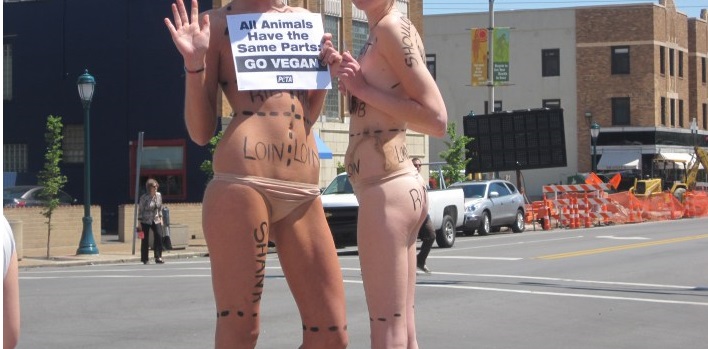
Two young thin white PETA volunteers pose naked on a street corner with their bodies marked like meat cuts holding a PETA sign that asks viewers to go vegan

Dear New Vegan,

Brace yourself, because it’s going to be a bumpy ride. Becoming vegan is, at first, a very frustrating and traumatizing experience. You will have to learn what to eat, what to buy, how to deal with friends and family, and how to manage the intense feelings of anger and sadness that come with opening your mind and heart to the suffering of others. None of this is going to be easy, but, please don’t give up, because it will definitely get easier the longer you stick with it. It will become normal and habitual before you know it, I promise.

You will probably reach out to the vegan community to help you through this transition. You will make lots of great friends and learn a lot from others. You will find great peace in knowing you are not alone and that other folks are out there who are just as passionate as you are about changing the world.

Eventually, however, you may start to realize that being vegan is one thing, but being vegan and female-identified1 is another one altogether. If you are in a relationship, you may find your partner is hostile to your choice. Especially if your partner is male-identified, your vegan presence may present a challenge to his masculine authority. He may insist that you can never change him (even if you never mentioned any intention of doing so!). He may insist that you cook non-vegan meals, or join him in non-vegan restaurants. As a self-identified woman, you may feel considerable pressure to concede. Women are groomed from early on to put the interests of men first. It stinks, but that’s how it is. Don’t feel bad if you do.

Woman looking outraged as her male partner scoffs down a burger

If you are a self-identified woman, you may find that male-identified friends are turned off to your veganism as well. For example, a well-meant Facebook post that reminds your readers that Nonhuman Animals matter, too, may aggravate men who are quick to respond with comments about how you’re a) too sentimental; b) loudmouthed; or c) “crazy.” Emotionality, outspokenness, and mental illness are all highly gendered characteristics. Women are easily dismissed for being either too feminine, or not feminine enough. For centuries, we women have been stereotyped as “hysterical” and subsequently institutionalized to control us and shut us up. You’ll often find yourself between a rock and a hard place: don’t be too sappy, but at the same time, watch your tone and don’t be too aggressive. You’ll find they’re pretty much impossible to please, and I suggest you just keep doing what you do.

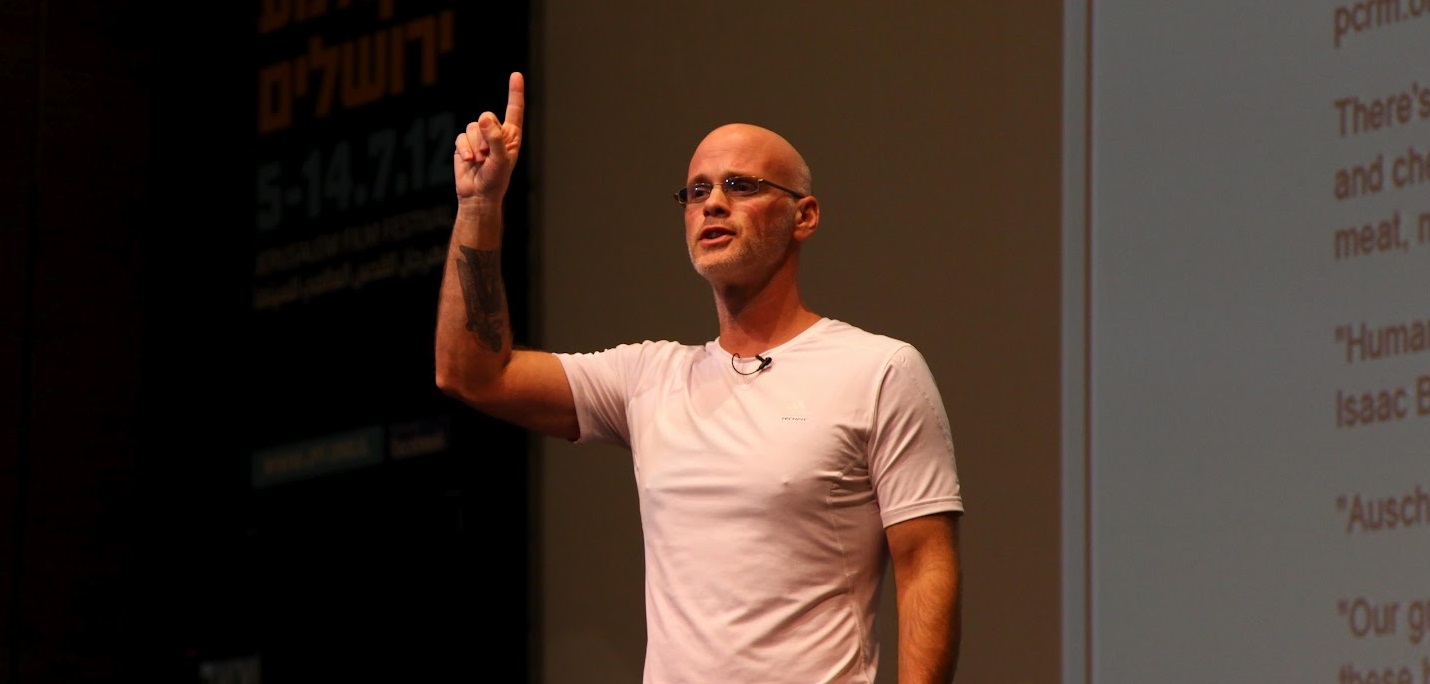
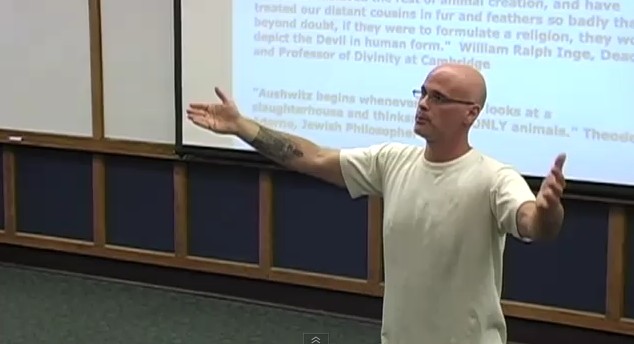
Male-identified vegan leader gives talk with microphoneBut your struggles as a vegan woman might not end there. If you decide that simply being vegan isn’t enough and that you want to get involved with activism, you are going to come up against more male violence. Vegan activism is dominated by women as far as the numbers go, so you may think it’s a safe space for you. In many ways, it is. You will find female solidarity. On the other hand, the vegan movement is very much controlled by men. Men lead vegan activism—they create the theory and they define what tactics are acceptable. They take up the most space and their voices are loudest.

What this means is that you are going to feel a lot of pressure to help other animals by taking a quiet role behind the scenes in support of these men. You may also be encouraged to take your clothes off for some campaigns. It may not be men directly telling you to get naked (women are in on it, too), but the patriarchal norms of the movement have created an environment where women are simply expected to become sex objects “for the animals.” You might start to think that getting naked for the cause is “liberating.” If you start thinking that, woah, stop. Think again. Consider also that only thin, white, cis women are allowed to “empower” themselves for other animals, and that turning men on sexually is not the same as turning men on to veganism. Empirical research shows that facilitating the oppression of women does not challenge the oppression of other animals.

You will also find a lot of sexual harassment and violence against women in the vegan movement. I don’t mean to scare you off, but it’s true, and you should be warned. It’s something that isn’t talked about a lot, but it’s actually quite common. If you are a woman, don’t let this deter you; just remember that commitment to social justice for Nonhuman Animals does not necessarily translate to a commitment to social justice for all. Really, those men who insist they care about the rights and wellbeing of women, people of color, and other disadvantaged human groups tend to be just as dangerous as those who don’t purport to care at all. If you identify as a man, I implore you to step up and work to make advocacy spaces safer.

Sadly, the work of changing the world is men’s work. If you are female-identified, you are likely to meet resistance if you want to participate in vegan outreach in ways more meaningful than making the coffee or stripping. It doesn’t have to be that way. Try not to lose yourself. Stay strong, demand voice, and demand that you be respected. Insist that veganism be a positive and affirming experience. Do not let the oppressive mentalities of some prevent you from doing the important work you’ve set out to do. And men, please stand with women in solidarity. We could use your help.

P.S. If you are a woman of color, that’s a whole extra set of challenges. As a white woman myself, I can’t speak to the depth of these challenges, but I can tell you that the vegan movement can be a really nasty “color blind” place at times. Definitely check out the Sistah Vegan Project!

Notes:

1. This piece speaks to the female experience, which may include that of trans women, intersex women, and gender-queer women. It should be acknowledged that trans, intersex, and gender-queer vegans have a number of additional challenges faced by the movement.

This piece was originally submitted to an advocacy anthology designed to introduce new vegans to the movement, but did not make the final cut. I suspect that the piece was accepted but later rejected due to its political undertones. It is reproduced here because I feel strongly about bringing honesty and accountability to our movement as a matter of justice for marginalized women. For more information on sexism in the Nonhuman Animal rights movement, please see my book, A Rational Approach to Animal Rights: Extensions in Abolitionist Theory (Palgrave Macmillan 2016). Please also see my publication with the Journal of Gender Studies, “The Role of Professionalization Regarding Female Exploitation in the Nonhuman Animal Rights Movement and my essay for The Feminist Wire, “Gender Policing the Vegan Woman.”


Corey Lee WrennDr. Wrenn is Lecturer of Sociology. She received her Ph.D. in Sociology with Colorado State University in 2016. She received her M.S. in Sociology in 2008 and her B.A. in Political Science in 2005, both from Virginia Tech. She was awarded Exemplary Diversity Scholar, 2016 by the University of Michigan’s National Center for Institutional Diversity. She served as council member with the American Sociological Association’s Animals & Society section (2013-2016) and was elected Chair in 2018. She serves as Book Review Editor to Society & Animals and has contributed to the Human-Animal Studies Images and Cinema blogs for the Animals and Society Institute. She has been published in several peer-reviewed academic journals including the Journal of Gender Studies, Feminist Media Studies, Disability & Society, Food, Culture & Society, and Society & Animals. In July 2013, she founded the Vegan Feminist Network, an academic-activist project engaging intersectional social justice praxis. She is the author of A Rational Approach to Animal Rights: Extensions in Abolitionist Theory (Palgrave MacMillan 2016).

Receive research updates straight to your inbox by subscribing to my newsletter.

PETA Sexualizes Woman’s Death in Canine Heat Exhaustion Campaign

Trigger Warning: Post contains misogynistic audience responses to campaign discussed. Also contains discussion of violence against women (specifically abduction and murder).

Not Safe for Work: Post contains misogynistic audience responses that utilize vulgar language.

Elisabetta Canalis in low cut tank top sweaty and passed out in the front seat of a car

With summer upon us, leading animal welfare organization PETA has been drawing attention to the dangers of locking dogs in cars with a commercial featuring model Elisabetta Canalis dying of heat stroke. PETA’s promotional website graphically describes Canalis’s death, calling it a “scorcher”:

As the car heats up, Elisabetta experiences the agonizing symptoms of heatstroke. As panic and anxiety set in, Elisabetta’s condition deteriorates rapidly with the addition of excessive thirst, lethargy, lack of coordination, and a rapid heartbeat. Scared and alone, she desperately attempts to escape the car, which is quickly heating up like an oven.

Essentially, the video shows a scantily clad Italian supermodel locked in a car against her will where she suffers and dies. PETA exclaims: “Italian supermodel Elisabetta Canalis knows what it means to be hot!”

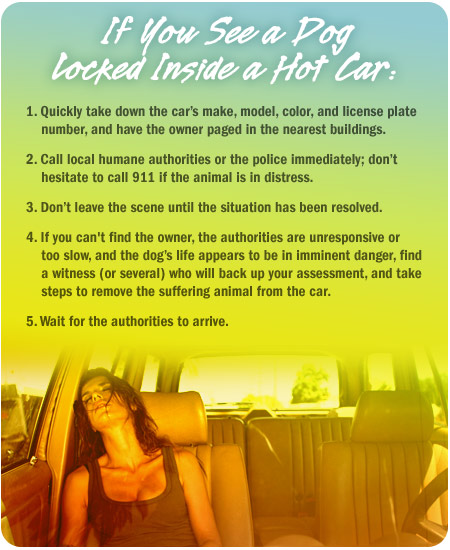
Nowhere in the commercial or on the promotional page is a dog ever shown. At all points, the “dog” referred to is the woman. Even the tip sheet listing appropriate actions for dogs found locked in cars shows an image of Canalis dead in the front seat.

PETA flyer for canines in cars: "If you see a dog locked inside a hot car: 1. Quickly take down the car's make, model, color, and license number, and have the owner paged in the nearest buildings. 2. Call local humane authorities or the police immediately; don't hesitate to call 911 if the animal is in distress. 3. Don't leave the scene until the situation has been resolved. 4. If you can't find the owner, the authorities are unresponsive or too slow, and the dog's life appears to be in imminent danger, find a witness (or several) who will back up your assessment, and take steps to remove the suffering animal from the car. 5. Wait for the authorities to arrive.

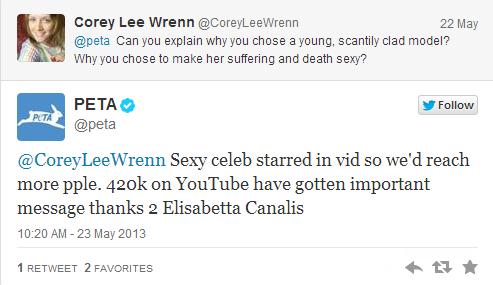
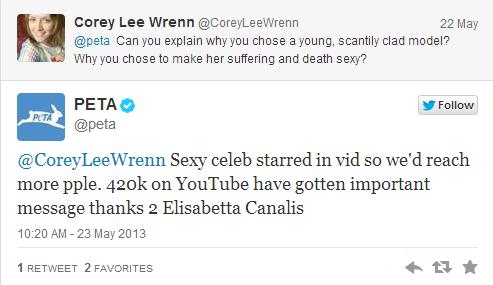
PETA defends the sexualization of this woman’s violent death because “sexy celebs” attract more viewers.

Twitter user asks PETA, "Can you explain why you chose a young, scantily clad model? Why you chose to maek her suffering and death sexy?" PETA responds: "Sexy celeb starred in vid so we'd reach more pple. 420k on YouTube have gotten important message thanks 2 Elisabetta Canalis"

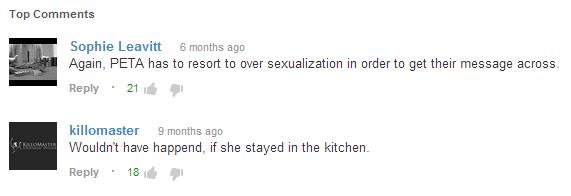
If attracting more viewers is the goal, it’s certainly working. But if educating the public on Nonhuman Animal issues is the intent, the message seems to be lost on many. For example, the top two comments on the commercial’s Youtube page read: “Again, PETA has to resort to over sexualization in order to get their message across” and “Wouldn’t have happened, if she stayed in the kitchen.”

PETA-Summer-Scorcher-Top-Comments

Similar comments characterize the public’s response:

dog damn! I have never realized how sexy it was to let a dog closed in a car for a few minutes!!!

I want to get trapped whit (sic) that dog in the worst summer day god ever create (sic) if you dont (sic) mind.

i think this video is a great lesson to all women everywhere on the dangers of leaving the kitchen.

yay im going to do this to females, thank you peta for the idea

Women=dogs

mmm let me get in that car too n heat thangs up a bit more /licks lips

I bet this ad would have been cooler if she de-robed!

This did not teach me or change my mind on anything about animals…just made me want to fap it

never leave ur bitches in the car…got it…

This video has backfired in 2 ways: 1, I now regard women as dogs, 2, now I have a heat exhaustion fetish

And yet PETA insists the model is sexy, not her suffering and death. The point of the video, it reassures, is to “show how wrong it is to lock a living being in a car.”

Twitter user to PETA: "This advertisement draws heavily on imagery of violence against women, and you sexualized it. I believe it was intentional. PETA responds: "Sry u feel that way, that wasn't the point of the video. There was no violence, other than the extreme heat in the car."

More likely, the point of this video is to exploit sexualized violence against women to bring attention to PETA. Depicting a panicked woman locked in a car against her will is drawing on imagery of kidnapping, rape, and murder, an all too common occurrence for women. I can’t even say I’m convinced this is intended to draw attention to dogs when dogs are completely absent from the campaign.

Elisabetta Canalis PETA Car

PETA’s intentions may be good, but its facilitation of rape culture is unmistakable. A lot of money and time goes into advertising campaigns—these images were intentionally chosen to trigger particular cultural knowledges. It is not an accident it chose a “sexy” woman pounding on the windows in a desperate attempt to escape as she dies trapped in a car. The sexualization of rape and violence against women is a cultural norm, it’s something we respond to.

But aggravating violence against woman is not a valid justification for advocating on behalf of dogs or other animals. As evidenced in the viewers’ responses, trivializing the oppression of women to challenge the oppression of other vulnerable groups is not effective. People tune in for sexy misogyny, and exactly what they get.


This essay originally appeared on Feminspire on May 28, 2013.


Corey Lee WrennDr. Wrenn is Lecturer of Sociology. She received her Ph.D. in Sociology with Colorado State University in 2016. She received her M.S. in Sociology in 2008 and her B.A. in Political Science in 2005, both from Virginia Tech. She was awarded Exemplary Diversity Scholar, 2016 by the University of Michigan’s National Center for Institutional Diversity. She served as council member with the American Sociological Association’s Animals & Society section (2013-2016) and was elected Chair in 2018. She serves as Book Review Editor to Society & Animals and has contributed to the Human-Animal Studies Images and Cinema blogs for the Animals and Society Institute. She has been published in several peer-reviewed academic journals including the Journal of Gender Studies, Feminist Media Studies, Disability & Society, Food, Culture & Society, and Society & Animals. In July 2013, she founded the Vegan Feminist Network, an academic-activist project engaging intersectional social justice praxis. She is the author of A Rational Approach to Animal Rights: Extensions in Abolitionist Theory (Palgrave MacMillan 2016).

Receive research updates straight to your inbox by subscribing to my newsletter.

Of Breeders, MOOs and Overpopulation: Eugenics in the Animal Rights Movement

Trigger Warning: Post contains potentially upsetting discussion of eugenics, forced sterilization and racially insensitive commentary from the white-centric Nonhuman Animal rights community. Also references sexist, classist, and ableist positions that are responsible for considerable structural harm to vulnerable demographics.

Large crowd of people

By: Dr. C. Michele Martindill

Stories about overpopulation appear so often in the news and op-ed essays they are barely gets a second glance. Overpopulation is blamed for all the ills of the social world, everything from obvious social problems such as poverty and hunger to less known concerns such as climate change and deforestation of the planet. Rarely is the concept of overpopulation questioned or defined beyond citing the overall population of planet earth or particular nation states. It is easy enough to find the figures—earth now has an estimated population of 7,318,275,998 as of this writing (Current World Population, 2015) and the United States has an estimated population of 324,907,247. Whenever news stories question how to dispose of the vast amounts of garbage generated by such numbers or to address an environmental hazard such as carbon emissions the first thought is to reduce the population that is destroying the planet. Sociologist David L. Altheide, author of Creating Fear: News and the Construction of Crisis (2002), argues that such stories are morality plays that unfold in “news reports, reality TV shows,…and documentaries,…it is the world of predators and prey, criminals and citizens,…Stories tend to be told from the perspective (voice) of the victim or criminal justice agents; seldom do we see or hear the accused outside of a prescribed role, for example, in handcuffs (193).” In many respects overpopulation is a morality play, pitting the dominant elite white culture against Persons of Color, women and anyone living in poverty, those who are handcuffed.

Vegans are divided in their response to overpopulation stories, but they seem to agree something must be done to save the planet and the lives of animals. Some vegans are vocal in their belief that if the human population was reduced or even eliminated then animals would no longer be slaughtered for consumer products, and the environment would heal. In an effort to counter overpopulation scare tactics, there are other vegans who quickly assert how livestock production contributes to water pollution, desertification of the land, displacement of Native populations and carbon emissions, but they become mired in point-counterpoint debates over environmental science, giving scant attention to the human groups most affected by the overpopulation morality play. They suggest the solution is more education and accessible birth control so that women can make better choices and stop having such large families. The problem in each instance is the absence of critical thought regarding the use of the term overpopulation. Specifically, as long as the vegan animal rights movement frames the discussion about human procreation as a choice argument grounded in pseudo-concern for the fate of the planet and economics, the movement ignores a far more serious threat and deep contradiction to veganism: the advancement of eugenics, the belief that the human gene pool can and should be improved through selective procreation and forced sterilization.

Any overpopulation claim that fails to address eugenics and simply demands that humans have to stop procreating because the planet and its resources are threatened is nothing more than a pseudo concern for the planet, a concern meant to disguise racism, classism and sexism. Overpopulation is a socially constructed concept with a long history of being promoted by the white man cis gendered elite scientists and corporations of the world. Stripped of polysyllabic terminology and statistical arguments about environmental damage, overpopulation is nothing more than a nameless, faceless scare tactic. Its aim is to objectify the so-called unruly masses, to deny them their rights, and to glorify the wealthy elite by encouraging them to procreate and populate the world with their precious gene pool. Those who assert that no one should procreate regardless of social status still fail to acknowledge the sexism and racism of such a demand.

Cartoon with oil well exploding with people, reads, "The well is dry, but we've got a gusher of new customers"

Certainly there is an element of truth to the overpopulationist propaganda, e.g. climate change is real, but it has little to do with the number of humans on the planet and everything to do with the overpopulation of cattle (McKnight, 2014). Oil spills, deforestation and global poverty are not the result of overpopulation; rather, they can be directly linked to corporate greed, capitalism that regards the earth as nothing more than an endless supply of materials for consumer goods and the military-industrial complex that values war over investing in real peace keeping efforts such as feeding the hungry. Arguments against these and other overpopulationist claims can be refuted statistic by statistic, but such debate will do nothing to reframe the issues in a way that accentuates the hidden agenda of overpopulationists—their racism, sexism, ableism and classism. Any future dialogues need to focus on individualism, social darwinism and eugenics, the ideologies that underpin the entire overpopulation perspective.

The rift between overpopulationists and social justice advocates both within and outside of the vegan movement is growing, thanks in large part to the hatred of humans so frequently espoused by animal rights leaders such as Gary Yourofsky and his loyal followers. Off-hand comments about humans not deserving to live because they are responsible for all of the suffering brought on other animals are expressions of the overpopulationist dogma and based in individualism. In order to understand how social darwinism and eugenics work it is necessary to first look at the concept of individualism (see Note 1).

Individualism is the belief that each person is only responsible for their own self and will receive rewards—wealth, salaries, social position, education, access to medical care—based on individual merit. This belief system is used to support capitalism and to keep the working class motivated while performing mundane tasks in dead end jobs. As long as workers believe if they work hard enough they can rise in social class and accumulate wealth, they will continue to show up for work, not complain about working conditions and tell anyone who will listen that the company owners are heroes. Those who do not succeed are easily dismissed as individuals who did not work hard enough or long enough; it is their own fault for being failures. After all, the evolution of society can be summed up as survival of the fittest, just like in nature, right? Well, no.

Ever since the work on evolutionary theory by Charles Darwin became known there have been attempts to identify patterns of evolution in society similar to those found in plants and other animals. Policy makers have long thought it obvious that those living in poverty or with mental health problems were not as evolved as the wealthy elite class. Such a belief depends on a misinterpretation of Darwin’s theory of evolution. While Darwin was interested in how plants, for instance, adapted to a changing environment and described the process as natural selection (not to be confused with artificial selective breeding), he also observed how such processes occurred slowly and could not be seen in any one generation. He did not initially see the processes as some sort competition in which only the fittest survived or were rewarded in some way by nature. Herbert Spencer (1820-1903) is credited with coining the term survival of the fittest in relation to society, and then Darwin later used the term to refer to local, immediate adaptations to a given environment. As time passed, Darwin’s theory became equated solely with survival of the fittest rather than natural selection, and sociologists tagged the phrase survival of the fittest as social darwinism, usually used as a pejorative term. Sociologists were pitted against politically conservative policy makers who were trying to justify discriminatory legislation by claiming only the fittest humans should survive. Social darwinism—a pseudo-scientific claim—thus became the rationalization for individualism and the social policies that were based on individualism.

Darwin

Individualism also decries charity as unnecessary for the lower classes since they are responsible for the consequences of their own laziness, for financial troubles and for having big families or too many children. While capitalism depends on having a ready supply of workers willing to accept low pay and to sing the praises of the economic system that entraps them, capitalism bears no responsibility for the hardships related to poverty. What a perfect economic system!! The wealthy elite exploit the workers, cast aside the humans deemed unfit and manage to get the exploited masses to defend the entire system by keeping the hope alive that anyone can achieve THE AMERICAN DREAM!!

This whole notion of individualism or the American Dream, which is now a global belief system, can be seen throughout the industrialization and modernization of the States. Eugenics, the belief and related practices that any animal population, including the human population, can be genetically improved through controlled reproduction, dates back centuries, but became closely linked to individualism in the 19th century. Scientists who promoted eugenics or the eugenics movement of the 20th century were at first interested in controlled reproduction as a way to eliminate mental illness and other hereditary diseases. After all, if scientist Gregor Mendel could trace patterns of inheritance in pea plants in 1865, later scientists reasoned similar patterns might be traced in humans. Eugenics was the cornerstone of the Immigration Restriction League which was founded in 1894 to prevent those of certain races who might contaminate the superior American gene pool from entering the country. Literacy tests were proposed as early as 1897 to help identify inferior immigrants. In 1910 Charles Davenport founded the Eugenics Record Office and within the next twenty years the goal of the organization became preventing unfit humans from having any children.

By the late 1920s forced sterilization of those deemed unfit was widely accepted and laws based on a 1914 model statute were passed:

Advocacy in favor of sterilization was one of Harry Laughlin’s first major projects at the Eugenics Record Office. In 1914, he published a Model Eugenical Sterilization Law that proposed to authorize sterilization of the “socially inadequate” – people supported in institutions or “maintained wholly or in part by public expense. The law encompassed the “feebleminded, insane, criminalistic, epileptic, inebriate, diseased, blind, deaf; deformed; and dependent” – including “orphans, ne’er-do-wells, tramps, the homeless and paupers.” By the time the Model Law was published in 1914, twelve states had enacted sterilization laws (Lombardo, n.d.).

It is estimated that between the early 1900s and the mid-1970s over 60,000 people were involuntarily sterilized. Women were the main victims of forced sterilization, and at first many who were sterilized were already committed to mental institutions and labelled imbeciles. As sterilization became the norm, some victims were taken from their homes and reasons for sterilization included pregnancy while unmarried, general promiscuity, having a sexually transmitted disease or being a pauper. The reasoning by the thirty-three states with forced sterilization laws was that it was a way to prevent people from becoming a burden on society, especially if they had to be housed in a state run mental institution, receive some kind of public aid or be held in prisons. Also, at this time in history more and more immigrants were arriving in U.S. cities and they were being blamed for the rise in crime and poverty. Eugenics was heralded as a solution by medical professionals and city officials alike (Norrgard, 2008).

The majority of the country is shaded to indicate presence of laws

It is an understatement to say racism and eugenics are historically and inextricably linked. Throughout the eugenics movement Black women were regarded as responsible for passing traits to their daughters that would lead to a future of doom, lives of “poverty, delinquency, and despair (Sebring, 2007).”

During the 1950s in the US South white women faced economic, legal, and medical obstacles to their access to reproductive services such as contraceptives and sterilization procedures. During this same time family planning initiatives targeted women of color (particularly black women) encouraging the use of contraceptives and sterilizations in the interest of reducing the growth of the black population. Family planning initiatives were politically espoused by conservatives such as Strom Thurmond, as a racialized form population control in the interest of limiting black voter strength in the US South. State funding for family planning clinics frequently received popular support when associated with women of color, though the same was not true when associated with white women. Or, in the words of Louisiana judge Leander Perez, “The best way to hate a nigger is to hate him before he is born.” (Sebring, 2007)

Who were the women who were involuntarily sterilized? The overpopulationists have managed to objectify them as populations, robbing them of their names, faces and voices in the process. Efforts to compensate victims were and continue to be met with disdain as well as arguments that the state funds are better spent elsewhere. Such was the case in North Carolina until 2013 when the victims were awarded $10 million dollars after a prolonged battle with legislators. Elaine Riddick is one of the victims.

Elaine Riddick and Son

Riddick and Son

Elaine Riddick was raped and impregnated at 13 years old and, after giving birth to her baby boy Tony, she was sterilized against her will. Afterward, she lived for years in shame, but had something to prove.

“People need to know that injustice was done towards them and they need to be compensated for that,” said Riddick,…

Riddick has been a formidable advocate for her fellow victims, pressing North Carolina to make amends. But multiple attempts at compensation have not come to fruition.

On Thursday Riddick said she was amazed to learn of North Carolina’s plans to compensate victims.

“I tip my hat to North Carolina, finally they came to their senses and decided to do what’s right,” she said.

Still, Riddick added, the money isn’t enough.

“You can’t put a price on someone taking your womb or castrating you, it’s humiliating,” Riddick said (Naggiar, 2013).

It was not until after WWII that forced sterilization began to fall out of favor with proponents in the United States. People learned that Laughlin’s Model Sterilization Law was the inspiration for the law adopted by Nazi Germany in 1933, a law that legally sanctioned the sterilization of over 350,000 people. Laughlin was even awarded an honorary degree from the University of Heidelberg in 1936 for his work in “the science of racial cleansing” (Lombardo P. A., 2008). So, it was not the racism of sterilizing Black women that launched the move to halt the sterilizations, nor was it forced sterilizations of girls as young as ten. Furthermore, the laws were not changed based on the lack of informed consent. No. The laws were not challenged until it became embarrassing to be associated with the genocide carried out by the Nazis, a genocide that ran concurrently with a genocide of POC in the states.

Eugenics and forced sterilization remain in the news today. In 2013 it was revealed that 148 women prisoners in California were denied their right to informed consent and sterilized between 2006 and 2010. On September 25, 2014 California passed Senate Bill 1135 to “prohibit sterilization for the purpose of birth control of an individual under the control of the Department of Corrections and Rehabilitation or a county correctional facility… (Senate Bill No. 1135, 2014).”

In September of 2014 the vice chairperson of the Arizona Republican Party and former state senator resigned his position after making comments about the sterilization of Medicaid recipients:

“You put me in charge of Medicaid, the first thing I’d do is get Norplant, birth-control implants, or tubal ligations,” Russell Pearce said on his radio show, according to a transcript from the Arizona Republic. “Then we’ll test recipients for drugs and alcohol, and if you want to [reproduce] or use drugs or alcohol, then get a job (McDonough, 2014).”

Similar stories continue to be reported from around the world, including comments by self-described vegans. A recent Facebook discussion among vegans on the topic of over-population shows how someone in a position of privilege can become defensive at the mere suggestion of racism in the language they use to discuss procreation:

Commenter #1: I am always skeptical around blanket statements about procreation. For too long it’s been a form of racism to talk about POC women as “breeders” or “welfare queens.” Demands to end procreation also come from a classist perspective in that rural white women and POC women have been targets, including decades of pressure to be sterilized or in some cases being sterilized without consent. Which leads to the observation that arguments against procreation contribute to sexism when they silence the voices of women. Yes, women should have access to information about birth control and adoption, but not at the expense of a patriarchal society doing so simply to perpetuate patriarchal values. What we’re really talking about here is the need to realize how corporatism and capitalism combine to create all of these products that are destroying the environment and marketing them to the point people think they can’t live without them. It’s not procreation that is the issue, but rather how consumption is promoted as a way of life

Commenter #2: Everyone should stop breeding imo. Every color, rich or poor. Birth control should be free & always available worldwide imo.

Commenter #1: …did I really just read these words? ” Everyone should stop breeding imo. Every color, rich or poor. Birth control should be free & always available worldwide imo.” I’ll play nice and ask: Why in your opinion should everyone stop “breeding”? Also, the word “breeding/ers” is problematic in terms of socially reproducing racism.

Commenter #2: The world is severely overpopulated period. We need to give it a rest. Too many ppl too many unnecessary selfish problems. Breed means procreate nothing racist. [emphasis added]

It is common to find the words breeders and moos used among certain vegan overpopulationist factions in reference to women who give birth to children, and there can be little doubt those terms are both racially charged and sexist.

Banana Girl Freelee, a self-described vegan, uses similar racist, sexist and classist language in a recent YouTube video:

We need drastic action or else we’re goin’ down the shitter and we’re takin’ the rest of the species with us. We’re destroying all the other species, including ourselves. So obviously the load needs to be lightened on Mother Nature. We need to stop draining the f*cking resources until they’re all gone and so here’s what I propose: is that people have a test. They need a license, a permit before they procreate, before they have children. They need to pass a test…So, what does that test consist of?…They definitely need to have a stable income so they can actually look after children…have money in the bank that’s for sure (vegan, 2015).

Freelee Banana GirlAt a time when voting rights for Persons of Color are being challenged with voter identification laws and literacy tests, it is not surprising to find the script for the overpopulation morality play includes a test for the right to procreate.

Ironically, members of the upper class are encouraged to have as many children as they want, as shown in a recent story about how large families are now “the ultimate status symbol” among wealthy women from New York City’s Upper East Side. Wendy Martin, Ph.D., author of Primates of Park Avenue, is quoted as saying:

When you think about it, it’s logical that a big family equals a big status symbol: It’s expensive to raise kids anywhere, and especially in New York City, where full-time nannies, private school, and summer camp are standard expenses. In the US, the average cost of raising a child is $245,340, according to a recent government report. But that figure more than doubles — to $540,514 — when that child is being raised in Manhattan (Zeveloff, 2015).

Thin white women in a park tending to childrenClearly, as long as the interests of the upper class are at stake, they must be defended and presented in a way consistent with individualism, with the notion that they earned the right to have as many children as they want and can afford. There are no suggestions that the wealthy need more education about birth control, nor is there any implication that they somehow are not smart enough to understand how large family size must surely lead to poverty. And what about all of those scarce resources that these children will consume over the course of their lifetimes? All is well as long as they can afford the steaks, fur coats, servants and fancy cars that burn an exorbitant amount of fossil fuel? Population expert Fred Pearce argues that rising consumption is the real problem, not overpopulation:

“Rising consumption today far outstrips the rising head count as a threat to the planet,” Mr. Pearce wrote in Prospect, a British magazine, in 2010. “And most of the extra consumption has been in rich countries that have long since given up adding substantial numbers to their population, while most of the remaining population growth is in countries with a very small impact on the planet.”

“Let’s look at carbon dioxide emissions, the biggest current concern because of climate change,” he continued. “The world’s richest half billion people — that’s about 7 percent of the global population — are responsible for half of the world’s carbon dioxide emissions. Meanwhile, the poorest 50 percent of the population are responsible for just 7 percent of emissions (Haberman, 2015).

Maybe the time has come for vegans who double as overpopulationists to think critically about whether they want to continue supporting a racist, sexist and classist ideology or consider how consumerism and consumption impact planetary resources.

Even if all the eugenics laws in the world are struck from the books, the ideology of individualism and the American Dream will continue to drive our social world and a large segment of the vegan movement. It is far easier to hate all humans for what they are doing to other animals than it is to examine how we all participate in systems of oppression. Go ahead and blame oppressed and exploited humans for speciesism, for rampant consumerism and for being selfish. Individualism tells us we have no responsibility for other humans, so why not hate them and objectify them? Know this one thing and know it well: We all serve the interests of the white man dominated elite class as long as we do not take the responsibility to challenge the racism, sexism and classism of the overpopulation myth. As long as we are preoccupied with directing hate toward other humans, we will not be demanding accountability from the capitalist leaders and major corporations that are responsible for environmental degradation, the murder and torture of animals for profit, the formation of the school to prison pipeline and the growth of the military-industrial complex.

Being against eugenics is NOT taking anything away from working for the animals or ending the oppression of other animals. BUT ending speciesism will not end the hatred of humans for other humans, the bigotry directed toward Persons of Color or the ideology of individualism that tells everyone to turn their backs on those deemed unworthy. The ultimate manifestation of speciesism occurs whenever humans objectify and dehumanize other humans by denying them their rights while at the same time claiming they are anti-speciesist because they think the rights of all animals must be respected. What a contradiction in terms!! Humans will work to universally grant rights to other animals and simultaneously direct hatred and blame toward other humans, toward breeders and MOOs, unless every effort is made to expose the overpopulation morality play for what it is: unadulterated bigotry.

The words of writer and animal rights activist Christopher Sebastian (personal communication, 2015) offer an eloquent summary of how individualism works and how deeply racism strikes in the animal rights movement:

Animal Rights Friends:

How come when I am talking about human privilege, most of my vegan friends understand I’m talking about living in a society structured to advantage humans…where humans are granted greater levels of access based on arbitrary biological distinctions outside of their control? Indeed, they’re even quick to abdicate such privilege and discuss ways in which we need to alter our society for greater levels of inclusion and sensitivity to our nonhuman animal brothers and sisters.

But when I start talking about how white privilege disenfranchises people of color in the same way, it’s a goddamn showcase showdown. Suddenly, my white vegan friends are quick to point out how they worked hard and sometimes they experienced adversity. None of this matters!!! You still hold power in a structure dominated by and cultivated to center whiteness. Some days, I’m just so damn tired of having to talk about this. But seriously, can we not make a space to understand how life operates differently for POC animal rights activists and allies? Damn. ‪


Note 1: Individualism is not to be confused with individuality. The former is an ideology that supports capitalism; the latter refers to someone’s personal preferences and tastes.

References

Altheide, D. L. (2002). Creating Fear: News and the Construction of Crisis. New York: Aldine De Gruyter.

Current World Population. (2015, May 31). Retrieved from Worldmeters: http://www.worldometers.info/world-population/

Haberman, C. (2015, May 31). The Unrealized Horrors of Population Explosion. Retrieved from The New York Times: http://www.nytimes.com/2015/06/01/us/the-unrealized-horrors-of-population-explosion.html?_r=0

Lombardo, P. A. (2008). Three Generations, No Imbeciles: Eugenics, the Supreme Court and Buck v Bell. Baltimore: The Johns Hopkins University Press.

Lombardo, P. (n.d.). Eugenic Sterilization Laws. Retrieved from Image Archive on the American Eugenics Movement: http://www.eugenicsarchive.org/html/eugenics/essay8text.html

McDonough, K. (2014, September 15). Arizona GOPer quits after disgusting comment — but there’s a catch . Retrieved from SALON: http://www.salon.com/2014/09/15/arizona_goper_quits_after_disgusting_comment_but_theres_a_catch/

McDonough, K. (2014, September 15). Arizona GOPer quits after disgusting comment–but there’s a catch. Retrieved from SALON: http://www.salon.com/2014/09/15/arizona_goper_quits_after_disgusting_comment_but_theres_a_catch/

McKnight, T. (2014, August 4). Want to have a real impact on climate change? Then become a vegetarian. Retrieved from The Guardian: http://www.theguardian.com/commentisfree/2014/aug/04/climate-change-impact-vegetarian

Naggiar, S. (2013, July 29). Victims of forced sterilization to receive $10 million from North Carolina. Retrieved from the Grio: http://thegrio.com/2013/07/29/victims-of-forced-sterilization-to-receive-10-million-from-north-carolina/

Norrgard, K. P. (2008). Human Testing, the Eugneics Movement, and IRBs. Retrieved from

Scitable A Collaborative Learning Space for Science: http://www.nature.com/scitable/topicpage/Human-Testing-the-Eugenics-Movement-and-IRBs-724

Sebring, S. (2007, November 19). sterilization — black women. Retrieved from mississippi appendectomy, a developing online archive of information about women of color and coercive sterilization: https://mississippiappendectomy.wordpress.com/2007/11/19/black-women-in-the-1960s-and-1970s/

Senate Bill No. 1135. (2014, September 14). Retrieved from California Legislative Information: http://leginfo.legislature.ca.gov/faces/billNavClient.xhtml?bill_id=201320140SB1135

vegan, p. a. (2015, May 14). Why “overpopulation” isn’t the real problem (Freelee response). Retrieved from YouTube: https://www.youtube.com/watch?v=nulTqmHH7eg&feature=youtu.be

Zeveloff, J. (2015, May 25). The ultimate status symbol for millionaire moms on New York’s Upper East Side is not what you’d expect. Retrieved from Yahoo! Finance: http://finance.yahoo.com/news/ultimate-status-symbol-among-millionaire-164732256.html



Michele Spino MartindillDr. Martindill earned her Ph.D. in sociology from the University of Missouri and taught there in the Sociology Department, the Peace Studies Program and the Women’s and Gender Studies Department. Her areas of emphasis include political sociology, organizations and work, and social inequalities. Dr. Martindill’s dissertation focuses on the no-kill shelter social movement and is based on ethnographic research conducted during several years of working in an animal shelter. She is vegan, a feminist and is currently interested in the stories women tell through their needlework, including crochet, counted cross stitch and quilting. It is important to note that Dr. Martindill consistently uses her academic title in order to inspire women and members of other marginalized groups to pursue their dreams no matter what challenges those dreams may entail, and certainly one of her goals is to see more women in academia.

PETA’s Sexy Pregnancy Campaign Against SeaWorld

By Corey Lee Wrenn, M.S., A.B.D. Ph.D.

Trigger Warning: Discusses pornography and the sexual exploitation of pregnant women.

Not Safe For Work: Contains discussion of pornography and erotic imagery.

Anti-Seaworld ad by PETA featuring Marisa Miller, a young white woman, nude and pregnant in a bathtub covering her breasts with her arms and looking at the camera from below

Supermodel Marisa Miller, widely regarded as a “sex symbol” for her work with Victoria’s Secret, Sports Illustrated’s swimsuit issues, and Maxim, has posed nude while pregnant for PETA’s SeaWorld ad campaign.

Because the media space is so saturated with sexualized images, pornographers consistently seek to push the edge with more and more taboo or sensational sexualizations.This means that children will be sexualized, grandmothers will be sexualized, pregnant women will be sexualized, etc. This is not to say that children, grandmothers, and pregnant women can’t or don’t feel sexual or enjoy sexual agency–the point is that pornography tries to encroach into spaces where women and girls are traditionally honored and protected from being viewed as a sexual resource to men as a marketing ploy. It is the taboo that sets them apart and sells product. Of course, with, many pornographers taking this route, what was once “taboo” is now accepted and normalized.

PETA protest against Seaworld float in Macy's Parade. Two nude women with body paint like orcas sit in a bathtub holding a sign, "Could you live in your bathtub? Boycott Seaworld!"

PETA also takes a more “traditional” approach in its Seaworld campaign by featuring nude women in public protest who do not appear to be pregnant.

There is definitely a connection between SeaWorld’s imprisoned whales and women in PETA’s ads, but it is not the connection PETA hopes we will decipher: vulnerable demographics are exploited for gain, and this exploitation is seen as entertainment.

We, the viewer, are invited to feel good by consuming, to feel good by gazing at a naked woman and then (maybe) donating to PETA, and to feel good by gazing at a trapped whale and paying admission and buying stuffed Shamus. More importantly, we see it as something the participants “enjoy” doing, and we are discouraged from thinking about the ugliness that lies behind the scenes. In all likelihood, Miller probably did enjoy it, being a supermodel is a career for her. However, we should consider how pornography hurts vulnerable women who do not have the same privilege and access available to wealthy white women. It is important to acknowledge how capitalist framing can obscure the exploitation involved with consumption with imagery of choice, independence, individualism, enjoyment, pleasure, and other good feelings.  SeaWorld uses the same rhetoric to justify the imprisonment of their whales: they love what they do. They’re enjoying themselves, so sit back and enjoy the show.

While lacking a feminist critique, Jezebel covers the campaign and admits similar confusion:

A pregnant Miller chilling in a tub makes me think SeaWorld is a place where pregnant Orcas chill in tubs. While that’s by no means a great life for an orca, it’s not exactly the right message.

Clawfoot bathtub with orca reclining inside, a baby orca is diving into her belly

Image from Jezebel

But maybe the image isn’t meant to be a metaphor at all. Maybe it’s just a continuation of PETA’s long-used tactic of stripping celebrities down as a way of titillating their audience into some kind of low-level version of awareness.

OK, fine. It’s probably that. But it’s still a crappy ad.

Indeed, the level of awareness is quite low. Social psychological research demonstrates that using sex to “sell” ethics backfires. Protest observers actually find the degradation of women to be a serious turn-off. Outside of social movements, research also finds that “sexy” advertising can distract an audience to the point where they don’t even know what was being sold to them.


Corey Lee WrennDr. Wrenn is Lecturer of Sociology. She received her Ph.D. in Sociology with Colorado State University in 2016. She received her M.S. in Sociology in 2008 and her B.A. in Political Science in 2005, both from Virginia Tech. She was awarded Exemplary Diversity Scholar, 2016 by the University of Michigan’s National Center for Institutional Diversity. She served as council member with the American Sociological Association’s Animals & Society section (2013-2016) and was elected Chair in 2018. She serves as Book Review Editor to Society & Animals and has contributed to the Human-Animal Studies Images and Cinema blogs for the Animals and Society Institute. She has been published in several peer-reviewed academic journals including the Journal of Gender Studies, Feminist Media Studies, Disability & Society, Food, Culture & Society, and Society & Animals. In July 2013, she founded the Vegan Feminist Network, an academic-activist project engaging intersectional social justice praxis. She is the author of A Rational Approach to Animal Rights: Extensions in Abolitionist Theory (Palgrave MacMillan 2016).

Receive research updates straight to your inbox by subscribing to my newsletter.

There are NO Cults in the Animal Rights Movement!! So, What about Yourofsky?

By: Dr. C. Michele Martindill

Trigger Warning: Discusses the violent rhetoric of Gary Yourofsky, which many have described as racist, ableist, and sexist. Comments from Yourofsky supporters included in this essay also engage heterosexism. Finally, this essay analyzes the formation of cults and may be upsetting to those who have been personally impacted by cult exploitation.

Yourofsky


Someone with years of experience in the animal rights movement raised an intriguing question when she asked a straightforward question: Why can’t we get all of the leaders within the animal rights movement into a room to work out their differences and find a way to do what’s best for the animals? What a question!! YES, great idea! The movement does need to find a common definition for animal rights and a comprehensive path for activism. After all, there is much confusion over what to call the movement: Veganism? Animal rights? Animal Liberation? Vegan Abolitionist? OR How about Movement for Animal Rights, Veganism, Environmentalism, Liberation and Abolition (MARVELA!!)? Once the leaders settle on a name for the movement they can sit down and plot movement strategies: Diets? Boycotts? Direct action? Marches? Information tables? Facebook pages? Passionate speeches? Shopping for vegan products? Good. Now the movement has a name and some immediate goals. Nice day dream so far, eh? All that’s left is deciding on the scope of the movement: Is the movement about social justice for all, the environment or just for the animals? Uh oh. The dream is getting fuzzy. Will the movement encompass ending the oppression and exploitation of humans, too? Zap!  Lightning bolt End of daydream! The realization dawns that the movement leaders gathered in a room to build a more coherent movement are all upper class-abled-cis gendered-white men—men like Gary Yourofsky. Nooooo!

Just when the movement needs to decenter and dismantle the white man dominated leadership in order to center previously marginalized groups, it would be a step in the wrong direction to even invite Gary Yourofsky to a planning session for a movement that could potentially impact so many lives. Recent essays have documented the problematic nature of Yourofsky’s views and the unquestioning loyalty of his followers. Some attribute his rise to prominence in the movement to hero worship on the part of followers. A few portray him as a fascist dictator, and others declare Yourofsky a cult leader. So, which is it? Using social psychology to examine how the cult leaders become established and the attraction of cults for followers will help to reveal a major problem within the animal rights movement—the notion that if we just silence one vocal, hate-filled leader the problem of disunity and oppression of marginalized groups in the movement will be solved.

Hero worship of a cult leader may end, but we will still be living in a social world grounded in patriarchy, a social world in which every interaction is man-centered or becomes man-centered the second a man notices women trying to make their voices heard. In addition, there are women in the movement who wear this institutionalized man-centered ideology either with pride or sometimes unknowingly—a patriarchal ideology that installs men as the leaders and women as the followers. The strategy of pitting women against women, those who support patriarchal leadership against those who challenge it, is not uncommon. A real danger in the movement is feeling that other women are the ones perpetuating oppression and exploitation of the women who dare to speak up, to question authority. It is important to keep in mind that all women are the victims here, victims of manipulation, and historical or institutionalized patterns of social organization.

Furthermore, the self-serving bias, a social psychological process through which people preserve their self-esteem by asserting the belief that only others participate in questionable behaviors or interactions, tells us no one is immune to joining a cult. Anyone—you, me, or the most dedicated social justice activist—can become or may already be a cult member, but continue to deny it because we fear looking bad to others. We’re not the problem; it’s everyone else. It is theorized that women are more likely than men to be cult members, possibly because they are more accustomed to living their lives under the authority of men in leadership roles and showing deference to men. More research needs to be done with regard to how gender, race, social class and ableism relate to cult membership. If the animal rights movement is to become inclusive of members of marginalized groups, then it is imperative to ask how the predominantly upper class white abled leadership and membership of cults in the animal rights movement contributes to classism, racism, ableism and ultimately exclusion.

Would we know a cult if we saw it? What are the distinguishing features of cults? Cults are distinct from organized groups that focus on activities, one-time events or volunteerism. Cults are comprised of a strong, authoritarian leader and a group of dedicated, loyal followers. Certain social psychological processes have been identified to help explain how cults are formed. Cults can be focused on religion, promises of future wealth or enlightenment to the capital-T Truth, and political causes such as animal rights or veganism. There is nothing particularly different about people who join cults. People who join cults may have recently gone through some life challenge such as a divorce or a death in the family. They might also be inexperienced in social interactions or disillusioned with the status quo, e.g. those who are concerned about the oppression and exploitation of other animals. The common denominator is that potential followers are vulnerable in the sense that they want answers, solutions or some way of coping with perceived problems. A cult promises not only answers, but camaraderie (Langone, 2013).

Several young women in blue dresses flank a raised throne with an older man who resembles jesus with a wooden cross behind him

One thing to keep in mind about cult members is that contrary to popular belief, they do not suffer from low self-esteem any more or less than the general population, nor are they recruited based on having low self-esteem. Persons with psychological problems would most likely be considered a liability by cults and not capable of carrying out the work of the cult—defending the leader, bringing in money or recruiting duties (Rhoads, n.d.). The core question centers on how cults keep members in line and actively involved. It is not simply the power of the message delivered by the cult leader that puts a cult in motion.

Researchers have identified countless tactics used to motivate cult members and prevent their questions about the integrity of cult leadership. The “hot-seat technique” is one of the best known strategies. It involves putting the new member center stage in front of the group to confess their misdeeds or impure thoughts, and then having the leader and membership berate them in an effort to shatter their self-confidence and self-esteem. The idea is to keep members doubting their capabilities, and in constant need of the support of the cult leader and other cult members. A big group hug of some kind usually follows the hot-seat or center stage treatment, assuring the cult member all is well IF they follow the party line.

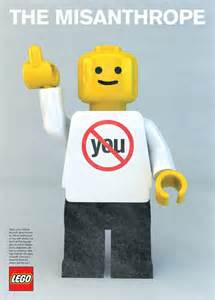
Lego man wearing a shirt with the word "you" crossed out while he flips the middle fingerSeveral examples of the hot-seat strategy from Facebook interactions and YouTube videos have Yourofsky spewing misogynistic, sexist, racist, ableist and other oppressive speeches aimed at supporters as well as those who might be swayed to become supporters. This strategy serves to set the rules of the cult, to impress listeners through dynamic, charismatic speech, and to force followers to consider their own actions and confess how they were once oppressors of other animals. The following comment by Yourofsky illustrates the point:

The latest lie being spread about me is that I’m a racist because I said Palestinians were crazy. But if I distrust or hate all humans and the way we behave, I am a misanthrope NOT a racist! Yet, my misanthropy causes no actual harm contrary to the human rights hypocrites who actively support violent exploitation AND murder every time they sit down to a meal.

In this introduction to Yourofsky’s latest YouTube video, “Palestinians, Blacks and Other Hypocrites,” Yourofsky uses ableist and racist language to defend himself against charges of racism, something that might seem likely to turn away followers, but actually establishes him as someone willing to insult and degrade humans—someone who appears brave and a formidable leader. Note the response of an enamored follower:

I thought the whole idea of being a vegan was for animal liberation. Why are we even talking about human rights, when so many animals continue to die every second of every year.
If you want to be a human rights activists, the door is open, exit veganism now.
I’ll agree with Gary on this. I’m glad he said it. At least he’s no hypocrite.
Can’t you see, we are the problem. Humans create their problems and then expect everyone to sympathize. Take responsibility for your actions.
On the other hand, animals, do not create problems nor do they expect any sympathy.
I defended Gary’s stance and I would do it again. Go join a human rights group and let us true vegans clean up your dirty work. And stay out of the way.

Support is offered for the leader’s ideology and followed with a confession that “…we are the problem. Humans create their problems…”. “True vegans” should either get with the plan or “go join a human rights group,” as if that would be the worst form of rejection by the cult.

The rules are clear: There is no room for human rights activists among Yourofsky’s followers, and his response to the above Facebook comment dishes up approval for those who agree and lets everyone know what constitutes sanity and logical thinking:

THANK YOU FOR THINKING LOGICALLY! YOU ARE SANE & COGNIZANT my friend (Yourofsky, 2015).

Racism comes more into play with the next comment from Yourofsky:

Malcolm X once said: “You cannot be anti slavery and pro slavemaster.” Animals are the victims/slaves. Humans are the victimizers/slavemasters.. I side with the slaves and will no longer defend humans who scream about their mistreatment when they dish it out to the animals.

The tokenism and appropriation of a quote from a leader in the Civil Rights Movement is blatant and allows Yourofsky to portray the simple good vs. evil mythology that grounds so many religions. He does so by ignoring hundreds of years of human slavery and claiming all humans are “slavemasters.” One follower touts the revelations of Yourofsky as the “new paradigm”; however, Yourofsky is well aware of those who would challenge this new paradigm:

… except my enemies come from WITHIN the vegan movement. vegans have been trying to silence me for more than a decade. and they’re gonna win soon because I am worn out and burnt out.

Prophecy!! One of the great trademarks of a cult leader—the ability to predict the future! Most impressive. We also gain a clearer picture of THE enemy: vegans!! A form of call and response, a preaching style in which the minister speaks and the congregation answers with an affirmation, follows throughout this Facebook discussion thread. Comments supportive of Yourofsky net words of praise from the leader, and negative comments are met with admonishments to watch his video again or to go away (polite terminology). The vast majority of responses from followers are reinforcing Yourofsky’s views, including his racism:

I’m rapidly becoming disliked by most people I know….because I 100% share your attitude, morals and beliefs. I’d rather be a fuc***g loner, than a murdering hypocrite! The name calling and personal attacks are becoming the norm, and I couldn’t give a shite! OUR WORDS ARE RIGHTEOUS, THE TRUTH, SPOKEN WITH COMPASSION AND MORAL. For every murderer I see shovelling in a fork full of suffering…they’ll get my harsh words for afters, couldn’t give a flying shit what colour or where they’re from! My life focuses on the devastation humans cause…so FU** HUMAN RIGHTS!!

Another writes:

If they ever win by silencing you, I’ll carry your cross for you. You have plenty of support Gary.
Never forget that!

Homosexuals are another frequent target for cult members:

Yeah or the homosexuals who want “their rights” and respect, but cannot do the same for all of nonhuman animals that end up on their plates every time of every day. They want to get what they themselves don’t want to do. I used to fight so much for the homosexuals rights until I saw that when it came to what I cared about ( nonhuman animals ) they were not willing to support my cause in any way. So sad that they’re so selfish.

And then one person dares to question Yourofsky on his claims of success in making the world go vegan:

I agree about the hypocrisy of fighting for human rights while hurting animals but I don’t think hating people helps them see what they’re doing.

Yourofsky responds:

The Real Gary Yourofsky how can you say that when I have converted between 100,000 to one million with MY ATTITUDE/STYLE and the lovey dovey BS pacifists haven’t done shit? stop believing in fairytales like love conquers hate.

Yes, a part of cult leadership is laying claim to vast numbers of unverifiable conversions or some other accomplishment as proof that their strategies are effective and to motivate followers. Given Yourofsky’s focus on making all of Israel vegan, it is possible Yourofsky is referring to a survey that suggests vegans in Israel number 10% of the population or about 700,000 people, giving the country one of the largest per capita vegan populations in the world, but questions grounded in critical thought about this number are absent from the discussion. A 2001 report from the Israeli Ministry of Health shows “7.2% of the men and 9.8% of the women identified themselves as vegetarians” (Neiman, 2014). These numbers indicate Israel had a strong vegetarian population well before Yourofsky started his campaign for veganism in Israel. Also, while a recent report by Israeli media confirms that Yourofsky’s video from a Georgia Tech appearance in the summer of 2010, “The Best Speech You Will Ever Hear” (Yourofsky, The Best Speech You Will Ever Hear, 2010), has been seen “by at least 396,000 people…(with Hebrew subtitles) (Darom, 2102), there is no way of knowing if all of the viewers were in Israel or if they immediately made the decision to be vegan.

Just as Yourofsky brags about his successes, he also proclaims extreme humility in an effort to show followers he is just like them, someone they can identify with and emulate:

“I’m not a politician. I’m not a salesperson. I don’t ask for donations. I don’t want donations. I want people’s minds. I want people to be kind for the animals (Yourofsky, Gary Yourofsky speaks to 450 students at Ben Gurion University, n.d.).

Setting aside Yourofsky’s comment that he wants people’s minds, his occupational profile fits that of many cult leaders who were writers, salespersons and carnival workers prior to leading their cults. Most notably, Yourofsky worked as a paid spokesperson or lecturer for PeTA between 2002 and 2005. The common thread is that these jobs all involve persuasion, a key skill requirement for someone trying to sell others on a particular dogma (Sagarin, n.d.). Any denial of political activity—using power to effect change—or working to sell people on his ideas is a direct contradiction of what he does every single time he takes the stage to speak. His denials are, however, a persuasive rhetorical technique, an attempt to show he has nothing to gain on a personal level. Nothing, except the notoriety that guarantees his voice will be heard over the voices from marginalized groups!

Internet culture brings with it new opportunities for cult formation and their sustained activities. Their work is often measured by the number of memes or YouTube videos they produce and disseminate, as well as the number of ‘likes’ these products receive on websites such as Facebook. There is also an unrelenting willingness of supporters to defend leaders, including Facebook page owners and moderators, no matter what they might publish. Public objections are frequently deleted and those who question authority are banned from the site. Still, the following general definition of cults remains the same for all types of cults:

• The leader is best classified as an authoritarian; simply put, it is the leader’s way or the highway
• The beliefs of a cult are different from the mainstream and often narrowly focused; they have the potential to be dangerous or even false; a cult often suggests that nothing matters except focusing on gaining converts
• Demanding changes in lifestyle for followers, e.g. a demand to cut off communication with family members who don’t show proper support
• Cults emphasize recruitment, soliciting money or other needed resources, and finding opportunities to make the cult’s videos or products available to the public
• Cults have distinctive ways of getting all members on the same page, of getting them to think the same way
• Insiders in cults are clearly distinguished from outsiders, sometimes with the use of insider language or symbols; outsiders are often attacked, and they are abused psychologically or physically (Nassim, 2013)

A friend once observed that the best way to handle cult leaders and the claims-making of cult members is to ignore them, to stop feeding their egos. Cults are more than the manifestations of any leader’s ego. Cults have to be seen in relation to the patriarchal institutions and oppressions of our social world. They do not exist in isolation of sexism, racism, ageism, ableism, classism or speciesism. It requires critical thought and questioning of cults in order to dismantle them or at least defuse their incessant attacks on those outside of the cult. Every time someone outside of the cult hedges their criticism of the cult they inadvertently support it. Yourofsky’s misogyny is often criticized, but the criticism is mitigated when it is promptly followed with praise, e.g. “But he does do a lot of good for the animals.”

Gary Yourofsky

Critical thinking involves revealing contradictions in interactions or public discourse, e.g. how can cult leaders claim to not care what people think about them, but then try to defend themselves from criticism? Critical thinking aims to expose relations of power and to challenge oppression. When it comes to an examination of the hate speech and the promotion of violence by Yourofsky here are a few questions grounded in critical thinking that must be asked:

1. Who or what group benefits from using violence—threats, bullying and verbal abuse—against humans as way to end violence against other animals? What is gained from threatening violence or violent acts? Psychological dominance? Financial power? Publicity?
2. Through what social processes have cults become a normalized part of the animal rights movement, normalized to the point that their role in promoting oppressions is rarely challenged?
3. Many movement members who are not involved with any cult insist they could never be cult members, following the pattern of the self-serving bias. To what extent is it an example of the self-serving bias that so many movement members try to excuse the problematic actions of cults by saying, “Well, at least they’re doing it for the animals”?
4. Whose voices are silenced by cults? How are they silenced? How do cults socially reproduce or reify existing structures of racism, sexism, ableism, classism, ageism and speciesism?
5. To what extent do members of animal rights movement cults lose their psychological autonomy? Especially the women who follow a man centered leadership?

An important point to consider in trying to end the influence of cults within the animal rights movement is that they are a reflection of our patriarchal social order. Without patriarchy and the acceptance of sexism and misogyny throughout society, cults would have a difficult time forming, much less gaining momentum. It may be frustrating to think about how cults make the animal rights movement look to the outside world, and to encounter the lies, exaggerations and misrepresentations vocalized by cult members; however, ending the influence of cults depends on identifying and challenging them with critically grounded questions. The demand made by cults to focus only on the animals does indeed sound noble and even desirable, but it is also a way of deflecting criticism by presenting a worthy goal, AND it is a way of isolating the membership from the pervasive oppressions of the social world. Cult followers are repeatedly told that there is no point in addressing racism or sexism, for instance, and that veganism is all that matters. Any plans for an inclusive animal rights movement, one that addresses social justice, will depend on a clear message that focuses on how speciesism cannot be eliminated by turning our backs on human oppressions.


References

Darom, N. (2102, September 6). Is vegan superstar Gary Yourofsky an animal savior or a mad militant? Retrieved from HAARETZ: http://tinyurl.com/q2hdmkw

Langone, P. M. (2013). Who Joins Cults and Why? Retrieved from ICSA International Cultic Studies Association: http://csj.org/studyindex/studycult/cultqa4.htm

Nassim, A. (2013, September 2). Online Cults. Retrieved from Internet Ascent: http://internetascent.blogspot.com/2013/09/online-cults.html

Neiman, R. (2014, February 6). What Israeli Vegans Eat – And Why. Retrieved from Israel 21c: http://www.israel21c.org/israel-in-pictures/what-israeli-vegans-eat-and-why/

Rhoads, P. K. (n.d.). Cults: Questions and Answers. Retrieved from Working Psychology: http://www.workingpsychology.com/cult.html

Sagarin, D. (n.d.). Cult Influence Tactics. Retrieved from Working Psychology: http://www.workingpsychology.com/cultdef.html

Yourofsky, G. (2010). The Best Speech You Will Ever Hear. Retrieved from YouTube: http://tinyurl.com/mkpoon4

Yourofsky, G. (2015, May 17). The Real Gary Yourofsky’s Photos. Retrieved from Facebook: https://www.facebook.com/therealgaryyourofsky/photos/pb.772568189464273.-2207520000.1432180346./822615614459530/?type=1&theater

Yourofsky, G. (n.d.). Gary Yourofsky speaks to 450 students at Ben Gurion University. Retrieved from YouTube: http://tinyurl.com/m2qwhrg


Michele Spino MartindillDr. Martindill earned her Ph.D. in sociology from the University of Missouri and taught there in the Sociology Department, the Peace Studies Program and the Women’s and Gender Studies Department. Her areas of emphasis include political sociology, organizations and work, and social inequalities. Dr. Martindill’s dissertation focuses on the no-kill shelter social movement and is based on ethnographic research conducted during several years of working in an animal shelter. She is vegan, a feminist and is currently interested in the stories women tell through their needlework, including crochet, counted cross stitch and quilting. It is important to note that Dr. Martindill consistently uses her academic title in order to inspire women and members of other marginalized groups to pursue their dreams no matter what challenges those dreams may entail, and certainly one of her goals is to see more women in academia.

Sustainability If

Painting of two bluefin tuna surrounded by swirls of hundreds of little fish

By Lisa Kemmerer

All oppression creates a state of war.

– Simone de Beauvoir, The Second Sex


“Sustainability” refers to an “ability to endure across time.” In the environmental movement, “sustainability” statements always entail an unstated “if.” In this usage, a particular action is deemed unsustainable if we value and wish to protect and preserve certain aspect of the natural environment.  Certain actions/consumer options are considered sustainable if they do not cause worrisome environmental problems.  Environmentalists who note that our beef habit is unsustainable are really saying that our beef habit cannot be sustained if we are to preserve rainforests and freshwater, if we are to arrest dead zone growth and climate change.  In these instances it is readily apparent that sustainability rests on common shared moral commitments to protecting the environment on which we depend. In this context, if we were to make a full and complete statement with regard to sustainability, we might say:

  • Eating bluefin tuna is unsustainable if we intend to protect endangered species.
  • Eating cheese is unsustainable if we hope to arrest the spread of dead zones.
  • Eating shrimp is unsustainable if we value ocean ecosystems, including essential, fragile deep-sea reefs.

In each of the above cases the “if” is rarely stated, and what we are likely to hear or read would look or sound something like this:

  • Bluefin tuna is unsustainable.
  • Cheese is unsustainable.
  • Shrimp is unsustainable.

When we finish the sentence, stating clearly the unspoken but essential “if,” we realize that statements of environmental sustainability rest on a moral commitment to make selections that decrease, rather than increase, environmental degradation.  In short, we come to see that sustainability statements rest on commonly held moral values.  We also come to see that our responsibility as consumers is often omitted—the product is labeled “unsustainable.”

What is most interesting about the missing “if” in the environmental context is that reinserting this conjunction allows us to see that sustainability is the key not just to environmental justice, but to social justice more broadly. Sustainability can fruitfully be employed in any social justice context. Consider in these more diverse applications of the term:

  • It is unsustainable for racist police to brutalize Black civilians if we hope to arrest the spread of hatred and violence.
  • Forcing a woman to carry a fetus to term is unsustainable if we value self-determination.
  • Permitting only heterosexuals to enjoy the financial and social benefits of legal marriage is unsustainable of we intend to protect human rights.
  • If we are committed to an ethic whereby we value justice and protect the vulnerable from the exploitation of the powerful, eating chickens is unsustainable.


Landscape view of a cattle herd in a cleared rainforest area

Sustainability is not just about cycling and recycling, it is also about redistributing wealth, yielding wrongly-gained power to the disenfranchised, and protecting all who are vulnerable from the miseries of exploitation and oppression.  Unsustainable behaviors—racist, sexist, homophobic, speciesist, ableist, ageist, and consumer behaviors—ought to be avoided not only if we value clean water and forests, but also if we value justice and peace.

At the end of the day, these unsustainable behaviors are interconnected. For example industrial fishing is unsustainable not only because it harms ocean ecosystems, but also because it is unjust—industrial fishing harms indigenous communities dependent on depleted ecosystems for subsistence survival.  Industrial fishing is therefore unsustainable if we intend to protect the comparatively powerless—ocean ecosystems, indigenous peoples, and fish—from powerful corporate interests and their indifferent/uninformed consumers. Similarly, factory farming is unsustainable if we value rainforests, fresh water reserves, and the earth’s present climate, and also if we value worker’s rights, the protection of defenseless farmed animals, and the health of unsuspecting consumers who suffer from heart attacks, strokes, diabetes, and obesity because of animal products they consume. These practices are unsustainable if—but not only if—we intend to protect the natural environment from horrendous environmental degradation. They are also unsustainable if we value justice and peace—if we intend to protect the vulnerable, whether minorities, the disenfranchised, or other species.


Further Reading

Kemmerer, Lisa. “Defending the Defenseless: Speciesism, Animal Liberation, and Consistency in Applied Ethics.” Les Ateliers de l’éthique/The Ethics Forum 9:3 (2015).

Kemmerer, Lisa. “Ecofeminism: Women, Environment, Animals.” DEP: Deportate, Esuli, Profughe. Ca’ Foscari University of Venezia, Italy, 23 (2013).

Click here to download the introduction to Speaking Up for Animals: An Anthology of Women’s Voices

Click here to download the introduction to Sister Species: Women, Animals, and Social Justice


KemmererDr. Kemmerer is a professor of Philosophy and Religion and a prolific author in animal ethics.  Her books include In Search of Consistency: Ethics and Animals, Animals and World Religions, Sister Species: Women, Animals, and Social Justice, Call to Compassion: Reflections on Animal Advocacy, Speaking Up for Animals: An Anthology of Women’s Voices, and Primate People: Saving Nonhuman Primates through Education. She is particularly interested in intersections of Nonhuman Animal advocacy and environmental advocacy in the spirit of Marti Kheel, as is evidenced in her 2015 publication Eating Earth: Environmental Ethics and Dietary Choice and her editorial work for the 2015 anthology Animals and the Environment: Advocacy, Activism, and the Quest for Common Ground.