How Farmers are Making Dairies Sexy for Men’s Health

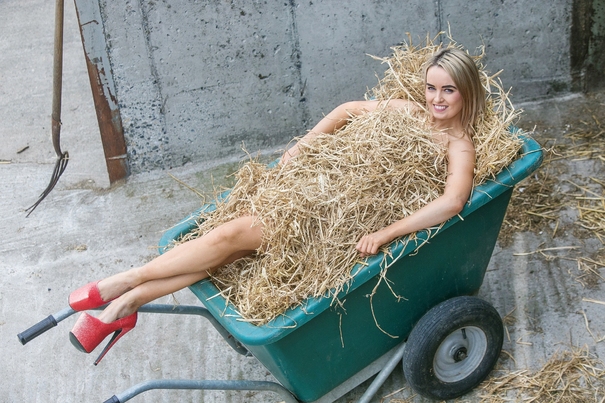
Young white woman naked in a wheel barrow; she is covered in hay and wearing very large pump red heels

Macra na Feirme, a farmer’s association in Ireland, is creating a pornographic calendar to raise awareness about mental health problems and suicide in the farming community, particularly that of young men.

This project is gendered, as pornography predominantly involves the display of women’s bodies, while farming is masculinized. Women are the objects on display, while men are the subjects of concern.
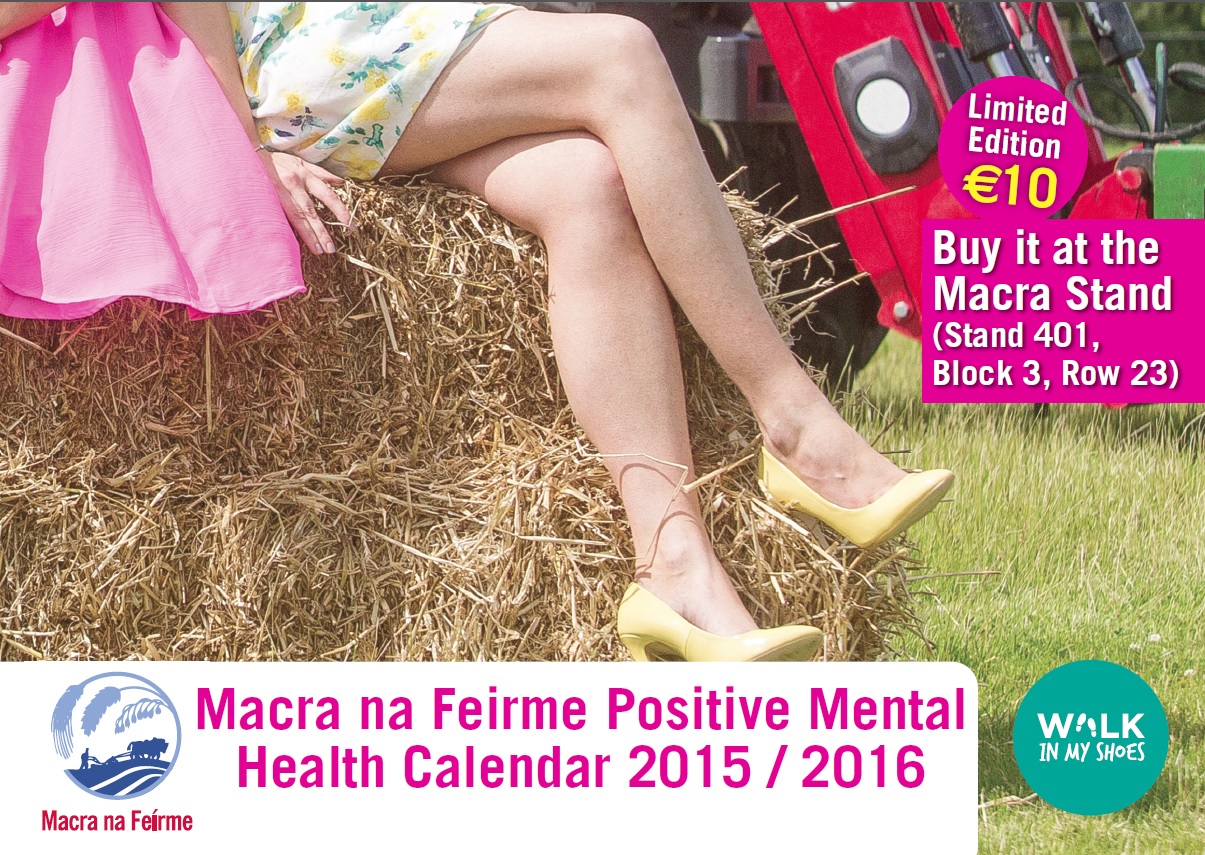
Advertisement for Macra; A pair of legs and the top of a skirt is visible, a woman is sitting on a bail of hay in high heels

Calendar sales will go to the mental health non-profit Walk In My Shoes

What is interesting is that the campaign seeks to challenge unrealistic masculine gender roles (which discourage boys and men with depression from seeking help or admitting weakness), and yet those same roles are protected by framing the campaign in clear scripts of patriarchal dominance.

Importantly, the centering of men’s experiences also makes invisible the multitude of research that shows clear correlations between the sexual objectification of women and women’s higher rates of depression, anxiety, and self-harm, as well as lower rates of self image and self efficacy.

But more is going on in these images–we’re also seeing the romanticization and sexualization of speciesism. In one image, the Rose of Kilkenny (Ireland’s version of Miss America), poses seductively with a milking device. An instrument of torture for the Nonhuman Animals involved, but a very naturalized symbol of power, domination, and the pleasurable consumption of the female body for humans who interpret the image.
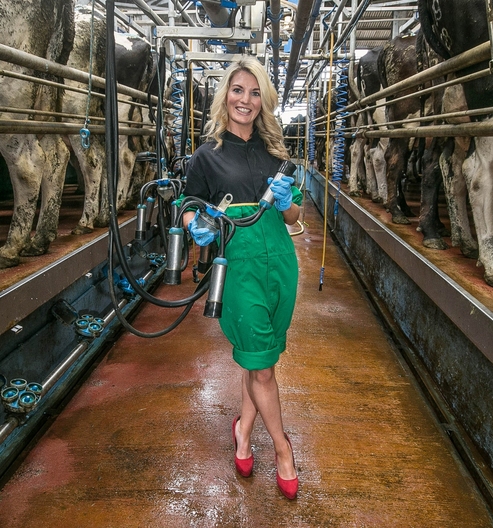
Woman in red high heels with legs exposed holds a milking device in the middle of a dairy, with the back ends of cows lined up on the machines visible in the background

What’s also made invisible is the relationship between mental health and participation in systemic violence against the vulnerable. Yes, the campaign seeks to bring attention to the emotional challenges associated with farming, but no connection is being made to the relationship between hurting others and the hurt one experiences themselves. Slaughterhouse workers, for instance, are seriously psychologically impacted by the killing and butchering they must engage. Dairy workers, too, are paying a psychological price for their participation. This isn’t just about “farming” in general, this is about speciesist practices in particular. Speciesism hurts us all: Nonhuman Animals in particular, male farmers as a consequence, and women who are objectified and hurt in a society where the exploitation of feminized vulnerable groups is normalized.

Indeed, I find it interesting that, for women who want to participate in a social movement, the “go to” response is so often to get naked or make pornography. It is a powerful statement about the gender hierarchy in our society and the limited and often disempowering choices available to women. Ultimately, it speaks to a considerable limitation on our social justice imagination.


Thank you to our Hungarian contributor Eszter Kalóczkai for bringing attention to this story.


Corey Lee WrennDr. Wrenn is Lecturer of Sociology. She received her Ph.D. in Sociology with Colorado State University in 2016. She received her M.S. in Sociology in 2008 and her B.A. in Political Science in 2005, both from Virginia Tech. She was awarded Exemplary Diversity Scholar, 2016 by the University of Michigan’s National Center for Institutional Diversity. She served as council member with the American Sociological Association’s Animals & Society section (2013-2016) and was elected Chair in 2018. She serves as Book Review Editor to Society & Animals and has contributed to the Human-Animal Studies Images and Cinema blogs for the Animals and Society Institute. She has been published in several peer-reviewed academic journals including the Journal of Gender Studies, Feminist Media Studies, Disability & Society, Food, Culture & Society, and Society & Animals. In July 2013, she founded the Vegan Feminist Network, an academic-activist project engaging intersectional social justice praxis. She is the author of A Rational Approach to Animal Rights: Extensions in Abolitionist Theory (Palgrave MacMillan 2016).

Receive research updates straight to your inbox by subscribing to my newsletter.
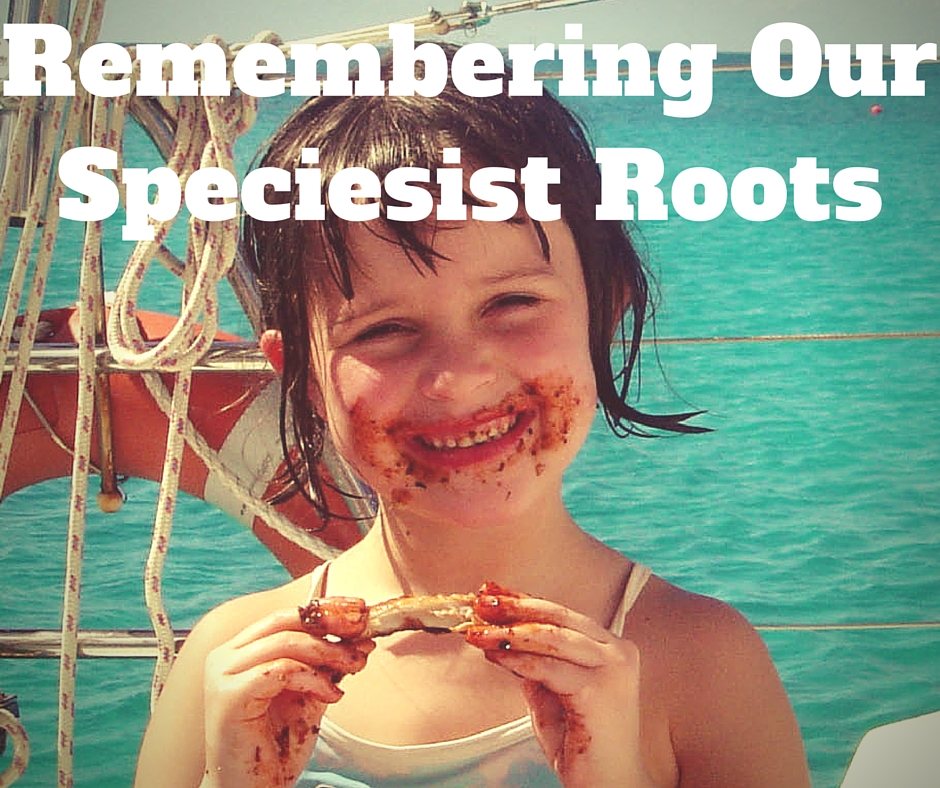
The Power Of The Vegan Who Remembers Their Roots

"Remembering Our Speciesist Roots" Girl smiling as she eats a barbecue rib, her face is covered in sauce

By Michele Kaplan

CONTENT WARNING: This article contains a couple of sentences (quotes from others) that reference misogyny, homophobia, and ableism.

NOT SAFE FOR WORK: Some violent language in said quotes.

Author’s Note: The following is in no way an attack on Direct Action Everywhere, but rather a discussion inspired by one of their graphics. I chose to use a DxE graphic because it’s the graphic that sparked this conversation on Facebook and thus inspired this article. I am not suggesting that the comments that were made, represent DxE as an organization, as you can’t control who comments on a public post. I wanted to write this article because variations of the comments that were made in reaction to this graphic, are comments that I’ve heard for years within the Animal Rights Movement and I wanted to speak on that.

“Walter [the hunter who is also a dentist] says he killed Cecil [the lion] because he didn’t know his name… Let’s hope Walter knows his patients’ names.”

Question: When you read that, what thoughts pop into your head?

For some animal rights activists (at least going by the comments on the internet), the response is one of anger. But not just anger. A kind of vindictive anger.

“A heartless piece of work…”
“He’s a f**king idiot!”
“Calling him a human is going too far.”
“Could we crowdfund to have the doctor dropped off somewhere in Africa, stripped naked and then hunted like an animal?”
“He’s a f**king, coward, tool who sucked someone’s dick to stay out of jail? The question is who’s whore is he?”

I could go on, but you get the gist. Now, putting aside for a moment that some of these comments are incredibly ignorant and some just disturbing, I would like to look at the overall vindictive and angry nature of the comments.

Question: How many of us within the Animal Rights movement were born vegan?

Smiling Baby

Not many. In fact, I think it’s safe to say that the majority of us participated in the killing and consumption of animals, at some point in our lives. While we may not have gone hunting (though I am sure some of us did), does it really matter if we directly or indirectly killed an animal?

The end result is the same. An animal who did not want to die is dead. So, if we too once participated in the death of animals, then it begs the question:

Question: As vegans, do we forget our speciesist roots?

I know when I heard about someone harming an animal, I would get really upset. But not just upset. Angry. “What a jerk!” I would say. And when I would make this comment on social media, it would get plenty of likes and support.

But one day, I stopped and pondered if I was being hypocritical to get mad and vindictive simply because a person hasn’t unlearned speciesism at the same rate/pace that I have?

This is not to say that it is wrong to feel angry. Anger (when used constructively) can inspire us to further fight for what is right. What can get in our way, is when it becomes vindictive. It can lead us to think things like “What kind of person does this sort of thing?!” instead of realizing “Oh, right. That was me.”

And once I realized this, and thus let go of the hypocritical and vindictive anger, it made room for empathy. As a result, I was having a much easier time communicating, connecting and reaching people who weren’t vegan.

Sleeping pig on couch

“Walter says he killed Cecil because he didn’t know his name… Let’s hope Walter knows his patients’ names.” read the graphic posted on Facebook. “His reasoning makes no sense.” I thought at first “What about the dog he passes by on the street but doesn’t know the name of?”

But instead of just chalking it up to Walter being senseless and unintelligent, I stopped and remembered my roots. And that’s when it occurred to me (and I left the following comment) : “I think what he (possibly) meant was that he never thought that an animal such as a lion would have a name / life / purpose etc. Which is no different than the people who eat pigs [and other animals] because they just viewed the animal as a means to their pleasure and never stopped to think / was not raised to think that animals have lives and hearts and emotions [and] aren’t just there for our consumption.”

Empathy is power. It’s great that we fight for the liberation of animals, my fellow vegans but always remember your roots.


This essay originally appeared on Rebelwheels’ Soapbox on May 17, 2015.


me in wheelchairMichele Kaplan is a queer (read: bisexual), geek-proud, intersectional activist on wheels (read: motorized wheelchair), who tries to strike a balance between activism, creativity and self care, while trying to change the world.

La Política Sexual del Veganismo Moralmente Superior

Translation by María. María is active with Ochodoscuatro Ediciones, a non-profit anti-speciesist book house that is noted for translating Carol Adams’ The Sexual Politics of Meat into Spanish. You can view the original English version of the essay below by clicking here.

Stella McCartney and dog walking on trail

Por Corey Lee Wrenn

La línea de moda vegana de Stella McCartney apareció en un reciente artículo de la revista feminista Bustle en la sección “Moda y belleza”. Al principio, me sentí encantada de que presentasen el veganismo en un espacio feminista, cosa que no suele suceder tan a menudo como debería.

Parece que la autora, también, es consciente de la falta de conexión política entre feminismo y veganismo, pues se encarga de amortiguar a los lectores con una advertencia. Siguiendo una declaración de McCartney que dice que su marca es “la empresa más ética y amorosa de la industria de la moda”, Bustle aclara:

La declaración apunta que ella dijo eso en broma, indicando que no se siente moralmente superior acerca de su postura libre de crueldad, cosa que no siempre es el caso de los activistas por los derechos animales.

Encuentro esa advertencia bastante curiosa, estando en el contexto de la política feminista. Las feministas generalmente ponen resistencia cuando alguien intenta controlarles el tono en que dicen algo y a menudo castigan a las celebridades que se niegan a identificarse a sí mismas como feministas. Pero todo vale cuando hablamos de los derechos de los animales no humanos. En otras palabras, las feministas fomentan con determinación un feminismo fuerte y orgulloso, en un esfuerzo por desestigmatizar el activismo de justicia social, pero pueden darle rápidamente la vuelta y vilipendiar a aquellas que hacen lo mismo en nombre de los otros animales.

Dado que el 80% del movimiento por los derechos de los animales no humanos está formado por mujeres y siendo que el veganismo está extremadamente “feminizado”, es importante reconocer los matices sexistas en la estereotipación de las veganas. Es posible que esa “superioridad moral” asignada a activistas y veganas sea de hecho una forma de vigilancia de género. En otras palabras, estos estereotipos trabajan para avergonzar y silenciar a las mujeres “engreídas” que se atreven a politizarse.

Las feministas deberían mantenerse al margen la ridiculización de la justicia social. Preocuparse por la opresión de las demás no debería ser algo que ocultar o que minimizar. El compromiso para acabar con la injusticia debería ser algo de lo que estar orgullosa. Deberíamos estar celebrando el activismo. Es un trabajo duro, se ganan pocos amigos, es mentalmente agotador y pocas personas están dispuestas a participar. Las feministas no deberían poner añadidos a esa dificultad, cuando podrían ser una fuente importante de apoyo. Esto especialmente cuando la mayor parte de activistas por el veganismo son mujeres y cuando el especismo está íntimamente ligado al patriarcado.


Corey Lee WrennDr. Wrenn is Lecturer of Sociology. She received her Ph.D. in Sociology with Colorado State University in 2016. She received her M.S. in Sociology in 2008 and her B.A. in Political Science in 2005, both from Virginia Tech. She was awarded Exemplary Diversity Scholar, 2016 by the University of Michigan’s National Center for Institutional Diversity. She served as council member with the American Sociological Association’s Animals & Society section (2013-2016) and was elected Chair in 2018. She serves as Book Review Editor to Society & Animals and has contributed to the Human-Animal Studies Images and Cinema blogs for the Animals and Society Institute. She has been published in several peer-reviewed academic journals including the Journal of Gender Studies, Feminist Media Studies, Disability & Society, Food, Culture & Society, and Society & Animals. In July 2013, she founded the Vegan Feminist Network, an academic-activist project engaging intersectional social justice praxis. She is the author of A Rational Approach to Animal Rights: Extensions in Abolitionist Theory (Palgrave MacMillan 2016).

Receive research updates straight to your inbox by subscribing to my newsletter.

Psychological Abuse in Animal Rights Advocacy

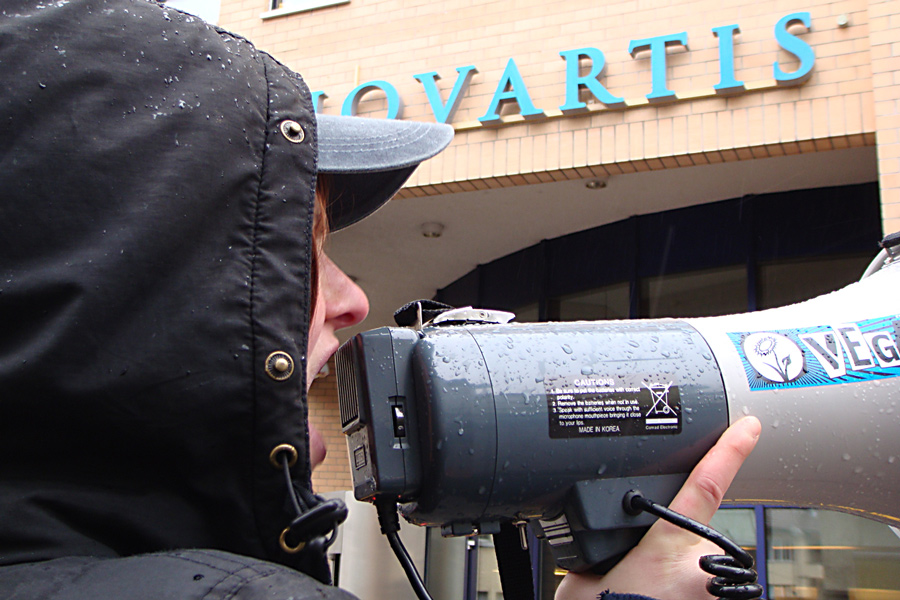
Man yelling into bullhorn at a protest

By Pooja Umbra

Since being diagnosed with an auto-immune neurological disorder and a mental illness as a vegan, I have been putting a lot of thought into the kind of vegan advocacy that can be categorized as psychologically abusive. I have myself partaken in this type of advocacy and I write this using my newly-acquired self-awareness and insight into psychological issues.

I’d like to state on record that I am not a mental health professional. I am articulating this as someone who has experienced psychological abuse from my early childhood and as someone who’s learning to tell the difference between emotionally healthy and unhealthy behaviors.

So what exactly is psychological abuse?

Psychological abuse, also referred to as emotional abuse or mental abuse, is a form of abuse characterized by a person subjecting or exposing another to behavior that may result in psychological trauma, including anxietychronic depression, or post-traumatic stress disorder.

It encompasses a wide range of behaviors such as, verbal aggression/ assault, domination, emotional blackmail, invalidation, gaslighting and blaming, among others.

Emotionally abusive behaviors by activists or any reminders of past emotional trauma can have debilitating consequences for survivors. Using guilt and shame for AR advocacy with the objective of elevating people’s consciousness to the plight of non-human animals may sometimes yield positive results, but it may also at times make survivors of emotional abuse relive the trauma of the past, feed their suicidal ideation, strengthen their ‘inner critic’, deepen their toxic shame, make the management of their illness difficult, or severely hamper their chances of recovery. Much has been written about certain damaging types of animal rights (AR) advocacy that is triggering to victims/survivors of violent crime such as rape. It is not much different for survivors of emotional trauma. Many in the AR movement, regrettably, still don’t see this as something to be rectified because of their anything goes approach to AR advocacy.

Before AR activists scream, ‘Meat is murder’ or tell non-vegans that they’re contributing to the death of shelter animals by purchasing animals from breeders, they need to stop and evaluate what they want to accomplish and why they’re using the kind of emotionally manipulative/ verbally aggressive approach that usually alienates people with mental disabilities and/or those with a history of trauma. Activists are better off using non-abusive approaches that don’t open up the emotional wounds of others. Furthermore, such non-abusive approaches are more likely to help non-human animals. Abusive tactics only serve to make abusers feel good by feeding off of the humiliation of others. It is self-serving and short-sighted. AR activists with able-minded and able-bodied privileges, as allies to non-human animals, need to recognize the imbalance of power between them and those with disabilities, and tailor their advocacy to be more compassionate.

Emotionality is an asset for bringing about lasting social change, but there is a difference between using corrosive tactics like guilt and shame, and encouraging self-reflection and accountability. All humans oppress non-human animals wittingly or unwittingly, to varying degrees. As those belonging to the oppressor group, we need to have more humility in our activism.


PoojaPooja Umbra is a multi-lingual vegan feminist from Bangalore who is fluent in four languages and semi-proficient in two others. She is a qualified accountant, though is currently on a break. She currently devotes her time to looking after her twelve and a half year old dog and to self- care.

Lack of Intersectionality: A Moral Inconsistency of the Animal Rights Movement?

Woman brandishing a large rainbow flag with a vegan symbol in the middle; appears to be at a gay pride festival

By Raffi Ciavatta and Lilia Trenkova

Animal rights activists are often accused of not caring about humans. We can argue that usually these accusations come from people who have just had their speciesism challenged and who feel attacked, so they’re reactionary statements. We can obviously also argue that we do indeed care about other humans. Yet this happens so often that even people who’ve never faced their speciesism have come to believe that animal rights activists simply do not see humans as important as non-humans.

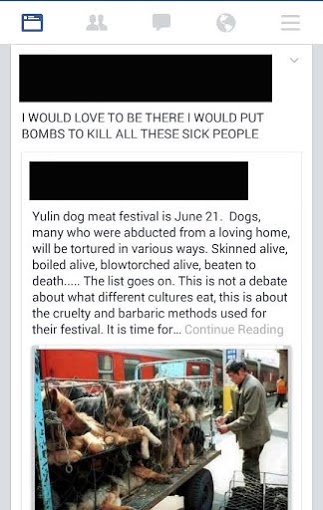
Facebook post responding to Yulin Dog Meat Festival (image shows a man tending to caged dogs awaiting slaughter): "I WOULD LOVE TO BE THERE I WOULD PUT BOMBS TO KILL ALL THESE SICK PEOPLE"

How can we change this view? There are among us those who truly believe we cannot fight one system of oppression (speciesism) by supporting another system of oppression (sexism, for example). It is morally inconsistent to claim we care about the bodily autonomy of hens but to oppose the bodily autonomy of women, just as it is morally inconsistent to say we care about equality but exclude certain species who are worthy of that consideration.

According to Javed Deck, for animals rights “[…] to be a movement that actually transforms relationships between humans and animals it needs to take seriously issues of race, class, and gender, and the ways these impact animal systems. Just like the transformations feminist and queer struggles have undergone as they crossed cultural boundaries, so must animal struggle change across these boundaries.”

>In the 70’s, black feminists who worked both for women’s rights and civil rights, started to look at gender and race as connected issues. The feminist movement back then wasn’t talking about race, and the civil rights movement wasn’t addressing gender. They developed a theory and practice called intersectionality, a term coined by Kimberlé Crenshaw in her insightful 1989 essay, “Demarginalizing the Intersection of Race and Sex: A Black Feminist Critique of Antidiscrimination Doctrine, Feminist Theory and Antiracist Politics”.

Applying Crenshaw’s frame of intersection to other systemic oppressions, we can no longer see discrimination based on gender, race, class, ability, sexual orientation, religion, caste, species, et al, as separate and independent from one another. Axes of identity interact on multiple levels, contributing to systemic injustice and social inequality.

Oppressive systems also share the same roots. They not only have the same strategy, the same tactics, but they also share patterns of behavior and thought. In her essay, Crenshaw uses an analogy to a traffic intersection, or crossroad, to concretize the concept:

“Consider an analogy to traffic in an intersection, coming and going in all four directions. Discrimination, like traffic through an intersection, may flow in one direction, and it may flow in another. If an accident happens in an intersection, it can be caused by cars traveling from any number of directions and, sometimes, from all of them.”

So why should we care about others’ struggles?

  1. Because it is the right thing to do. There is nothing wrong with choosing to be morally consistent.
  2. If we want animal liberation, then we had better build bridges. According to professor Will Kymlicka, 99% of the intersectional analysis that is done by the left today completely ignores the intersection of species. He adds, “I think there’s no way for the animal rights movement to possibly succeed without the support from other social justice movements.”
  3. Being able to create a safe space for activists and potential supporters is key to grow our movement. If we choose to ignore the intersections of oppressions, we run a great risk of turning people away from our cause.

The word intersectionality currently seems to be getting a lot of attention as well as confusion. Quite often there isn’t a mention of the originators of the concept, leaving it to be a white-centric circle, as explained here. Love it or hate it, the concept is challenging all of us, and we shouldn’t turn away from it.

We would like to share our view about it and how we are learning to apply it to Collectively Free. When we first started CF, our dream was to create an anti-speciesist group that embraced the intersections of oppression, both internally in our community and externally in our actions.

Within our community, we strive to create a safe space for activists to express themselves and for potential supporters to join us. We have made plenty of mistakes along the way, but we have also tried our hardest to remain humble enough to recognize our mistakes and implement prompt changes to repair them. A great example of that was when the amazing activist, Heather P. Graham, felt triggered during one of our protests after hearing an activist use the word “rape” trivially.

We reached out to her, heard her concerns and asked her to do a panel discussion about the “Importance of Language In Our Movement” followed by a Q&A. We learned a lot from Heather that day. It pushed us forward to officially retire a poster we hadn’t used in a long time, part of our early days, which had the r-word in it. The decision wasn’t because of personal purity, because we care more about what other people may think, or because we don’t believe that mother cows are truly sexually assaulted – it is because we learned that we can achieve the same result in making people understand our message without running the risk of triggering them. Lesson learned: always listen when people who have been hurt share their stories, and always listen when someone brings up issues to your attention.

In terms of delivering an effective message for our activism and building bridges, our first big effort was at NYC PRIDE 2015 (here’s a YouTube link if you don’t have Facebook). We wrote a speakout and chants that reflected the common goal of anti-speciesist, anti-heterosexist and anti-cissexist struggles – liberation from oppression and equality of consideration. Feedback on our video from that day was overwhelmingly positive, from both animal rights and LGBTQ rights activists. Another lesson learned: participate in different movements’ protests and support their causes.

It wasn’t until we launched the campaign against Starbucks that we had the opportunity to really bring that concept out in our actions. We spent several months trying to convey a strong message for the animals while highlighting Starbucks’ exploitation of coffee workers. We have never felt so listened to in any action we ever participated in as on our first day of action, and we are certain it was because we carefully brought together human rights and animal rights.

Our community is not perfect, and we’ll surely continue to make mistakes and learn from them. But if we all stay open to ideas that challenge us we’ll also make strides. Don’t worry, our community will still be hard-core, progressive, envelope-pushers – but now with a bonus! Our activism will no longer appear as a one-way street but as a lane on a highway, a highway shared with other fighters for liberation, equality and freedom.


Raffaella

Co-founder of Collectively Free, Raffi Ciavatta is vegan animal liberation activist, art director, poet, photographer wanna-be, DJ in some past live and most importantly… a big dreamer who makes things happen.


Lili

Lilia Trenkova is an activist vegan, set designer, fabricator, organizer and musician.

Minding Our Language

Content Warning: Discusses sexist, racist, ableist, and heterosexist language.
Not Safe For Work: Some offensive words are presented.

Reads, "It doesn't mean what you think it means!" Picture of a fedora

By Corey Lee Wrenn, M.S., A.B.D., Ph.D.


Language is a process that we begin to learn as children, but continue to refine as adults. Social justice advocates in particular are constantly reevaluating our language with the understanding that words are embedded in power structures. We can disrupt oppression by rejecting particular words or labels. We can create our own power in creating alternatives.

In my own case, this reevaluation began at sixteen.  My friend told me that when I said, “That’s so gay,” it was hurtful to him.  I stopped using it right then and there.  When I got a little older, I realized what “That’s retarded” really meant: “This is so silly and ignorant it’s the equivalent of something that someone with an intellectual disability might say or do.”  I stopped saying it.  When I went vegan, I realized that calling people “chicken,” “cow,” “scaredy cat,” “rat,” etc. used Nonhuman Animals as objects of insult.  I’ve started cutting back (I’m still a work in progress!). In my late 20s, as I started to find my feminist voice, I began to realize that “bitch” was no longer so easily articulated. It now makes me cringe. Fortunately, the “N word” has never crossed my lips.

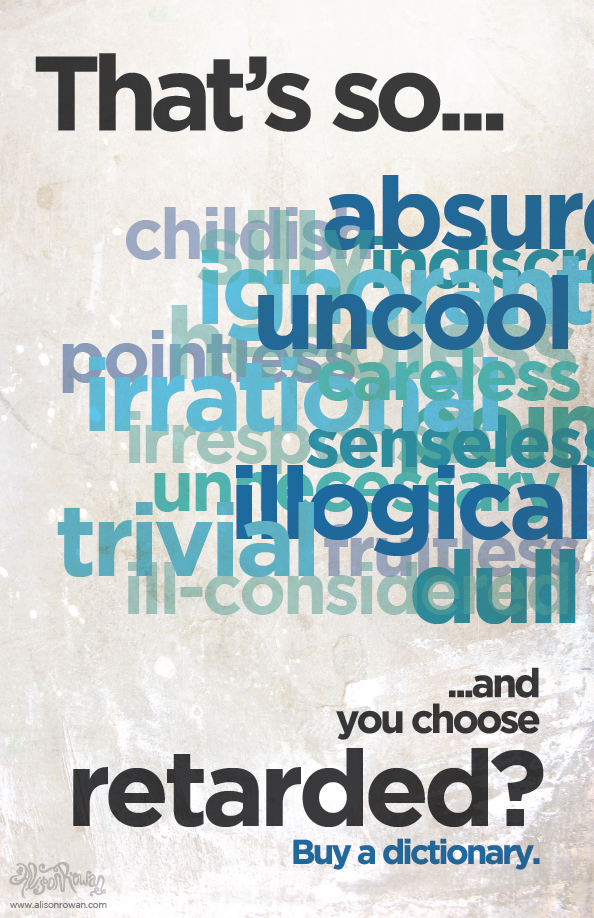
PSA that lists a number of words that can replace the use of "retarded"

Is this political correctness run amuck? Why do activists care so much?

Derogatory language has the power to uphold inequality.  A lot of this language is either used by folks who are fully aware of the hurt behind it, or folks who are honestly unaware and have never stopped to consider the meaning of their words. Admittedly, the hold that language has over our brain makes it very difficult to eradicate many words, even when we are aware and want to change.  Fair enough.  However, when someone is presented with the reality of that hurt and the logic behind oppressive language, and they continue to dig their heels in, then we should find this problematic.  At this point, it is no longer about ignorance. It’s about privilege.

When I was visiting Scotland in 2012, my activist colleagues there had an ugly habit of calling any person they didn’t like a “twat.”  After about the 100th time of hearing it, I finally said something. I explained that they were using a crass word for my genitalia as an insult.  Basically being a female is lower; if they think something is bad, they insult it by calling it female.  As punishment for making this objection, I was dragged into a 20 minute debate. It was me, the female-identified visitor, pitted against two British adult men who were convinced if they just explained to me what the word “really means” and that it “really means” nothing at all, it’s just something they say all the time, it’s always been that way, etc., then I’ll suddenly give up and realize the word isn’t sexist. And after all, don’t we use “dick” as an insult?  The “men, too” argument is a common one that falsely imagines a post-gender utopia where men and women are represented equally and fairly.

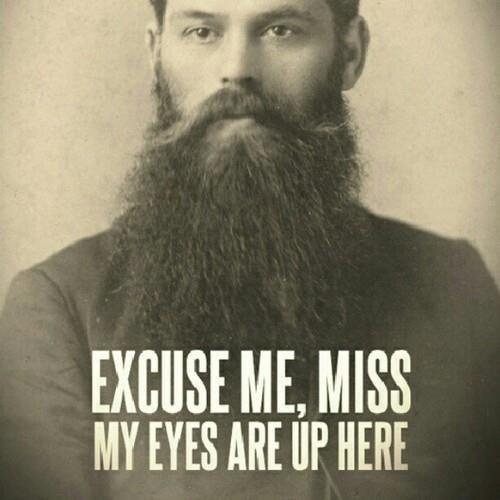
Large bearded man, reads, "Excuse me miss, my eyes are up here"

In another example, an administrator for a Nonhuman Animal rights organization Vegans for Reason and Science adamantly defended the use of “stupid,” “insane,” “loons,” etc. as valid insults.  I asked if they would ever use “faggot” or “gay” as an insult, they said absolutely not, and they would call it out if they ever heard it.  I asked what was so different about using ableist language as slurs? Well, I was reading their words too literally, they explained.

The vulnerable groups in each situation may have varied, but there was one similarity between the people defending this language:  their privilege.  For the most part, I was up against men who were middle class, heterosexual, cis-gendered, non-disabled, and white-identified.  This is the demographic that is granted the ability to create language and define meaning. Power is manifested and replicated through the construction of meaning and the validation (or invalidation) of others’ existence and their social worth.

People with privilege should not get to decide what language is or is not hurtful to vulnerable people.  It shouldn’t matter how many gay friends or close female friends or sisters they have, or how long they’ve used the words, or how “figurative” they are meant to be.  If someone in a disadvantaged position says they hurt, stop using them. These words are a product of ongoing discrimination and violence. Even if we do not condone the political meaning of these words, we have a responsibility not to be an active participant in the oppression of others.

Avoid using the identity of oppressed groups as an insult.  There are about 171,000 words in the English Language; it won’t be a major inconvenience to retire a few.  I recognize that these words are habitualized and continuously reinforced by our peers and pop culture, but we can do better if we try.


Corey Lee WrennMs. Wrenn is the founder of Vegan Feminist Network and also operates The Academic Abolitionist Vegan. She is an instructor of Sociology and graduate student at Colorado State University, council member with the Animals & Society Section of the American Sociological Association, and an advisory board member with the International Network for Social Studies on Vegetarianism and Veganism with the University of Vienna. In 2015, she was awarded Exemplary Diversity Scholar by the University of Michigan’s National Center for Institutional Diversity. She is the author of A Rational Approach to Animal Rights: Extensions in Abolitionist Theory.