An Overlooked Intersection: Ageism, Sexism and the Animal Rights Movement

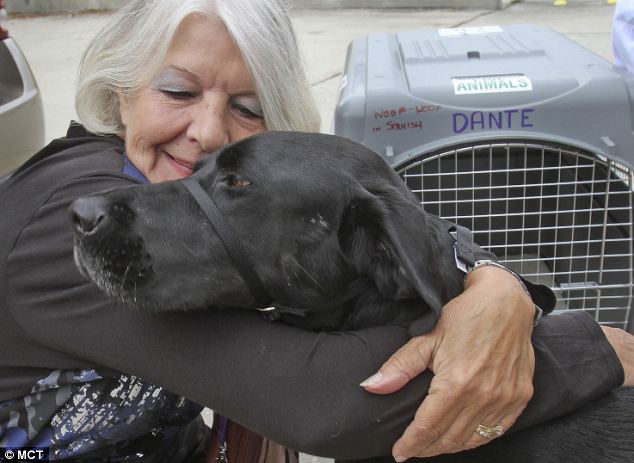
Older woman hugging black lab

Author: C. Michele Martindill

Within the animal rights movement there is some understanding that vegans have a responsibility to lead by example in stopping the oppression and exploitation of animals. A meme recently making the rounds of various Facebook pages is a call to positive action and leadership for all vegans:

“As vegans, we must lead the way in ending animal use, and so we must be committed to ending it. This means that we must reject exploitation and commodification of nonhumans in all its forms. We ought never seek to regulate or perpetuate that which we want to end. Don’t participate in nonveganism by endorsing it. Unequivocally embrace veganism and educate others to it.”
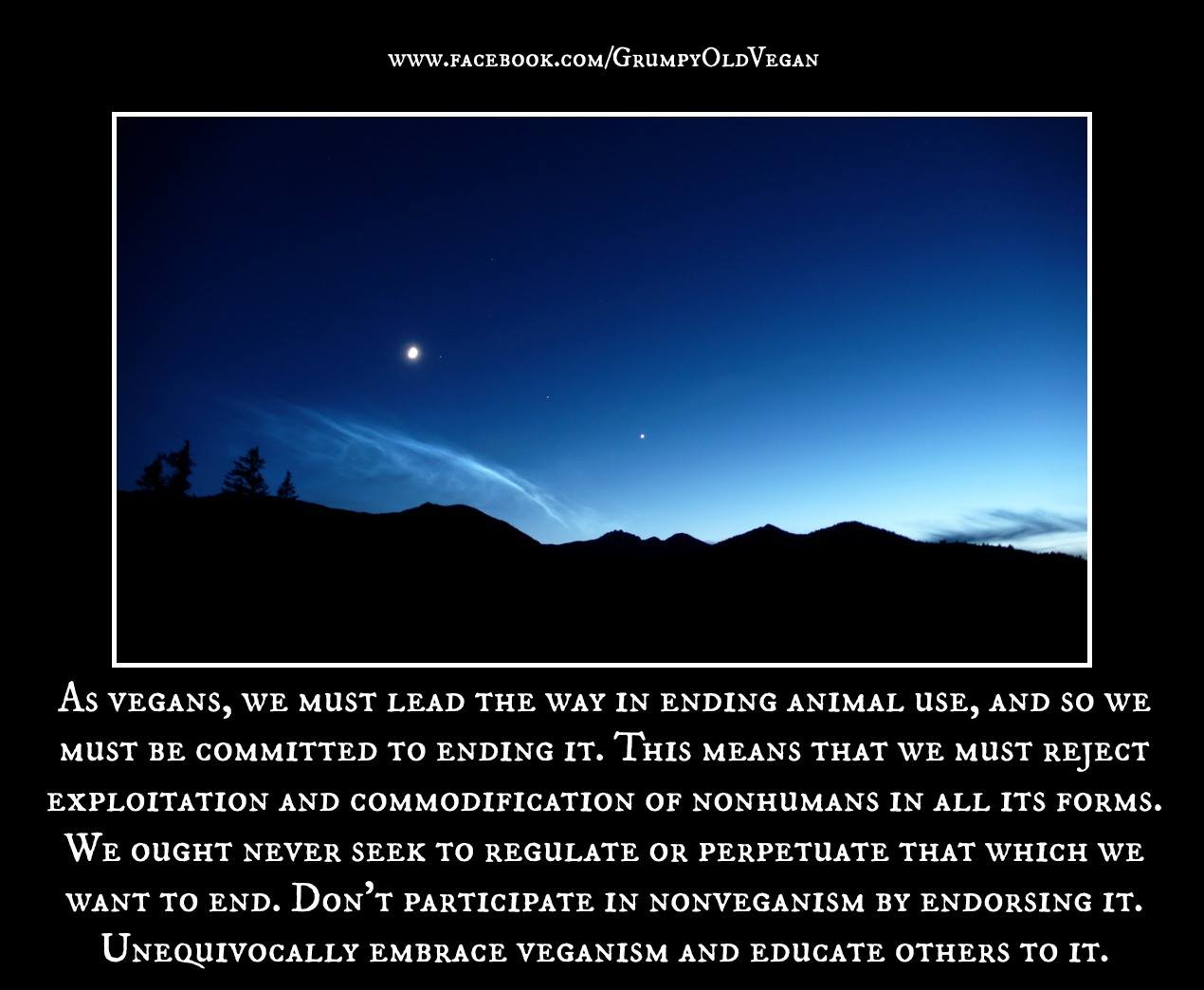
Image of the meme discussed. Pictures a mountainscape in the night with a bright star in the sky.

The message is clear. In order to end the use of animals vegans have to completely stop all use of animals and not settle for merely regulating the use of animals. Laws that try to make slaughterhouses more humane or stores that sell so-called happy meat still treat animals as products and insure their continued suffering, although the humans who consume these animals are lead to believe life is better for all concerned. The part of the message in the aforementioned meme that makes no sense in terms of veganism is the last sentence, the admonition to not equivocate in accepting veganism and to get others to learn about veganism. Why then does the organization responsible for this meme have a name and logo that reflect ageism and sexism? How can the animal rights movement consider itself inclusive of all members of society as long as any group openly stereotypes, objectifies and commodifies older people, specifically older women? If veganism is defined by a “rejection of exploitation of nonhumans in all its forms” then it’s time for vegans to realize the same call to social justice must be extended to all marginalized groups. Vegans do not get to exploit one group as a means to end the exploitation of another group.

It is unfortunate when any group within the animal rights movement fails to think reflexively or critically about its role in the oppression of others. Most of the time these groups do good work on behalf of all animals and do express a desire to be inclusive in their membership, especially in terms of accepting people of all races, genders, ages, physical abilities and social classes. Still, the group Grumpy Old Vegans remains defensive over its name and logo. The group used to be named Grumpy Old Vegan (GOV) and was the brainchild of a man who quickly drew well over a thousand Facebook followers to his animal rights group, a group that focuses on abolitionist veganism. Dating back to the launch of the group, the membership has been mainly comprised of women. When GOV was approached about the exclusion of women in the leadership of the group, the name of the group became Grumpy Old Vegans, with the addition of an ‘s’ to the name which implied the leadership was not just that of one man. To further deflect criticism of sexism within GOV the logo of the group went from being a caricature of just an older man to a caricature of both an older man and an older woman. The caricatures add to the ageism by depicting the man and woman as having oversized ears and noses, toothless and pinched oversized frowns, deep and exaggerated wrinkles, baldness for the man and gray hair in an outdated style for the woman. The overall message conveyed by the name of the group and logo is that old people are always grumpy, wrinkled, toothless, and possess oversized facial features. In short, they should be dismissed as nothing more than a joke. It’s too bad the GOV group members do not see how deeply their ageism cuts.

Actual avatar for Grumpy Old Vegans as described in text.

It should be noted that the GOV group has dismissed these concerns about ageism with a litany of clichés, claiming that anyone finding ageism in their name or logo “clearly has too much time on their hands,” and that they, too, are aged fifty or older and don’t see a problem with the caricatures. One person even mentioned how the logo makes the group seem fun, a place for jokes. Others added that all that really matters are “the animals.” Not one single person tried to understand ageism or see how even if they felt fine with the name and logo, others might not feel the same way. Empathic understanding or sensitivity to the perspectives of others was nowhere to be found. Certainly if the name of the group had been Grumpy Old Women, Grumpy Old Indians or Grumpy Old Blacks, and had the logo featured caricatures of women, Native Americans or Persons of Color that stereotyped their appearance, this essay would not be necessary because most vegans know it is inappropriate to stereotype marginalized groups; nor would we need to define sexism and racism in relation to those caricatures or the resulting effects on the animal rights movement—those definitions are known and discussed throughout the movement. Now it’s time to recognize ageism, what constitutes an ageist stereotype and the consequences of exploiting older people with oppressive imagery.

Collection of racist Native American sports mascots

Stereotyping iconography is known to incite racist attitudes as well. The popularity of redface sports imagery has necessitated heavy campaigning by Native American activists and their allies.

Ageism refers to the discrimination and stereotyping of people based on the number of years they have spent on earth, their appearance, and the perception they have diminished physical and mental capacities. Ageism is a form of oppression and exploitation, and it mainly involves ignoring older people or silencing their voices in order for younger people to assert their positions of power and privilege. On occasion the very young can experience ageism when their lives and opinions are devalued solely based on their age; however, this essay addresses ageism directed toward people over the age of fifty, those who, as economist Joanna N. Lahey (Lahey, 2006) (Barnett, 2005) observes are finding their age is making them unwanted in the work world. Employers are buying into the stereotype of older people as ill-tempered, out of touch and in physical decline. When ageism intersects with sexism the invisibility, lack of respect for and devaluing of women becomes more profound, and yet it is ignored or treated like a joke among those who have yet to see their hair turn white or those making an ill-advised attempt at self-deprecating humor. The ageism-sexism intersection is particularly embedded in (Lahey, 2006) the structure of the animal rights movement, preventing the movement from both gaining the knowledge and experience of older women, and from being regarded as an inclusive, progressive social movement.

Senior woman holding large pan of food for a huge group of hungry dogs

The contributions of older women in animal liberation spaces are invaluable, and yet devalued. A group of senior women in China feed and care for hundreds of homeless dogs.

The sexism of the animal rights movement is well documented (Abolitionist, 2015). Ageism, like the older women in the movement, is largely not considered an issue. It is easy enough to point to the leading members of the movement who are older and have achieved the revered status of founders, philosophers or experts, members like Tom Regan and Peter Singer. Women are not prominent on these lists. As Rosalind Chait Barnett establishes, there are attitudes and social structures in our workplaces that leave women more vulnerable than men to the hardships of aging (Barnett, 2005). Those hardships are found in the animal rights movement, as well. While aging is seen as a state of decline for both men and women, successful men are viewed as “having grown in skill and wisdom,” [p. 26] but older women are too often stereotyped as round-tummied grandmas, kind and nurturing till the end of their days. Older women are making a strong drive to dispel this stereotype by pushing against the glCloseup of an older woman's face. She has "BEST BEFORE MAR 73" printed across her forehead.ass ceilings of their workplaces, by working in fields traditionally dominated by men, by demanding equal pay for equal work; however, none of the advancements made by women have given them secure futures in their old age. They often have to leave work to be caregivers to family members, and lose both opportunities for advancement and robust pensions. When it comes to women animal rights activists, they continue to encounter men in most of the leadership roles, to inherit strategies for activism that were created by men and to operate in social movement structures that men continue to enforce. As women animal rights activists age, if they are visible at all they are many times type-cast as nurturing and lacking the youthful exuberance of the majority of movement members (Barnett, 2005). Their online involvement in activism is too often unquestioning support of the men who run the animal rights groups. They become groupies who seek approval through their comments, knowing that any criticism or critical thinking will be deleted.

It must also be mentioned that women are objectified in terms of their appearance on a daily basis. Saggy skin and wrinkles are treated as a problem that needs to be solved rather than a part of the aging process that has its own beauty. Gray hair is something to be avoided at all costs through expensive color treatments. Surgeries exist to remove varicose veins and veins running across women’s hands simply because society deems veins to be ugly. Age spots are the targets of countless lotions and potions, even laser treatments. It is hard enough for aging women to accept their own bodies and fight against societal stereotypes of the aging body without a logo for an animal rights group adding to this stereotype of aging women’s bodies. Series of road signs pointing to senior center. Underneath them are another series of signs reminding them to make the turn and not forget.GOV could easily become an exemplary leader in the animal rights movement by addressing the intersection of ageism and sexism. Why not name the group simply Grumpy Vegans? Why not find a logo that doesn’t socially reproduce the stereotypes of aging in our society? Surely in a group so concerned with a call to “reject exploitation and commodification” of animals they could reject the exploitation and commodification of aging women—and men—by finding some other name and logo to promote their group. Just as sports teams are rejecting names and logos that stereotype women, Native Americans and POC, rejecting ageism in the animal rights movement is an important next step. Just as the language of racism and actions like dressing in red or black-face are rejected, ageism in the animal rights movement must be rejected. Reject ageism.

 

References

Abolitionist, T. A. (2015, March 27). About this Project. Retrieved from The Academic Abolitionist Vegan: http://academicabolitionistvegan.blogspot.com/

Barnett, R. C. (2005). Ageism and Sexism in the Workplace. Generations, 25-30.

Lahey, J. N. (2006). Age, Women, and HIring: An Experimental Study. Chestnut Hill, MA: The Center for Retirement Research at Boston College.

Dr. Martindill earned her Ph.D. in sociology from the University of Missouri and taught there in the Sociology Department, the Peace Studies Program and the Women’s and Gender Studies Department. Her areas of emphasis include political sociology, organizations and work, and social inequalities. Dr. Martindill’s dissertation focuses on the no-kill shelter social movement and is based on ethnographical research conducted during several years of working in an animal shelter. She is vegan, a feminist and is currently interested in the stories women tell through their needlework, including crochet, counted cross stitch and quilting. It is important to note that Dr. Martindill consistently uses her academic title in order to inspire women and members of other marginalized groups to pursue their dreams no matter what challenges those dreams may entail, and certainly one of her goals is to see more women in academia.
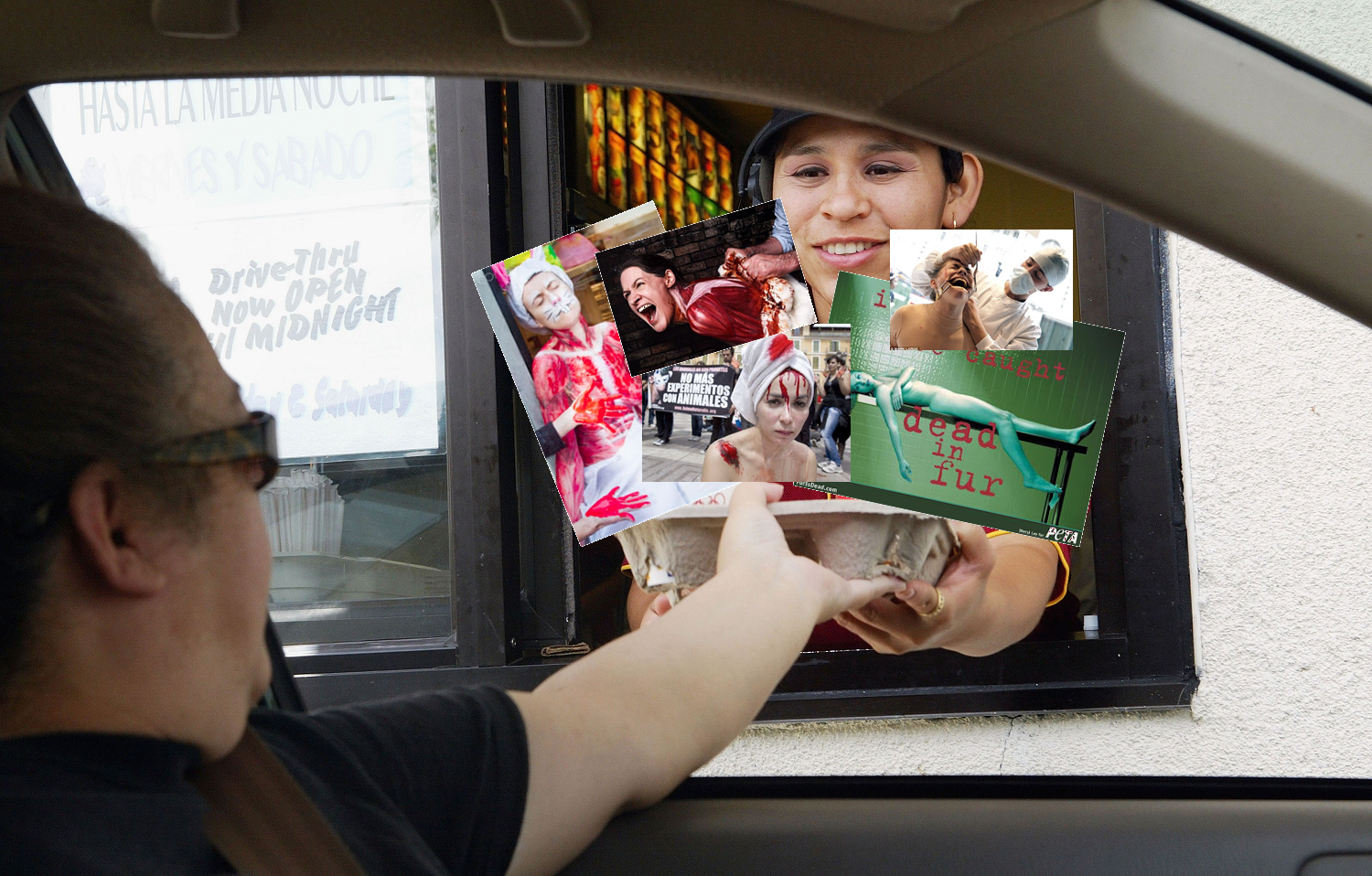
Rape Analogy as Fast Food Advocacy

TRIGGER WARNING: This essay contains a frank discussion of rape analogy in the Nonhuman Animal rights movement, including images that depict violence against women. There are also discussions of other forms of human suffering (like pedophilia and racism) that may be painful for some readers.

Fast Food Advocacy

In this essay, I want to quickly address some common responses to Vegan Feminist Network’s position on misogynistic imagery as a tactic in Nonhuman Animal rights. I believe much of the response reflects a commitment to sexism, but some also reflects a general ignorance to the impact that patriarchal ideology and a social environment of misogyny has on the activist imagination. The response also reflects a need to deflect discomfort, because these are tactics that have come to dominate our social movement space, and many have taken them for granted as acceptable and useful. Being made aware of participation in violence triggers cognitive dissonance, and it is a natural response to debate, deride, or deflect in order to protect a positive self-concept.

One of the most common responses we receive is an appeal to alternatives (the implication being that alternatives are either too difficult to imagine or simply do not exist). Activists may be sincere in their inquiries for alternatives to misogynistic tactics, but I believe this response is often engaged to derail the discussion. All activists know that there are certain lines that should not be crossed because they will be so offensive that they will hurt others and repel participants.1 We don’t want to cause hurt and we want to grow our movement, so analogies that go too far are inappropriate.

Man artificially inseminating a cow

Just today, this image was shared by A Well Fed World and Free From Harm. While no women are pictured, the analogy is implicit. Research into morally shocking imagery suggests that this approach can easily repel audiences. We can imagine how this response would be magnified by female audiences that are triggered by images of sexual assault and rape.

More and more activists in the movement recognize that slavery and Holocaust analogies are problematic. True, there are still some white-identified/non-Jewish persons clinging onto these analogies, but there are other analogies that I daresay no one would get behind. For instance, I think it is fair to say that everyone agrees that pedophilia analogies would go too far. A common analogy between women and other animals involves the violence of dairy production. Women are often depicted as being assaulted, beaten, and raped to make a point about what happens to cows. When women are targeted, there seems to be little objection. However, if activists were to produce and promote memes of children being sexually assaulted to raise awareness to dairy cows being violated, most would have to agree that this approach would be so triggering and hurtful, that it would be an act of violence and would put the movement in a bad light. Indeed, because the cows in the dairy industry are still babies and children themselves when they are hoisted onto the industry-termed “rape rack,” wouldn’t pedophilia analogies be more accurate than those that draw on violence against adult women?

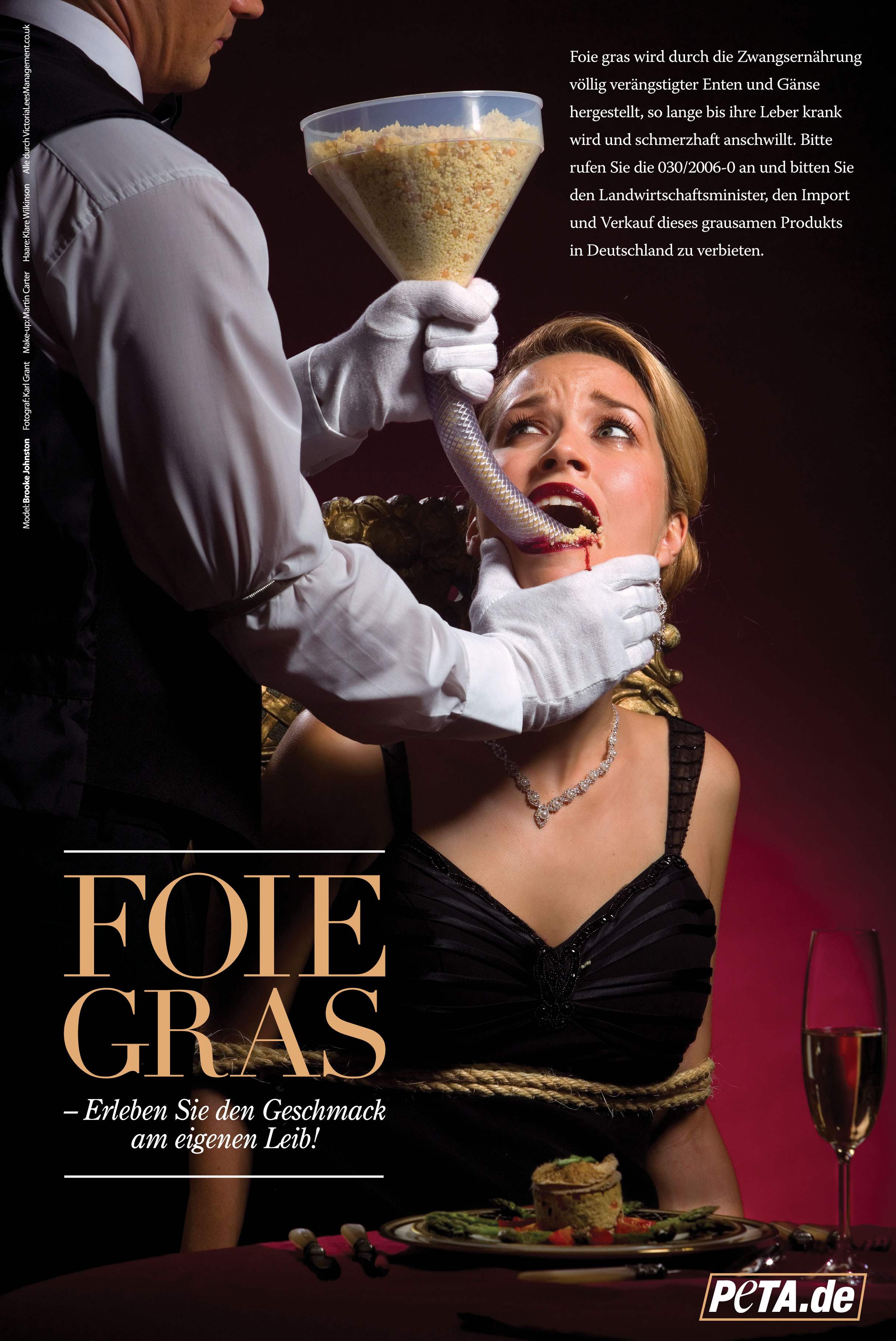
But it isn’t about accuracy. It’s about swapping out one degraded and worthless body for another. As one reader pointed out, PETA’s foie gras campaign that positions women as the duck victim in advertisements and demonstrations across the world is illogical because ducks used in the industry are male. That doesn’t stop PETA from “telling it like it is.”

Woman at a dining table being forcefed by a man with a tube, she looks frightened Woman bound by rope face down on a dining table covered in her blood and vomit in an anti-foie gras demo PETA Founder Force-Fed Outside Fortnum&Manson Man standing over woman on her knees being choked by a feeding tube in an anti-foie gras demo Woman force fed with feeding tube, her mouth is stretched and bleeding Man standing over bound and kneeling woman, he is pushing her head down and forcefeeding her with a feeding tube, she looks scared

Indeed, a common response to misogynistic analogies is that “this is accurate; this is how it really is.” Vegan Feminist Network isn’t arguing against that, but we must be cognizant of media as a social construction. Media creators choose what story they want to tell and they seek to manipulate how audiences will interpret them. We live in a rape culture where violence against women is commonplace. The movement draws on this social reality to trigger a specific response. Patriarchal ideology may make many unconscious to this language they are using, but activists are not ignorant. No one (I hope) uses images of lynching or violence in nursing homes or mental institutions. No one uses images of humans with deadly diseases like cancer, AIDS, or ebola. All of these human experiences with violence and suffering could easily be enacted to make analogies about Nonhuman Animal exploitation. Fortunately, activists know better than to use them, because it is understood that they will be offensive and painful to the vulnerable groups whose experiences are appropriated. Except for women. The movement produces thousands of images and reenactments of women bloodied, bruised, assaulted, raped, dying and dead. Because women don’t count.

Women are still at the bottom of the ladder. Violence against women is so commonplace, it is rarely even questioned as a painful subject in the Nonhuman Animal rights movement. This is to be expected. In all social movements, women have been ignored, exploited, and left behind.2 The anti-slavery movement would not let women participate and intentionally excluded gender from campaigns to make legislative language more inclusive. The Civil Rights movement kept women in organizational roles and pushed men into the leadership positions.  The gay rights movement seriously underserved lesbians. The free-thinking/atheist movement soundly denies the need to recognize feminist issues. In all efforts to advance social justice, women have been made to take a back seat, never considered fully equal or worthy of rights. The feminist movement has been seeking to challenge this ideology since women were first ousted from anti-slavery efforts in the 1800s, but female activists continue to be framed as loudmouthed, unattractive, mentally unstable, feminazis. Just last month, Time Magazine listed the word “feminist” on their reader poll of words that should be banned. We’ve come a long way baby…but not nearly far enough.

Sexism is so normalized in our society that it has become invisible. You cannot turn on the television without being exposed to sexist remarks, jokes at women’s expense, sexual harassment, sexual objectification, and violent assault and rape of women. We are all exposed to a nonstop onslaught of sexist imagery in our society. It becomes as natural as the air we breathe. The bodies of women have always been sites of violence and domination, to the point where it becomes mundane and expected. So, when Vegan Feminist Network takes a stand against the encroachment of this violent imagery in Nonhuman Animal rights spaces, readers are understandably taken aback. They’ve never been made to think critically about the gender-based violence they have taken for granted as acceptable and normal for all of their lives.

Readers often respond with disbelief or with weak justifications, demanding a soundbite explanation as to why this behavior is problematic in two Facebook comments or less. The information is out there (as just one example, the Vegan Feminist Network website is chock full of free information), but few really want to learn more, because I suspect that few really care. This is the way it has always been done, women are easy targets, and women’s pain doesn’t matter (or matters less).

Kim Socha refers to these kinds of trans-species tactics as “fast food activism.” There is no concern with investigating why these analogies might be problematic, that is, why they may not work as a scientific matter, how the state of sexism is in our society influences interpretation, or how they impact women. Just like McDonalds, these analogies pull on the readily available language of violence against women and pump out advocacy cheaply and quickly irrespective of the hurt it causes to vulnerable groups and the damage done to society.

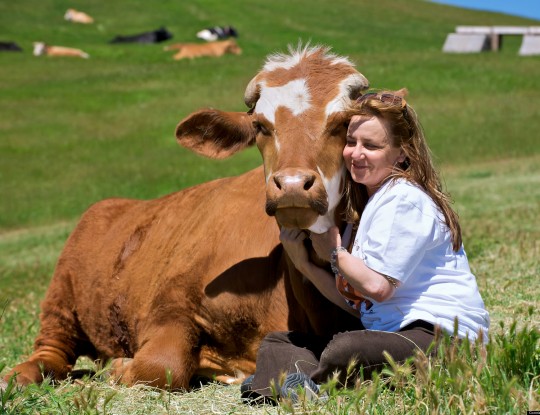
Woman hugging cow

Violence-free activism that brings attention to Nonhuman Animal exploitation and the intersectionality of oppression is not difficult to achieve.

There are tons of ways we can help other animals without resorting to this tokenizing approach. I’ve published hundreds of essays on this website and on my personal blog, The Academic Abolitionist Vegan, most of which are grounded in my research in social movement theory and social psychology, and all of which are freely available. There are also hundreds of books on effective social change available. There’s no excuse for allowing patriarchal norms and PETA’s influence to dictate our activism. We don’t need to hurt women to help animals. We do it because it is easy and because women don’t matter, and that is a problem.

Notes

1. There are a few exceptions, including Israeli group 269Life which, in addition to “reenacting” sexual assault and violence against women in public, also uses shackles, chains, and branding on humans in street demonstrations. PETA, too, has utilized graphic analogies of African slavery and the Holocaust.

2. This is not to say that women were not leaders and important players (in all movements there are important exceptions), but only to emphasize that movements act as microcosmic social systems and too often exclude women and ignore their interests.

As Long As It’s Vegan? Single-Issues, Silos, and Social Justice

Not Safe for work:  Contains semi-revealing images of nude woman.

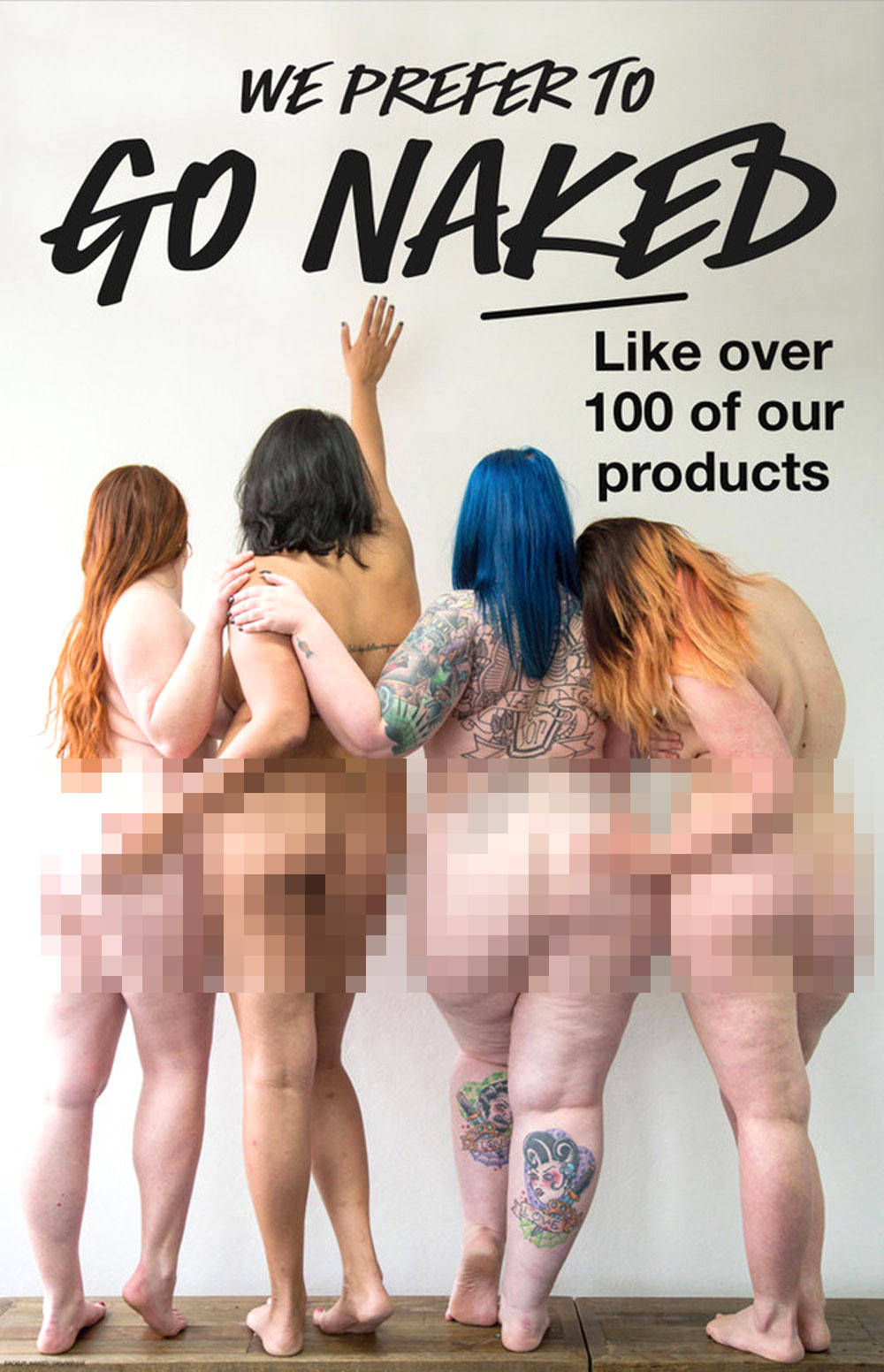
LUSH "Go Naked" ad featuring four women standing naked, exposing their bottoms. Reads, "We prefer to go naked, like over 100 of our products"
LUSH Cosmetics advertisement

Single-issue campaigning and social movement siloing are toxic for social justice. Despite the veganism’s collective identity as a movement for love and compassion, it has a remarkable tendency to dismiss human injustices under the banner of “nonhumans first.” The “as long as it’s vegan” ideology has been used to protect nazism, rape, racism, and other manifestations of bigotry in the Nonhuman Animal rights movement, stifling critical thought and eliminating any chance for coalition-building.

What makes this ideology so insidious is that its adherents often believe themselves to be a compassionate activist committed to Nonhuman Animals at any cost. While this is, of course, admirable, it is also a self-concept which inhibits self-reflection. Because the movement is white-centric and post-citizen (meaning that most vegan activists already have a number of essential rights and privileges established for themselves), it becomes very difficult for them to acknowledge how many humans still lack these rights.

Woman used in LUSH demo pictured with cords attached to her head, she is gagged and wearing a nude suit

In one of several misogynistic live action advertisements, LUSH hired a street performer in a nude bodysuit to enact gruesome scenes of vivisection for approximately 10 hours.

This is aggravated by segregation; when privileged groups do not have to interact with disenfranchised groups, it is easy for them to ignore or downplay the experiences of others. Membership in a white-centric, middle-class social movement only reinforces these walls of separation.

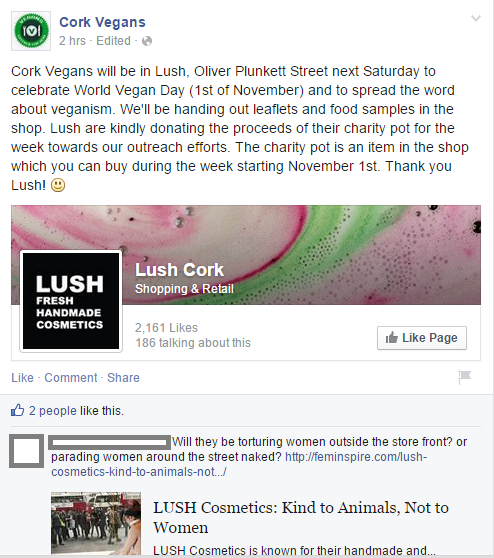
Consider, for instance, this Irish grassroots group’s promotion of LUSH Cosmetics products on World Vegan Day. LUSH is known to regularly engage misogynistic tactics to scare or shame women into buying its products.  It also mirrors People for the Ethical Treatment of Animals in prostituting women’s bodies to grab media attention and sell goods. The group announced that it would be leafleting outside the Cork LUSH store and accepting donations from LUSH for every “Charity Pot” lotion product that is purchased.

Please email for transcript of image

When confronted with LUSH’s misogynist business ethic, this local vegan community predictably employed a number of tropes to restore its positive self-image. First, it suggested that as long as individual women “choose” to participate, this supposedly absconds the organization that hosts the event as well as all involved parties from any responsibility for the negative consequences for women as a class.

Second, it is mistakenly argued that the inclusion of “men, too” would eliminate the misogyny of these tactics. But this falsely presumes that society is gender-neutral and that sexualized violent imagery of women would be interpreted equally with equal impact.

Third, for the purposes of this essay, this group also highlighted that the supposed animal-friendliness of the company trumped any misgivings about its misogyny. Nonhumans first.

As these deflections illustrate, there is a profound disconnect between the oppression of women and the oppression of other animals. The logic that normalizes the commodification and sexualization of violence against women is the same logic that normalizes the commodification and fetishization of violence against animals.

The vegan movement’s confusion over this intersection is all the more evident in its bizarre alliance with LUSH. LUSH is not a vegan company. It is a speciesist industry that profits from the the sale of Nonhuman Animals’ bodies, products, and labor. Bizarre though this relationship may be, it exemplifies how a movement culture that devalues intersectional awareness can undermine Nonhuman Animal interests. Putting “nonhumans first” may unwittingly be putting nonhumans last.

LUSH employee wearing nothing but an apron as part of an advertising campaign

LUSH often holds in-store promotions that feature its mostly female staff unclothed.

That activists appeal to the marketplace to support their single-issue focus is not surprising. I am of the persuasion that intersectional failure is intimately bound to capitalism and its intentional fanning of individualism and false consciousness. This ignorance is key for the perpetuation of an oppressive system. It undermines efforts for equality.

Any movement, faction, organization, or activist that fails to acknowledge the root cause of capitalism in manifesting inequality will never achieve its goals. By participating in capitalist enterprise, vegans only contribute to the humane-washing of an inherently violent economic system. For resource-starved grassroots groups, it is all too tempting to partner with speciesist industries who trade attention and platform for community approval and immunity from protest.

This trade-off is not a wise one. “As long as it’s vegan” does Nonhuman Animals no favors if it destroys the movement’s ability to be taken seriously as a social justice effort. Neither is it helpful if it normalizes frameworks of oppression, as these frameworks are not species-specific but universally dangerous.


Corey Lee WrennDr. Wrenn is Lecturer of Sociology. She received her Ph.D. in Sociology with Colorado State University in 2016. She received her M.S. in Sociology in 2008 and her B.A. in Political Science in 2005, both from Virginia Tech. She was awarded Exemplary Diversity Scholar, 2016 by the University of Michigan’s National Center for Institutional Diversity. She served as council member with the American Sociological Association’s Animals & Society section (2013-2016) and was elected Chair in 2018. She serves as Book Review Editor to Society & Animals and has contributed to the Human-Animal Studies Images and Cinema blogs for the Animals and Society Institute. She has been published in several peer-reviewed academic journals including the Journal of Gender Studies, Feminist Media Studies, Disability & Society, Food, Culture & Society, and Society & Animals. In July 2013, she founded the Vegan Feminist Network, an academic-activist project engaging intersectional social justice praxis. She is the author of A Rational Approach to Animal Rights: Extensions in Abolitionist Theory (Palgrave MacMillan 2016).

Receive research updates straight to your inbox by subscribing to my newsletter.

Speaking of Logical Fallacies…A Response

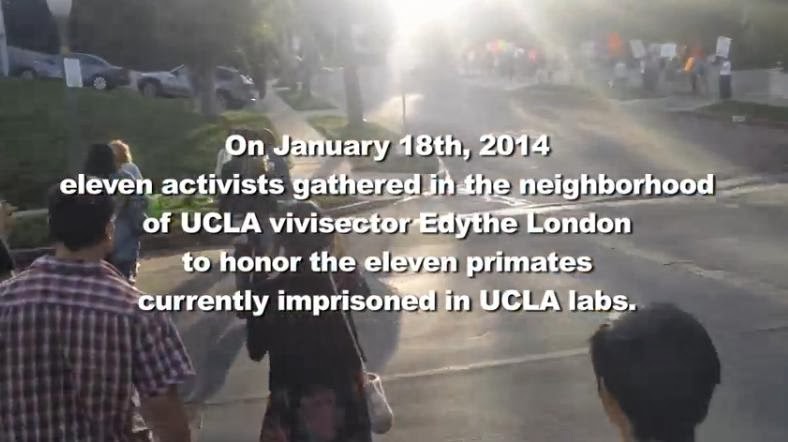
My buddy and colleague Cheryl Abbate recently commented on an activist demo which involved several folks stalking out (or “staking out” depending on your perspective) the private residence of a female vivisector.  Activists staged a silent vigil outside this woman’s home, and a bunch of counter-protesters were waiting to greet them. The animal advocates maintained their nonviolence, but were screamed at and spit upon.  Cheryl and others have been understandably shocked by the event, and because it was caught on camera, it offers an excellent opportunity for a little sociological analysis…

My first reaction to this event is to recognize that framing the animal advocates as “nonviolent” is not wholly accurate. These are people who have staked out a woman’s private home. That is in itself a violent action. Many vegan feminists, myself included, do not view this as a nonviolent tactic. Carol Adams has even recounted her own experience on the other side of a protest, as her home had been picketed once. It not only terrified her, but it terrified her children. You can read Marti Kheel’s analysis of “direct action” by clicking here.

Violent tactics only continue to give us a bad name and support our negative stereotype. Tom Regan has identified this negative stereotype as one of the  primary reasons why our movement has been stunted and fails to flourish (see Empty Cages). For that matter, this tactic represents your classic single-issue campaign. As I have argued before, single-issues are a waste of time and a waste of resources. They ignore the root of the problem, and they single out particular (popular) species at the expense of others. They also detract from vegan education. You can read more about this in an article I’ve recently published in Food, Culture & Society.

On the other hand, I recommend Cheryl’s essay on this bizarre interaction between activists and counter-activists. Sociologically speaking, it is interesting to see how the social problem is defined and how the power of patriarchy and science is used to dismiss anti-speciesist claimsmaking. Pay attention to how both sides frame the issue, and how both seek to capitalize on the perceived vulnerabilities of each. Jasper & Poulsen (1993) have published an article on this very topic: “Fighting Back:  Vulnerabilities, Blunders, and Countermobilization by the Targets in Three Animal Rights Campaigns.” They make the argument that blunders can be capitalized on to achieve success. The disgusting behavior of the vivisectionists and their supporters captured on film might easily be perceived as a blunder.

However, two caveats: 1. How are we defining success? I don’t think single-issue campaigns are strongly correlated with dismantling oppression (instead, they have more to do with fundraising and activist morale/ego); 2. We need to recognize the context of these interactions. We live in speciesist world. We also live in a world that has branded animal activists as terrorists. A bunch of strangers stalking out someone’s home is only going to be perceived as a threat, even if they are “silent.” If a bunch of “silent” people showed up at my home, I’d be dialing 911, I don’t care what their moral position is. It’s threatening.  Especially as a woman.  And the vivisector they were stalking was indeed a woman. Even male vivisectors who are targeted have families that activists should consider.

Neither can we ignore the white privilege inherent to these kinds of tactics. There is a reason most of these protesters are white. People of color are heavily harassed by the police: they are more likely to be reported, stopped, and arrested. Once arrested, they receive heavier penalties. In a society with a grossly racist criminal justice system, these tactics are inherently white-centric. So, when people parise these types of tactics, I read that as praise for white male approaches to social change. Using white maleness to fight white maleness, not surprisingly, isn’t getting us anywhere.

So, in sum, I think the activists have no reason whatsoever to be surprised at what happened to them. I also think tactics like this aggravate our bad reputation and squander resources. We have limited time, money, and personpower…we should be investing what little we have into vegan education…not stunts like these that are bound to backfire. These stunts are about two things 1. Fundraising and 2. Giving activists the feeling that they’re “doing something” for the animals…because, frankly, vegan education isn’t glamorous work, it’s feminized, and it won’t get you a bunch of Youtube hits.  But it’s the necessary foundational work that we must embrace if we want to enact change.

– Corey Lee Wrenn

This post originally appeared on the Academic Abolitionist Vegan. You can follow Ms. Wrenn on Facebook and Twitter.

“Booth Babes” Bad for Business & Animal Rights

Two teenagers in mini-dresses pose on a PETA Youth booth offering "Free hugs"

The animal rights movement loves using young women to sell veganism, but whether or not this tactic is effective has come under serious scrutiny.

New research on the effectiveness of “booth babes” at techie conferences suggests that the use of provocatively dressed young women to sell items at trade shows doesn’t work. The comparison group, which consisted professionally dressed older local women, performed significantly better:

The results? They were great. The booth that was staffed with the booth babes generated a third of the foot traffic (as measured by conversations or demos with our reps) and less than half the leads (as measured by a badge swipe or a completed contact form) while the other team had a consistently packed booth that ultimately generated over 550 leads, over triple from the previous year.

Why don’t booth babes make good salespersons?  Marketing executive Spencer Chen suggests that they are intimidating to men.  That is, rather than attracting men, they repel men.  Chen also suggests that women who are hired specifically for these events have little incentive to work for the company. As he explains, “They are used to not doing much except showing up to make their fee for the day.”  Customers are looking to learn more, something models are not often invested in.  This point may or may not apply to vegan booths, as PETA and other organizations that objectify women rely on volunteers as well as paid models.

Chen also reports, “Business and product execs don’t talk to booth babes.”  While vegan “booth babes” are not targeting important business persons, the effect is similar.  Animal justice is a serious matter, as is changing one’s diet, and “booth babes” simply do not convey seriousness:

Many times I observed that while my team was busy in demos with other prospects, the booth babes were unable to hold the interest of these execs for the extra five minutes that I needed to get a person from our team to engage.

Who they do tend to attract, however, are young men who are interested more in photo ops than business.

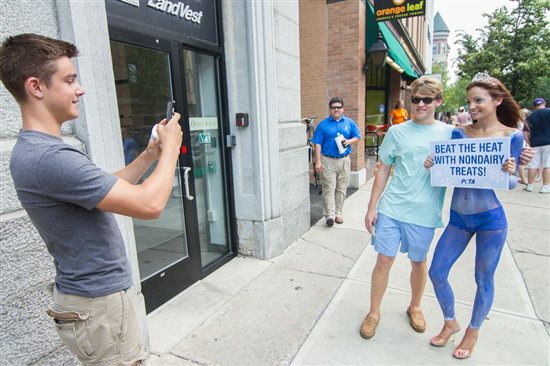
Young man poses next to the "Ice Queen" while another young man takes their picture. The woman is very thin, white, and painted in blue. She wears a tiara and high heels. Sign reads: "Beat the heat with nondairy treats."
So why use booth babes at all? Chen suggests that it’s simply cheaper than relying on qualified individuals and experts.  It’s not only easier on the budget, but it’s indicative of cheap advertising standards that dominate the marketplace:

[…] there still exists the “stripper and steaks” mentality in sales, where it’s less about the product and more about relationships and the art of the “close.” Booth babes have long been a part of this dog-and-pony show in this old approach to sales.

This study comes on the heels of the Australian study published in December of 2013 that demonstrated PETA’s “sex sells” approach is actually counter-productive.  Male participants recognized that the women were dehumanized and were subsequently less likely to support the animal rights cause.

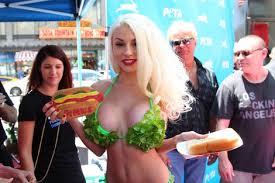
Courtney Stodden poses with a veggie dog in a revealing lettuce bikini. Men in the background stare at her.


Corey Lee WrennDr. Wrenn is Lecturer of Sociology. She received her Ph.D. in Sociology with Colorado State University in 2016. She received her M.S. in Sociology in 2008 and her B.A. in Political Science in 2005, both from Virginia Tech. She was awarded Exemplary Diversity Scholar, 2016 by the University of Michigan’s National Center for Institutional Diversity. She served as council member with the American Sociological Association’s Animals & Society section (2013-2016) and was elected Chair in 2018. She serves as Book Review Editor to Society & Animals and has contributed to the Human-Animal Studies Images and Cinema blogs for the Animals and Society Institute. She has been published in several peer-reviewed academic journals including the Journal of Gender Studies, Feminist Media Studies, Disability & Society, Food, Culture & Society, and Society & Animals. In July 2013, she founded the Vegan Feminist Network, an academic-activist project engaging intersectional social justice praxis. She is the author of A Rational Approach to Animal Rights: Extensions in Abolitionist Theory (Palgrave MacMillan 2016).

Receive research updates straight to your inbox by subscribing to my newsletter.

The Misogyny of Animal Rape Imagery

Trigger Warning:  Discussions of rape.

Dear colleagues,
Many of you may have seen a meme that is floating around called, “Sexual Violation.”  It reads:

Sexual violation of female animal bodies for exploitation, murder and profit.

Animal Agriculture’s shameful standard industry practices.

It is time for the masses to reject these crimes.  LIVE VEGAN.

The image is not reproduced here because it is extremely triggering.  Several species of animals are shown in a variety of compromised positions, as men sexually violate and rape them, the point being that standard animal agricultural practices are similar to the rape of women.  In other words, Nonhuman Animal pornography is being used to promote veganism.

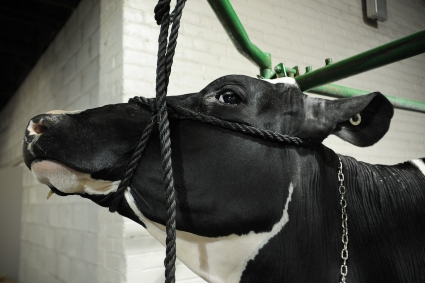
Cow's face is pictured, constrained by ropes and chains

Cow tethered to a “rape rack”

In the caption, the author writes, “I know this is difficult to see.  I take no joy in sharing it.” No joy in sharing it?  Well there’s something behind the rationale of those who have been sharing it…

The entire point of pornography is to titillate via the sexual degradation and humiliation of an oppressed body.  Those who consume pornography are consuming it specifically to “get off,” so to speak, on the demonstrated powerlessness of otherized bodies.  The relationship between the viewer and the viewee is one that reproduces and reinforces a hierarchy of domination.  Pornography users also report experiencing a “tolerance,” meaning increasingly degrading and shocking imagery is needed for them to feel something.  The pornography industry is happy to serve that need by producing increasingly disturbing media.

Male photographers at a pornography convention photographing a woman with her legs spread

So what makes it any different for vegan advocates who share these images with the intention of shocking people with images of violated and degraded animal bodies?  And for that matter, what gives them the right?  What’s stopping them from using images of men raping women to solicit shock value?  Should we also recount graphic tales of other women’s rape to rally for veganism?

I argue that sensationalizing the rape of other animals feeds rape culture and revictimizes women.  While the public may not be aware of the institutionalized rape of Nonhuman Animals, most of us are aware of the epidemic of rape against human women.  Most of us know this from first-hand experience.

Knowing that about 1 in 3 women have or will be raped, I find it extremely inappropriate to utilize rape imagery to promote veganism.  First off, our primary audience is women.  If 80% of the movement is women, and 1 in 3 women are rape victims, that means that more than 27% of our movement (or more than 1 in 4 activists) are likely to have been the victim of rape.  Any rape victim can tell  you, seeing images of rape or reading graphic descriptions is extremely triggering.  It is also revictimizing when it is made obvious that our community doesn’t care enough about our safety to avoid using our experiences for animal rights claims on our behalf.

These types of tactics demonstrate tokenizing.  That is, they appropriate the experiences of an oppressed group for the movement’s purposes, while the movement fails to address the ongoing and continuing oppression that group is still experiencing. What’s worse, the movement itself is responsible for aggravating that oppression.  For example, PETA’s slavery and Holocaust analogies use the horrific experiences of oppressed people of color and Jews for their purposes, but, in doing so, they fail to acknowledge that these memories are not forgotten, but are still hurting. In addition to that blatant insensitivity, PETA is presuming that racism, slavery, and human genocide are things of the past, when they are actually ongoing injustices.  Furthermore, PETA fails to acknowledge the present-day needs of communities of color, often excluding them.  In other words, PETA uses the experiences of the oppressed when it is convenient for them to do so, but they simultaneously haven’t done anything to alleviate those injustices and actually aggravate them.

Outdoor display of several animal rights posters with passerby stopped to read them

PETA’s “Meat Equals Slavery” display

Likewise, the Nonhuman Animal rights movement is a very misogynistic space.  Not only does PETA and other groups like Animal Liberation Victoria, LUSH Cosmetics, and Citizens United For Animals regularly aggravate sexism through their tactics (see our Organization Watch for more examples), but activist spaces themselves are rife with male-on-female violence (See Emily Gaarder’s 2011 release Women and the Animal Rights Movement).  If the movement isn’t going to take violence against women seriously, it has no business using our oppression for its gain.

Recall the author wrote, “I know this is difficult to see.”  The author knew exactly what they were doing.  They wanted to trigger.  Those who utilize memes and arguments that liken Nonhuman Animal rape to women’s rape seem to forget that many people exposed to those arguments are rape victims themselves.  Triggering these memories and trivializing these experiences does nothing to dismantle oppression.  Indeed, they only facilitate it.  It becomes one more means of alienating women from anti-speciesist work. It becomes one more means of solidifying male rule over advocacy spaces.  It works to keep women in a constant state of not-belonging, of victimhood, of hurt.

Recognizing the intersections between human and nonhuman oppression is important, but we have to practice sensitivity in doing so.  Blasting activist spaces with violent pornography is one example of how not to practice sensitivity.


Corey Lee WrennDr. Wrenn is Lecturer of Sociology. She received her Ph.D. in Sociology with Colorado State University in 2016. She received her M.S. in Sociology in 2008 and her B.A. in Political Science in 2005, both from Virginia Tech. She was awarded Exemplary Diversity Scholar, 2016 by the University of Michigan’s National Center for Institutional Diversity. She served as council member with the American Sociological Association’s Animals & Society section (2013-2016) and was elected Chair in 2018. She serves as Book Review Editor to Society & Animals and has contributed to the Human-Animal Studies Images and Cinema blogs for the Animals and Society Institute. She has been published in several peer-reviewed academic journals including the Journal of Gender Studies, Feminist Media Studies, Disability & Society, Food, Culture & Society, and Society & Animals. In July 2013, she founded the Vegan Feminist Network, an academic-activist project engaging intersectional social justice praxis. She is the author of A Rational Approach to Animal Rights: Extensions in Abolitionist Theory (Palgrave MacMillan 2016).

Receive research updates straight to your inbox by subscribing to my newsletter.